10
pulse lasting for 0.05 seconds. The duty cycle is set for 50%
so you will have 1 energy pulse with 1 period of rest with no
energy between each pulse. If the laser is producing energy
at 1 pulse per second for 0.5 seconds per pulse, you will be
producing energy for a total of 0.5 seconds. The result will be
an average energy per second that will be 50% of what you
have set the laser for. Therefore, when using pulsed energy,
you will have to adjust your power upward in order to achieve
the same rate of work as the same power set in . Two Watts
of Pulsed energy will be the same average power output
as 1 Watt . Remove your foot from the foot pedal and use
a clean 2 x 2 gauze sponge moistened with water to remove
debris from the ber tip. Do not use ammable liquids to wet
the sponge. Place the laser in Standby mode by turning
“Ready” off until you are ready to start another procedure.
Tissue Responses to Laser Energy: Maximum results will be
achieved by regulating the power and the speed that the
operator moves the ber tip. Tissue charring is an undesirable
after effect of too much power or the tip moving too slowly.
Always use the least amount of power necessary to complete
your procedure. The ideal tissue response will show little or no
discoloration after lasing and there will be less residual damage
and faster healing. Avoid penetrating or damaging the
periosteum and do not use the laser on alveolar bone. Because
the laser energy is attracted to melanin and hemoglobin,
power must be reduced when treating patients with darker
soft tissue. Always begin lasing with the lowest power you can
use to remove or modify the target tissues. Avoid damage to
the gingival sulcus by moving the ber tip quickly and using
low power settings. Check to make sure you have a good
cleave of the ber so that no shard is present on the tip. A
shard may act as a miniature scalpel and damage the small
blood vessels, thus preventing hemostasis and coagulation.
3.2.3 After Each Procedure
•
Cleave used ber tip and discard in suitable biowaste disposal.
•
Wipe the outside of the ber using a disinfectant or sterilization
solution and then retract the ber by depressing the RETRACT
button on the control panel. Do not retract the distal end of
the ber into the cartridge.
•
Turn the key to the off position if you are not going to be
starting another procedure and remove key.
•
Record the Powers and Total Lasing Times used for each
procedure in the patient’s chart.
Example:
Patient Name Mary Jones
Procedure Gingivectomy #6 and #7
#6 Lasing time
90 seconds @ 2.0 Watts
air cooled
#7 Lasing time
60 seconds @ 1.5 Watts
air/water spray
SECTION 4: PREPARATIONS, CARE,
AND MAINTENANCE
The ber optic element of a laser is responsible for carrying the light
from the diode array to the tissue being treated. The dental laser
bers are usually made of quartz, sapphire, silica or a combination
of those elements. Quartz/silica is the most popular product used
in diode lasers. Be advised about the potential hazards when
inserting, steeply bending or improperly securing the ber optics to
the chassis. Laser radiation exposure may occur in these instances
which could be harmful to yourself, your staff, and your patient.
Special care should be taken not to break or snap the ber.
As the Aiming Beam passes down the same delivery system as the
Working Beam, it provides a good method of checking for integrity
of the delivery system. If the aiming beam spot is not present at
the distal end of the delivery system, its intensity is reduced or it
looks diffused, this is a possible indication of a damaged or an
inproperly working delivery system.
4.0 DISPOSABLE FIBER CARTRIDGE
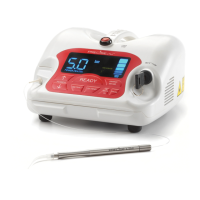
The ber cartridge is a removable assembly with a plug-in
capability that provides power for the internal retraction device.
This cartridge is disposable after all ber has been used. This
cartridge is not autoclavable.
4.0.1 Replacing the Fiber Cartridge
A white mark on the ber indicates 6’ of ber remaining on the
cartridge. At this point, a new ber cartridge should be ordered.
When the cartridge is empty, it should be released from the laser
aperture and gently removed. Slowly slide the cartridge out to
the left using the dovetail as a guide. The ber cartridge can be
thrown away.
Note: Retain the ber end cap. DO NOT discard the end cap.
4.0.2 Fiber Preparation
Using the EXTEND button on the control panel, press the button
to extend (toward the front of the laser) the ber. Extend 3 - 4’ of
ber and feed it through the ber locking collar after you have
loosened the collar. The ber should extend about 1’ beyond the
distal end of the handpiece so that you can strip the ber and
place the disposable tip.
Do not continue to use the ber tip once you have observed that
the tip has a blackened appearance that is greater in length
than 2 - 4 mm from the previous cleave spot. The protein debris
of gingival tissue accumulates on the tip during surgery and
retains extreme heat that can cause rapid tip deterioration and
subsequent breakage. This is especially important when using the
laser for periodontal pocket debridement. During surgery, clean
the tip often using a 2 x 2 sponge moistened with water. Do not
use alcohol or other combustible liquids to moisten the 2 x 2 gauze
sponge and do not use the sponge while the tip is hot. Always use
a cold disinfectant solution like BIREX® or CIDEX® to wipe off the
ber jacket before retracting the ber. The ber can be advanced
or retracted by using the retract and extend buttons on the front
control panel.
The ber cartridge is a removable assembly with a plug-
in capability that provides power for the internal retraction
device. This cartridge is disposable after all ber has been used.
This cartridge is not autoclavable. The ber cartridge contains
approximately 20’ (6 meters +) and is wound onto a spool. The
ber itself has three components:
• Jacket
• Cladding
• 400 micron quartz/silica ber
4.0.3 Jacket
This is the protective cover for the ber system and usually is made
of a synthetic material that is clear or white in color. There can be


 To Next Page