20
Optional Outputs
Damper/Economizer (0-10VDC)
If the RTULink will be controlling
an 0-10VDC damper or
economizer, it must be
configured to accommodate this
feature. Choose a 0-10VDC
output on the “RTU” side of the
RTULink that will be controlling
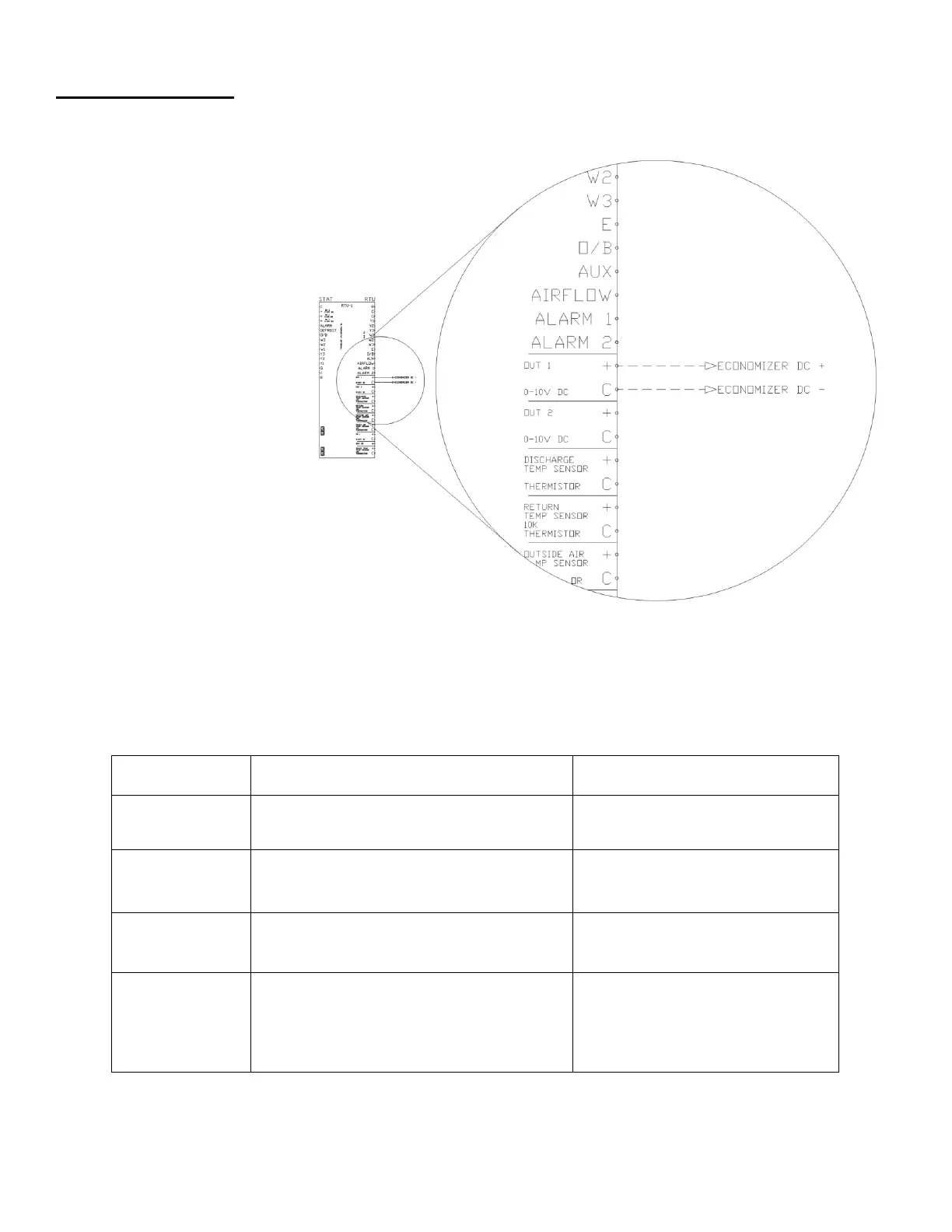
the economizer. Figure 23 is a
wiring schematic of an
economizer connected to Output
#1. View the FUNCTIONALITY
section of this manual to
determine how to setup an
economizer and how to change
the set points that are associated
with it. There are four
economizer types that the
RTULink has the capability of
controlling: fixed dry bulb,
differential dry bulb, fixed
enthalpy, or differential enthalpy.
Each economizer requires
specific auxiliary sensors which
are explained in Table 3.
For enthalpy economizers,
enthalpy is calculated using
temperature and relative
humidity.
In Table 3, the outside air enthalpy is represented as OAE and the return air enthalpy is represented as RAE. View
APPENDIX C for psychometric chart visuals on how the four economizer types operate.
• Outside Air Temperature (OAT)*
• Outside Air Relative Humidity (OARH)
• Return Air Temperature (RAT)*
• Return Air Relative Humidity (RARH)


 To Next Page