24
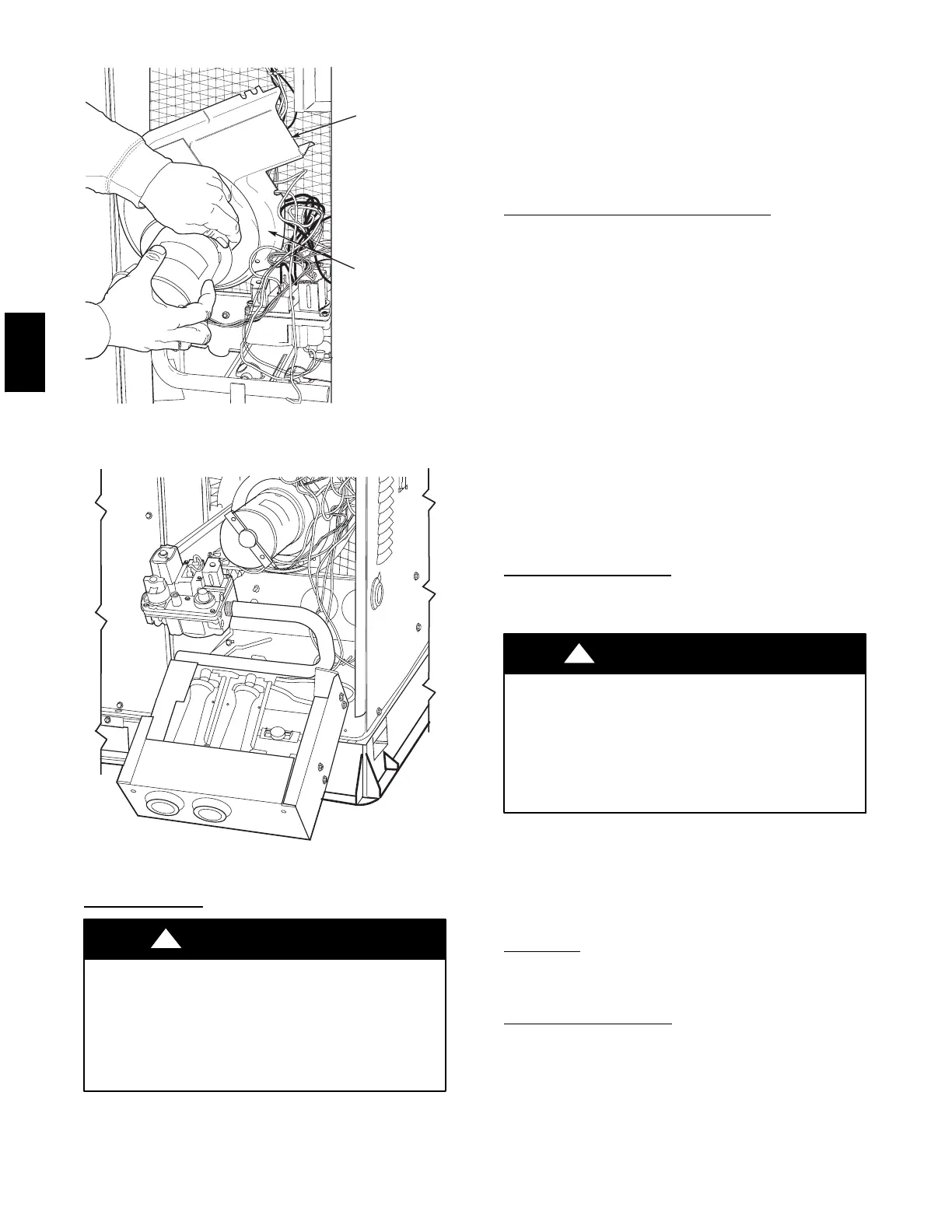
BLOWER
HOUSING
2 SETSCREWS
(HIDDEN)
C99085
Fig. 23 -- Removal of Motor and Blower Wheel
C99086
Fig. 24 -- Burner Rack Removed
CONDENSER F
AN
UNIT OPERATION HAZARD
Failure to follow this caution may result in damage to unit
components.
Keep the condenser fan free from all obstructions to ensure
proper cooling operation. Never place articles on top of the
unit.
CAUTION
!
1. Remove 6 screws holding condenser grille and motor to
top cover.
2. Turn motor/grille assembly upside down on top cover to
expose the fan blade.
3. Inspect the fan blades for cracks or bends.
4. If fan needs to be removed, loosen the setscrew and slide
the fan off the motor shaft.
5. When replacing fan blade, position blade so the hub is 1/8
in. away from the motor end (1/8 in. of motor shaft will be
visible, See Fig. 15).
6. Ensure that setscrew engages the flat area on the motor
shaft when tightening.
7. Replace grille.
ELECTRICAL CONTROLS AND
WIRING
Inspect and check the electrical controls and wiring annually. Be
sure to turn off the gas supply, and then the electrical power to the
unit.
Remove access panel to locate all the electrical controls and
wiring. Check all electrical connections for tightness. Tighten all
screw connections. If any smoky or burned connections are
noticed, disassemble the connection, clean all the parts, re--strip
the wire end and reassemble the connection properly and
securely.
After inspecting the electrical controls and wiring, replace the
access panel. Start the unit, and observe at least one complete
heating cycle and one complete cooling cycle to ensure proper
operation. If discrepancies are observed in either or both
operating cycles, or if a suspected malfunction has occurred,
check each electrical component with the proper electrical
instrumentation. Refer to the unit wiring label when making these
checkouts.
NOTE: Refer to the heating and/or cooling sequence of
operation in this publication as an aid in determining proper
control operation
REFRIGERANT
CIRCUIT
Annually inspect all refrigerant tubing connections and the unit
base for oil accumulations. Detecting oil generally indicates a
refrigerant leak.
EXPLOSION, PERSONAL INJURY HAZARD
Failure to follow this warning could result in personal injury,
death or property damage.
System under pressure. Relieve pressure and recover all
refrigerant before system repair or final unit disposal. Use all
service ports and open all flow--control devices, including
solenoid valves.
!
WARNING
If oil is detected or if low cooling performance is suspected,
leak--test all refrigerant tubing using an electronic leak--detector,
halide torch, or liquid--soap solution. If a refrigerant leak is
detected, refer to the Check for Refrigerant Leaks section.
If no refrigerant leaks are found and low cooling performance is
suspected, refer to the Checking and Adjusting Refrigerant
Charge section.
GAS INPUT
The gas input does not require checking unless improper heating
performance is suspected. If a problem exists, refer to the
Start--Up section.
EVAPORATOR AIRFLOW
The heating and/or cooling airflow does not require checking
unless improper performance is suspected. If a problem exists, be
sure that all supply-- and return--air grilles are open and free from
obstructions, and that the air filter is clean. When necessary, refer
to the Indoor Airflow and Airflow Adjustments section to check
the system airflow.
48XP





 To Next Page