4
blows when there is a high current draw on transformer, high
voltage applied to low--voltage circuit, or a direct secondary short.
When there is a high current draw on transformer, it is most likely
because transformer has been shorted or system is trying to draw
more VA than transformer rating allows. When fuse blows because
of high voltage, the system has mixed high-- and low--voltage
signals.
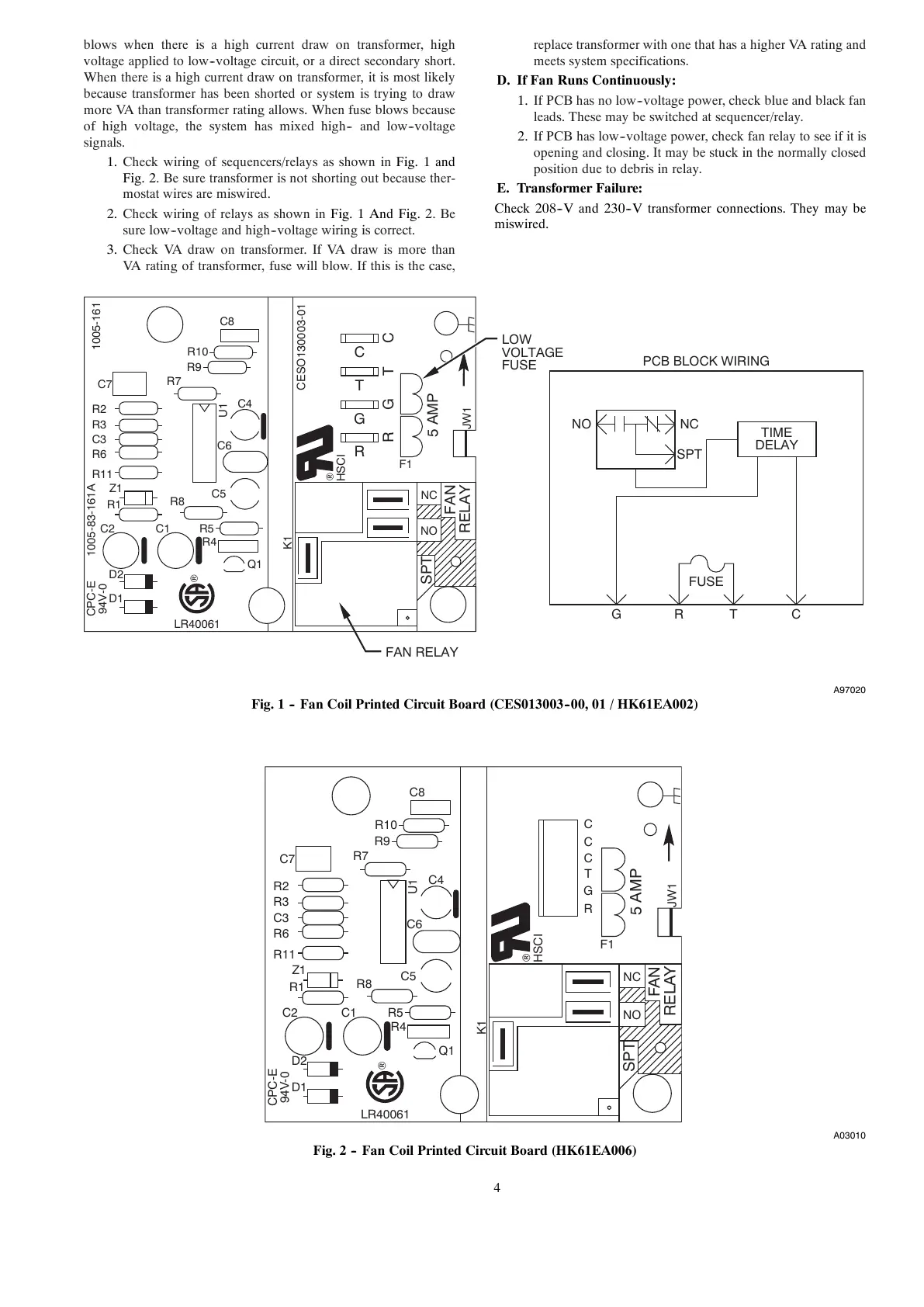
1. Check wiring of sequencers/relays as shown in Fig. 1 and
Fig. 2. Be sure transformer is not shorting out because ther-
mostat wires are miswired.
2. Check wiring of relays as shown in Fig. 1 And Fig. 2.Be
sure low--voltage and high--voltage wiring is correct.
3. Check VA draw on transformer. If VA draw is more than
VA rating of transformer, fuse will blow. If this is the case,
replace transformer with one that has a higher VA rating and
meets system specifications.
D. If Fan Runs Continuously:
1. If PCB has no low--voltage power, check blue and black fan
leads. These may be switched at sequencer/relay.
2. If PCB has low--voltage power, check fan relay to see if it is
opening and closing. It may be stuck in the normally closed
position due to debris in relay.
E. Transformer Failure:
Check 208--V and 230--V transformer connections. They may be
miswired.
LOW
VOLTAGE
FUSE
FAN RELAY
FUSE
PCB BLOCK WIRING
TIME
DELAY
NO
GRTC
NC
SPT
®
®
1005-83-161ACPC-E
94V-0
1005-161
LR40061
CESO130003-01
HSCI
5 AMP
TRG C
C
T
G
R
SPT
K1
U1
R7
R9
R10
C8
C7
R2
R3
C3
R6
R11
C4
C6
C5
R8
R5
R4
Q1
C1C2
F1
JW1
R1
Z1
D2
D1
NO
NC
FAN
RELAY
A97020
Fig. 1 -- Fan Coil Printed Circuit Board (CES013003--00, 01 / HK61EA002)
®
®
CPC-E
94V-0
LR40061
HSCI
5 AMP
C
T
G
R
SPT
K1
U1
R7
R9
R10
C8
C7
R2
R3
C3
R6
R11
C4
C6
C5
R8
R5
R4
Q1
C1C2
F1
JW1
R1
Z1
D2
D1
NO
NC
FAN
RELAY
C
C
A03010
Fig. 2 -- Fan Coil Printed Circuit Board (HK61EA006)





 To Next Page