26
REFRIGERANT FLOW--CONTROL
DEVICES
THERMOSTATIC EXPANSION VALVES (TXV)
The FX4, FV4, FF1E and FE4 Fan Coils are factory equipped with
a hard shutoff (HSO) TXV. The hard shutoff TXV has no bleed
port and allows no bleed--through after system is shutdown.
The TXV is a bi--flow metering device that is used in condensing
and heat pump systems to adjust to changing load conditions by
maintaining a preset superheat temperature at outlet of evaporator
coil. The volume of refrigerant metered through valve seat is
dependent upon the following:
1. Superheat temperature sensed by sensing bulb on suction
tube at outlet of evaporator coil. As long as this bulb con-
tains some liquid refrigerant, this temperature is converted
into pressure pushing downward on the diaphragm, which
opens the valve via push rods.
2. The suction pressure at outlet of evaporator coil is trans-
ferred via the external equalizer tube to underside of dia-
phragm.
The bi--flow TXV is used on split system heat pumps. In cooling
mode, TXV operates the same as a standard TXV previously
explained. However, when system is switched to heating mode of
operation, refrigerant flow is reversed.
The bi--flow TXV has an additional internal check valve and
tubing. These additions allow refrigerant to bypass TXV when
refrigerant flow is reversed with only a 1--psig to 2--psig pressure
drop through device.
When heat pump switches to defrost mode, refrigerant flows
through a completely open (not throttled) TXV. The bulb senses
the residual heat of outlet tube of coil that had been operating in
heating mode (about 85_ F and 155 psig). This temporary,
not--throttled valve decreases indoor pressure drop, which in turn
increases refrigerant flow rate, decreases overall defrost time, and
enhances defrost efficiency.
PROBLEMS AFFECTING TXV
A. Low Suction Pressure
1.RestrictioninTXV
2. Low refrigerant charge
3. Low indoor load
4. Low evaporator airflow
B. High Suction Pressure
1. Overcharging
2. Sensing bulb not secure to vapor tube
3. High indoor load
4. Large evaporator face area
NOTE: When installing or removing TXV, wrap TXV with a wet
cloth. When reattaching TXV, make sure sensing bulb is in good
thermal contact with suction tube.
5. The needle valve on pin carrier is spring--loaded, which also
exerts pressure on underside of diaphragm via push rods,
which closes valve. Therefore, bulb pressure equals evapor-
ator pressure at outlet of coil plus spring pressure. If load
increases, temperature increases at bulb, which increases
pressure on topside of diaphragm, which pushes pin carrier
away from seal, opening valve and increasing flow of refri-
gerant. The increased refrigerant flow causes increased leav-
ing evaporator pressure which is transferred via the equal-
izer tube to underside of diaphragm, with which the pin
carrier spring pressure closes valve. The refrigerant flow is
effectively stabilized to load demand with negligible change
in superheat.
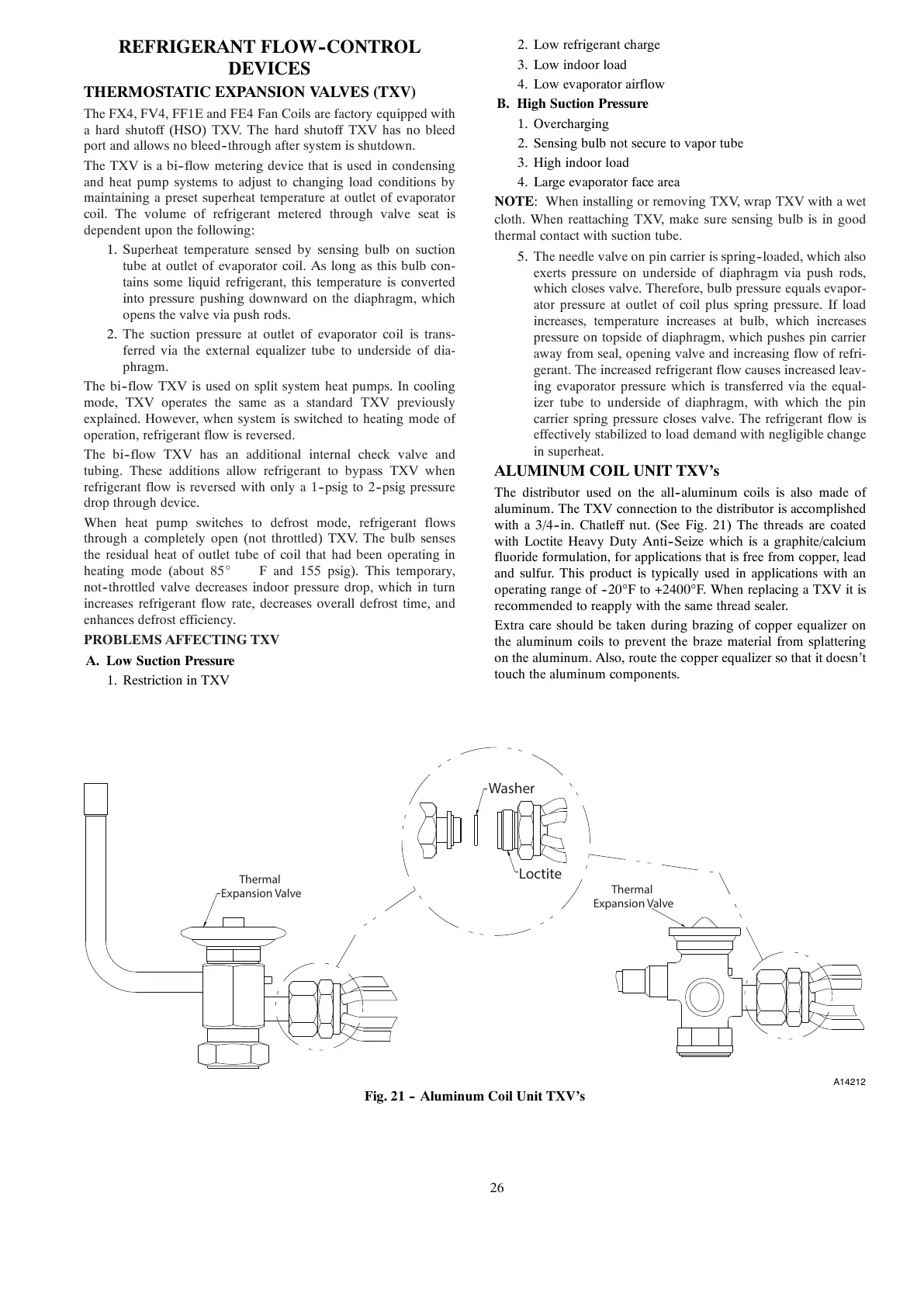
ALUMINUM COIL UNIT TXV’s
The distributor used on the all--aluminum coils is also made of
aluminum. The TXV connection to the distributor is accomplished
with a 3/4--in. Chatleff nut. (See Fig. 21) The threads are coated
with Loctite Heavy Duty Anti--Seize which is a graphite/calcium
fluoride formulation, for applications that is free from copper, lead
and sulfur. This product is typically used in applications with an
operating range of --20°F to +2400°F. When replacing a TXV it is
recommended to reapply with the same thread sealer.
Extra care should be taken during brazing of copper equalizer on
the aluminum coils to prevent the braze material from splattering
on the aluminum. Also, route the copper equalizer so that it doesn’t
touch the aluminum components.
Loctite
Washer
Thermal
Expansion Valve
Thermal
Expansion Valve
A14212
Fig. 21 -- Aluminum Coil Unit TXV’s





 To Next Page