24
If drain tube is restricted, it can generally be cleared by
high--pressure water. Cut plastic line and work outside condensate
pan and away from coil to clean drain tube.
UNIT DAMAGE HAZARD
Failure to follow this caution may result in equipment damage.
Do not use caustic household drain cleaners in the condensate
pan or near the coil. Drain cleaners can quickly destroy a coil.
CAUTION
!
BLOWER MOTOR AND WHEEL
Clean blower motor and wheel when cooling coil is cleaned.
ELECTRICAL SHOCK HAZARD
Failure to follow this warning could result in personal injury
or death.
Disconnect electrical power before removing any access
panels. Lock out and tag switch with a suitable warning label.
!
WARNING
To clean blower motor or blower wheel:
1. Remove blower access panel.
2. Remove motor leads from fan coil control. Note lead loca-
tion for ease of reassembly.
3. Remove the two outside screws holding blower/motor as-
sembly against blower deck flange and slide assembly out
of cabinet.
4. (If applicable) Remove screw in strap holding motor capa-
citor to blower housing and slide capacitor out from under
strap. Remove screw with green wire from blower housing.
Mark blower wheel, motor, and motor support in relation to
blower housing before disassembly to ensure proper reas-
sembly. Note position of blades on wheel.
5. Loosen setscrew holding blower wheel onto motor shaft.
6. Remove the three bolts holding motor mount to blower
housing and slide motor and mount out of housing. Further
disassembly should not be necessary as adequate clearance
is available.
7. Remove blower wheel from housing by removing cutoff
plate from blower housing outlet. Note wheel orientation
and cutoff location for reassembly. The blower motor and
wheel may be cleaned by using a vacuum with a soft brush
attachment.
8. Remove grease with a mild solvent such as hot water and
detergent. Be careful not to disturb balance weights (clips)
on blower--wheel vanes. Also, do not drop or bend wheel,
as balance will be affected.
To reassemble blower:
1. Place blower wheel back into housing. Be sure to position
correctly for proper location.
2. Reassemble cutoff plate to housing using identified holes
from disassembly procedure.
3. Position motor and mount in same position as when blower
housing was in unit. Secure motor mount on housing, using
removed bolts. Make sure mount or motor is grounded to
blower housing.
4. Locate blower wheel setscrew over flat on motor shaft. Ro-
tate wheel in housing. It should not rub housing and should
be centered in inlet opening. If not, loosen setscrew and
align as necessary.
5. Attach green wire to blower housing with screw.
6. (If applicable). Secure motor capacitor under strap and
tighten strap screw.
7. Slide blower assembly to blower deck. Be sure (once
blower is within the unit casing) to force blower assembly
toward control box while sliding assembly into unit to en-
sure that blower assembly engages deck properly.
8. Fasten blower assembly to deck with screws previously re-
moved.
9. Reconnect electrical leads to fan coil control.
10. Reconnect electrical power to unit and test fan for proper
rotation.
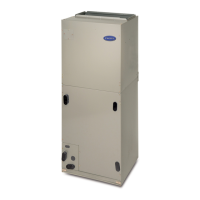
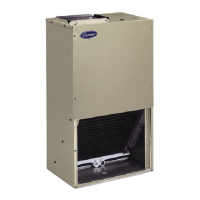
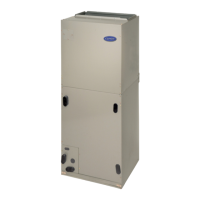
FF1E and FFMA
The minimum maintenance requirements for this equipment are as
follows:
1. Inspect and clean or replace air filter each month or as re-
quired.
2. Inspect cooling coil, drain pan, and condensate drain each
cooling season for cleanliness. Clean as necessary.
3. Inspect blower motor and wheel for cleanliness each heating
and cooling season. Clean as necessary.
4. Inspect electrical connections for tightness and controls for
proper operation each heating and cooling season. Service
as necessary.
CUT HAZARD
Failure to follow this caution may result in personal injury.
Sheet metal parts may have sharp edges or burrs. Use care and
wear appropriate protective clothing and gloves when handling
parts.
CAUTION
!
A. Air Filter
The air filter should be replaced as needed.
UNIT DAMAGE HAZARD
Failure to follow this caution may result in equipment damage.
Never operate unit without a filter.
CAUTION
!
B. Cooling Coil, Drain Pan, and Condensate Drain
The cooling coil is easily cleaned when it is dry. Inspect coil and
clean (if necessary) before each cooling season. To check or clean
cooling coil, remove blower/heater access panel to gain full access
to cooling coil. If coil is coated with dirt or lint, vacuum with a soft
brush attachment.
Be careful not to bend coil fins. If coil is coated with oil or grease,
clean it with a mild detergent and water solution. Rinse coil with
clear water.
Be careful not to splash water onto insulation.
Inspect drain pan and condensate drain at same time cooling coil is
checked. Clean drain pan and condensate drain by removing any
foreign matter from pan. Flush pan and drain tube with clear water.
If drain tube is restricted, it can generally be cleared by
high--pressure water. Cut plastic line and work outside condensate
pan and away from coil to clear drain tube.





 To Next Page