27
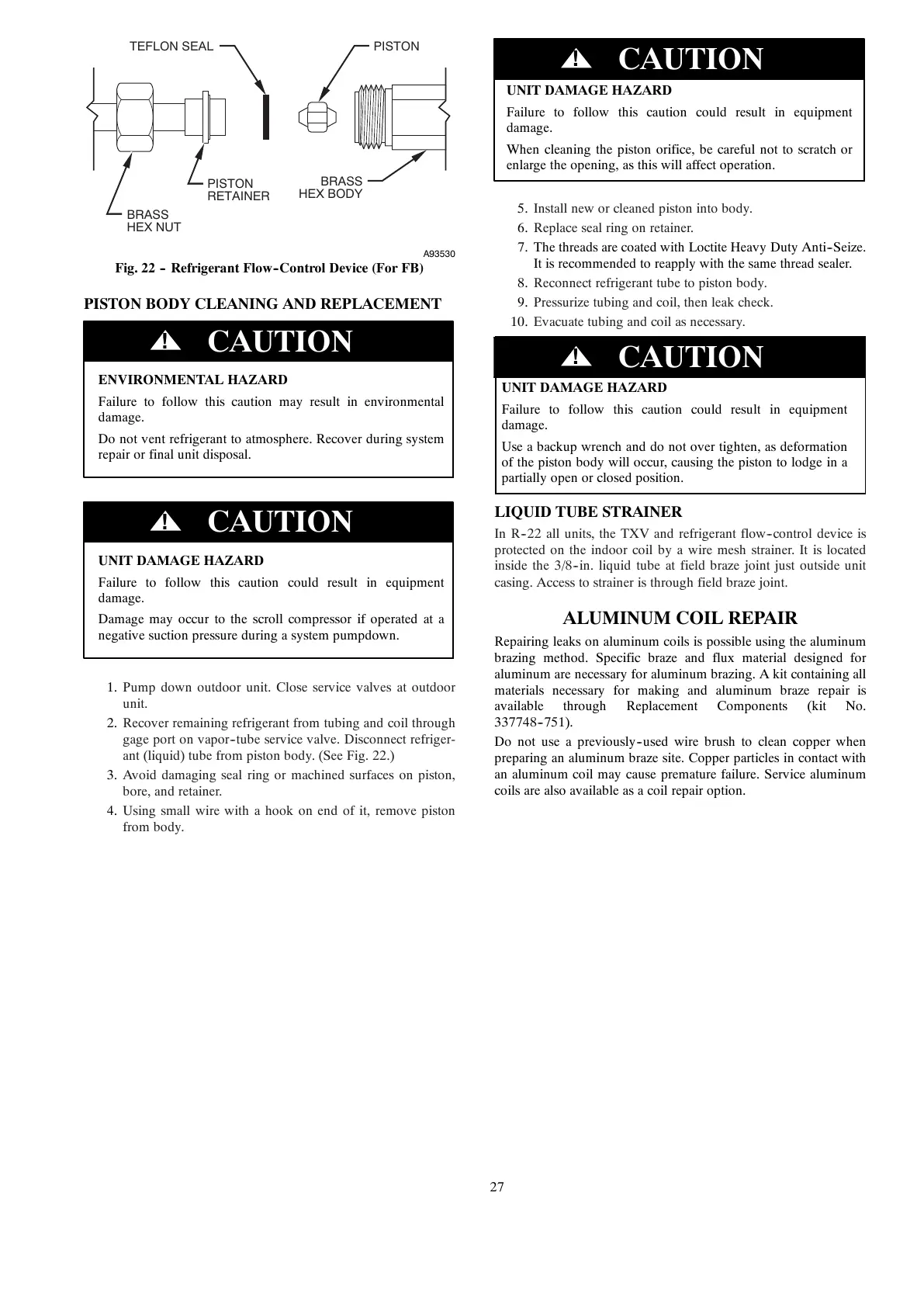
PISTON
PISTON
RETAINER
BRASS
HEX NUT
BRASS
HEX BODY
TEFLON SEAL
A93530
Fig. 22 -- Refrigerant Flow--Control Device (For FB)
PISTON BODY CLEANING AND REPLACEMENT
ENVIRONMENTAL HAZARD
Failure to follow this caution may result in environmental
damage.
Do not vent refrigerant to atmosphere. Recover during system
repair or final unit disposal.
CAUTION
!
UNIT DAMAGE HAZARD
Failure to follow this caution could result in equipment
damage.
Damage may occur to the scroll compressor if operated at a
negative suction pressure during a system pumpdown.
CAUTION
!
1. Pump down outdoor unit. Close service valves at outdoor
unit.
2. Recover remaining refrigerant from tubing and coil through
gage port on vapor--tube service valve. Disconnect refriger-
ant (liquid) tube from piston body. (See Fig. 22.)
3. Avoid damaging seal ring or machined surfaces on piston,
bore, and retainer.
4. Using small wire with a hook on end of it, remove piston
from body.
UNIT DAMAGE HAZARD
Failure to follow this caution could result in equipment
damage.
When cleaning the piston orifice, be careful not to scratch or
enlarge the opening, as this will affect operation.
CAUTION
!
5. Install new or cleaned piston into body.
6. Replace seal ring on retainer.
7. The threads are coated with Loctite Heavy Duty Anti--Seize.
It is recommended to reapply with the same thread sealer.
8. Reconnect refrigerant tube to piston body.
9. Pressurize tubing and coil, then leak check.
10. Evacuate tubing and coil as necessary.
UNIT DAMAGE HAZARD
Failure to follow this caution could result in equipment
damage.
Use a backup wrench and do not over tighten, as deformation
of the piston body will occur, causing the piston to lodge in a
partially open or closed position.
CAUTION
!
LIQUID TUBE STRAINER
In R--22 all units, the TXV and refrigerant flow--control device is
protected on the indoor coil by a wire mesh strainer. It is located
inside the 3/8--in. liquid tube at field braze joint just outside unit
casing. Access to strainer is through field braze joint.
ALUMINUM COIL REPAIR
Repairing leaks on aluminum coils is possible using the aluminum
brazing method. Specific braze and flux material designed for
aluminum are necessary for aluminum brazing. A kit containing all
materials necessary for making and aluminum braze repair is
available through Replacement Components (kit No.
337748--751).
Do not use a previously--used wire brush to clean copper when
preparing an aluminum braze site. Copper particles in contact with
an aluminum coil may cause premature failure. Service aluminum
coils are also available as a coil repair option.





 To Next Page