23
2. Check blower motor and wheel for proper operation. Ex-
cessive current draw of motor will cause internal overload
to trip.
3. The fan speed may be low.
FFM
This section describes EHK2 series electric heaters by examining
functional operation of this heater.
Service can be completed with heater in place. Shut off power
before servicing.
DESCRIPTION OF ELECTRIC HEATER COMPONENTS
A. Limit Switch
The limit switch is a temperature sensitive control that’s function is
to prevent system from overheating in abnormal conditions. The
temperature settings often vary from heater to heater due to
variations in airflow patterns and element radiant heat conditions.
The devices are sized to remain on-line under heat pump
conditions (115_ F air off coil) and minimum CFM, but trip to
prevent outlet air conditions above 200_ F or excessive component
or duct temperatures. The device itself consists of a bimetallic disc,
which when overheated “snaps through” to open a normally closed
high-voltage, high-current switch. When system temperatures cool
sufficiently, the switch will automatically reset to its closed
position. Normal failure mode for this switch is open.
If a limit switch has been determined to be defective, NEVER
BYPASS THE LIMIT SWITCH. When replacing limit switch,
ensure that it is replaced with a limit switch of identical opening
temperature and closing differential. Limits switches are typically
color--coded to identify their range.
B. Sequencer
The sequencer is essentially a thermally--activated time-delay relay
normally activated by low-voltage control signals from thermostat.
The typical sequencer is a 1- or 2--pole normally open device
which energizes within 30 to 70 seconds after application of
control signal and de--energizes 60 to 90 seconds after control
signal is removed.
In simplistic terms, the sequencers which we use are nothing more
than normally open limit switches which sit on top of a small
resistive heater. When voltage is applied to this heater, a positive
temperature coefficient resistor (PTC), heat is supplied to a
bimetallic disc which “snaps through” and closes switch.
The time required for PTC to heat to a sufficient point controls ON
timing of device. The time required for disc to cool down when
power is removed controls OFF time of device. The PTC can be
varied to provide varied timing. Typically a short ON equates to a
long OFF.
Because this is a thermally--activated device, ambient conditions
affect the ON/OFF cycle. Higher ambient temperature means
shorter ON times and longer OFF times.
Application of these devices is such that the first switch ON not
only turns on first heater element, but also ensures that indoor fan
is energized, because first ON is last OFF. This ensures fan remains
ON until the last heater de-energizes.
CARE AND MAINTENANCE
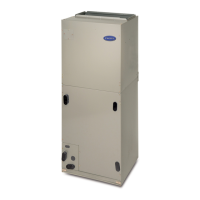
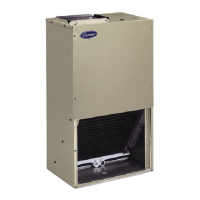
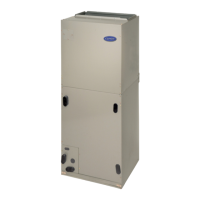
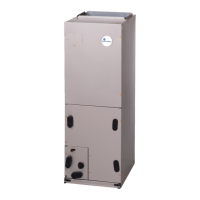
FB4, FE4, FH4, FV4, FX4, and PF4
To continue high performance, and minimize possible equipment
failure, it is essential periodic maintenance be performed on this
equipment.
The ability to properly perform maintenance on this equipment
requires certain mechanical skills and tools. The only consumer
service recommended or required is filter maintenance. (See Filter
Assembly.)
ELECTRICAL SHOCK HAZARD
Failure to follow this warning could result in personal injury
or death.
Disconnect all power to the unit before servicing the field
wires or removing the control package. The disconnect (when
used) on the access panel does not disconnect power to the line
side of the disconnect, but does allow safe service to all other
parts of the unit.
!
WARNING
The minimum maintenance requirements for this equipment are as
follows:
1. Inspect and clean or replace air filter each month or as re-
quired.
2. Inspect cooling coil, drain pan, and condensate drain each
cooling season for cleanliness. Clean as necessary.
3. Inspect blower motor and wheel for cleanliness each heating
and cooling season. Clean as necessary.
4. Inspect electrical connections for tightness and controls for
proper operation each heating and cooling season. Service
as necessary.
CUT HAZARD
Failure to follow this caution may result in personal injury.
Sheet metal parts may have sharp edges or burrs. Use care and
wear appropriate protective clothing and gloves when handling
parts.
CAUTION
!
FILTER ASSEMBLY
To clean or replace air filter, push plastic connectors toward center
of unit and remove filter access panel outward. Push filter up and
back into unit. Then slide filter out.
Clean filter by using cold water and mild detergent. Rinse and
allow filter to dry. No oiling or coating of filter is required.
New filters are available from your local distributor. Place filter in
slot with cross--mesh binding up or facing cooling coil and replace
filter access panel.
COOLING COIL, DRAIN PAN, AND CONDENSATE
DRAIN
The cooling coil is easily cleaned when it is dry. Inspect the coil
and clean (if necessary) before each cooling season. To check or
clean cooling coil, remove coil access panel. If coil is coated with
dirt or lint, vacuum it with a soft brush attachment.
Be careful not to bend coil fins. If coil is coated with oil or grease,
clean it with a mild detergent and water solution. Rinse coil
thoroughly with clear water. Be careful not to splash water on
insulation.
Inspect drain pan and condensate drain at the same time cooling
coil is checked. Clean drain pan and condensate drain by removing
any foreign matter from pan. Flush pan and drain tube with clear
water.





 To Next Page