22
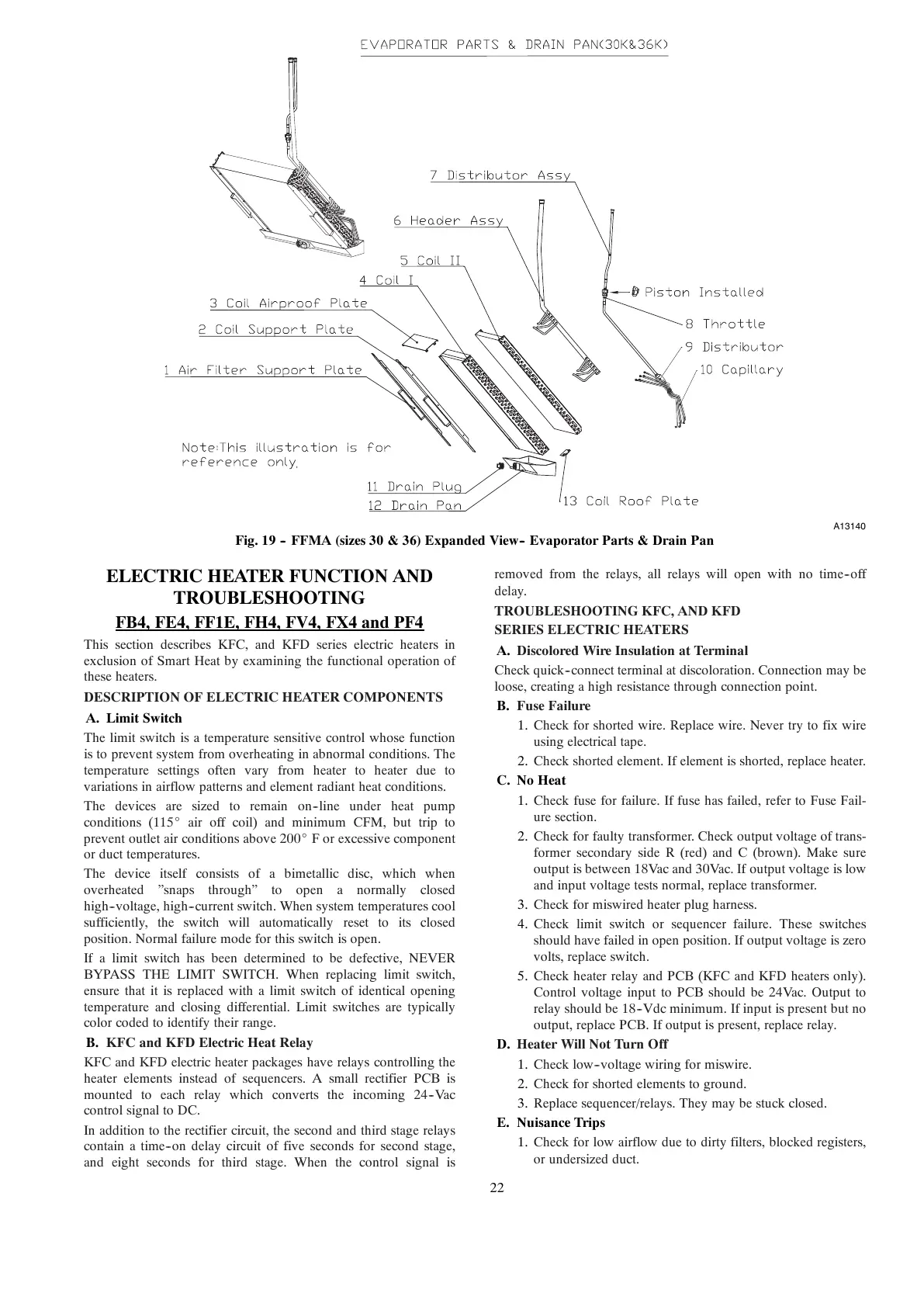
A13140
Fig. 19 -- FFMA (sizes 30 & 36) Expanded View-- Evaporator Parts & Drain Pan
ELECTRIC HEATER FUNCTION AND
TROUBLESHOOTING
FB4, FE4, FF1E, FH4, FV4, FX4 and PF4
This section describes KFC, and KFD series electric heaters in
exclusion of Smart Heat by examining the functional operation of
these heaters.
DESCRIPTION OF ELECTRIC HEATER COMPONENTS
A. Limit Switch
The limit switch is a temperature sensitive control whose function
is to prevent system from overheating in abnormal conditions. The
temperature settings often vary from heater to heater due to
variations in airflow patterns and element radiant heat conditions.
The devices are sized to remain on--line under heat pump
conditions (115_ air off coil) and minimum CFM, but trip to
prevent outlet air conditions above 200_ F or excessive component
or duct temperatures.
The device itself consists of a bimetallic disc, which when
overheated ”snaps through” to open a normally closed
high--voltage, high--current switch. When system temperatures cool
sufficiently, the switch will automatically reset to its closed
position. Normal failure mode for this switch is open.
If a limit switch has been determined to be defective, NEVER
BYPASS THE LIMIT SWITCH. When replacing limit switch,
ensure that it is replaced with a limit switch of identical opening
temperature and closing differential. Limit switches are typically
color coded to identify their range.
B. KFC and KFD Electric Heat Relay
KFC and KFD electric heater packages have relays controlling the
heater elements instead of sequencers. A small rectifier PCB is
mounted to each relay which converts the incoming 24--Vac
control signal to DC.
In addition to the rectifier circuit, the second and third stage relays
contain a time--on delay circuit of five seconds for second stage,
and eight seconds for third stage. When the control signal is
removed from the relays, all relays will open with no time--off
delay.
TROUBLESHOOTING KFC, AND KFD
SERIES ELECTRIC HEATERS
A. Discolored Wire Insulation at Terminal
Check quick--connect terminal at discoloration. Connection may be
loose, creating a high resistance through connection point.
B. Fuse Failure
1. Check for shorted wire. Replace wire. Never try to fix wire
using electrical tape.
2. Check shorted element. If element is shorted, replace heater.
C. No Heat
1. Check fuse for failure. If fuse has failed, refer to Fuse Fail-
ure section.
2. Check for faulty transformer. Check output voltage of trans-
former secondary side R (red) and C (brown). Make sure
output is between 18Vac and 30Vac. If output voltage is low
and input voltage tests normal, replace transformer.
3. Check for miswired heater plug harness.
4. Check limit switch or sequencer failure. These switches
should have failed in open position. If output voltage is zero
volts, replace switch.
5. Check heater relay and PCB (KFC and KFD heaters only).
Control voltage input to PCB should be 24Vac. Output to
relay should be 18--Vdc minimum. If input is present but no
output, replace PCB. If output is present, replace relay.
D. Heater Will Not Turn Off
1. Check low--voltage wiring for miswire.
2. Check for shorted elements to ground.
3. Replace sequencer/relays. They may be stuck closed.
E. Nuisance Trips
1. Check for low airflow due to dirty filters, blocked registers,
or undersized duct.





 To Next Page