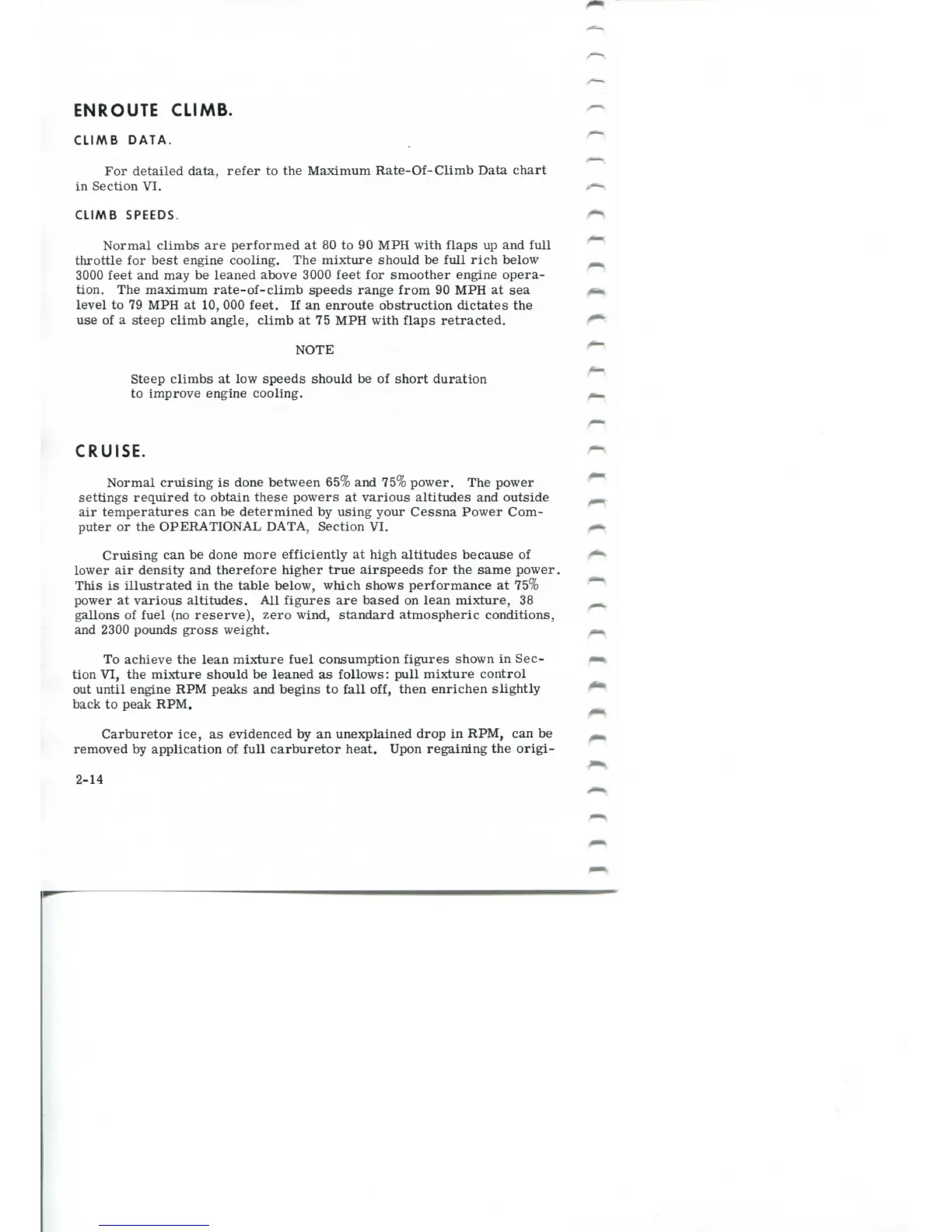
ENROUTE
CLIMB.
^
CLIMB
DATA.
NOTE
Steep
climbs at low
speeds
should be of short duration
to improve engine cooling.
CRUISE.
Normal
cruising is
done
between 65% and 75% power. The power
settings required to obtain
these
powers
at various altitudes and outside
air
temperatmres can be determined by using your
Cessna
Power
Com-
puter
or the OPERATIONAL DATA, Section VI.
Cruising
can be
done
more efficiently at high altitudes
because
of
lower air density and therefore higher true
airspeeds
for the
same
power.
This
is
illustrated
in the table below, which
shows
performance at 75%
power at various altitudes. All figures are
based
on lean mixture, 38
gallons of fuel (no reserve),
zero
wind,
standard atmospheric conditions,
and
2300
pounds
gross
weight.
To
achieve
the lean mixture fuel consumption figures shown in
Sec-
tion
VI, the mixture should be leaned as follows:
pull
mixture control
out
until
engine RPM
peaks
and
begins
to
fall
off, then enrichen slightly
back
to peak RPM.
Carburetor ice, as
evidenced
by an unexplained drop in RPM, can be
removed by application of
full
carburetor heat. Upon regaining the
origi-
2-14
For detailed data, refer to the Maximum Rate-Of-Climb Data chart
in
Section VI.
CLIMB
SPEEDS.
Normal
climbs are performed at 80 to 90 MPH
with
flaps up and
full
^
throttle
for
best
engine cooling. The mixture should be
full
rich
below
^
3000
feet and may be leaned
above
3000
feet for smoother engine opera-
tion.
The maximum rate-of-climb
speeds
range from 90 MPH at sea ^
level to 79 MPH at 10, 000 feet. If an enroute obstruction dictates the
use of a
steep
climb angle, climb at 75 MPH
with
flaps retracted.
r



 To Next Page