
 Need help?
Do you have a question about the CGX Quick-20r and is the answer not in the manual?
Detailed explanation of the wireless EEG headset and its dry sensor technology.
Guide to downloading and installing the CGX Acquisition software for Windows.
Instructions on choosing the appropriate sensors and attaching them to the headset.
Steps for assembling earclips and connecting lead wires to the headset.
Guide to charging batteries, checking status lights, and inserting the Bluetooth dongle.
Steps to launch the software and establish a connection with the headset.
Visual guide and tips for correctly positioning the headset on the subject's head.
Step-by-step instructions for wearing the headset, including sensor contact and earclip attachment.
Ensuring good signal quality by optimizing sensor-scalp contact using LEDs and impedance checks.
Instructions for starting, stopping EEG recordings and properly ending the session.
Procedures for cleaning sensors, pods, legs, battery storage, and product disposal.
Examples of clean EEG data and artifacts from blinks and eye movements.
Identification of artifacts caused by jaw clenching, tongue movement, and swallowing.
Explanation of artifacts from neck tension, sensor pops, head movement, pulse, and power lines.
Troubleshooting common errors related to reference and ground contact in the setup.
Configuring and connecting the acquisition device within the CGX software.
Adjusting scaling, filtering, and channel display parameters in the software.
Viewing channel information, impedance, and sensor contact quality.
Using markers for event annotation and monitoring transmission status and battery level.
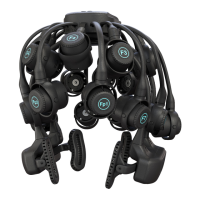
The CGX Quick-20r is a wireless, battery-operated EEG headset designed for research and development efforts. It is not an FDA-approved medical device. The device is intended to acquire electroencephalogram (EEG) signals and transmit them wirelessly to a computer.
The Quick-20r utilizes dry sensor technology for EEG acquisition. Its channel positions are arranged in a 10-20 montage, supplemented by two variable-placement ExG channels. The headset provides an integrated approach to wireless acquisition of EEG signals, allowing subjects to move freely while real-time data is collected and displayed. It is designed to obtain high-quality EEG with minimal scalp preparation. Patented mechanisms and replaceable dry sensors align to various head shapes and sizes, maintaining sensor positions in a standard montage. The EEG channels are sampled at a time resolution of 500Hz and converted to digital data at 24 bits of resolution. The Quick-20r delivers research-grade signal quality, making it suitable for general-purpose EEG and ERP research in both laboratory and field environments.

 To Next Page
 General