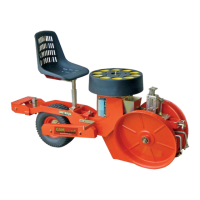
24.0 - WHEEL SCRAPER
It is possible to adjust the height from the ground by operating the screws (fi g. 16.A) and turning the
support (fi g. 16.B).
It is possible to adjust the distance from wheels by operating the screws(fi g. 16.C).
25.0 - TRANSPLANT DISTANCE
INTER-ROW: min. 50 cm for the single frame version (fi g. 17)
DISTANCE BETWEEN DOUBLE ROWS: min. 25 cm for the DT double frame (fi g. 18)
Inter-row spacing must be adjusted with the machine coupled to the tractor and with the lift unit lowe-
red.
Loosen the screws (fi g. 19 A) and place the unit at the desired distance by sliding it on the frame. Do not
carry out these operations by hammering with metal objects as this could cause serious damage to the
components.
25.1 - INTER-ROW SPACING
The diagrams (fi g. 20) indicate the distances that can be obtained with the ratios available for the 10-
bucket model (fi g. 20 A) and the 6/12-bucket model (fi g. 20 B). Each transplanting unit is equipped with a
transmission with relative rapid gear-shifting (fi g. 21 A).
26.0 - DRIVE WHEELS (fi g. 22.B)
During operation, the drive wheel must always be in contact with the ground in order to operate the trans-
planting unit. By acting on the adjusting screw (fi g. 21 C) it is possible to increase or reduce pressure and
to adjust the range.
27.0 - TRACTOR GAUGE
The imprint left on the ground by the wheels of the tractor, as well as having a compacting effect, also
usually lowers the surface of the ground. Keep a transplanting distance of not less than 10-12 cm
from the imprint (fi g. 22) by adjusting the inter-row spacing or the gauge of the tractor.
28.0 - ACCESSORIES
28.1 - ROW MARKERS: fi t as shown in (fi g. 23) and adjust the point of the marker to the desired
distance (fi g. 23.A). Positioning on the ground and lifting are manual. Carry out these operations with the
machine stationary and make certain that there is nobody in the area in question.
When this accessory is fi tted, the overall dimensions of the machine are increased; for this reason, take
greater care during manoeuvres and disassemble before travelling on the road.
28.2 - EXTRA SEAT
Meets the possible need for two operators for each transplanting unit; only for row inter-spacing of more
than 100 cm.
Fit as shown in fi g. 24.
28.3- EXTRA TRAY HOLDER KIT
Using this kit, it is possible to have two rotating tray holders for each transplanting unit; only for row inter-
spacing of more than 120 cm.
Fit as shown in fi g. 25 and pay attention to the increased lateral dimensions.
28.4 - DISTRIBUTOR EXTENSION (fi g. 26.A)
Recommended for transplanting plants with very long leaves (13-20 cm approx.). Facilitates discharge
of the plant and reduces the risk of blockages caused by plants failing to descend from the distributor
immediately.
Fit as shown in fi g. 26.
28.5- BUCKET REDUCTION UNIT (fi g. 26 B)
It is recommended when transplanting plants with a scarcely developed leaf apparatus and rooted in
small-sized clods. It ensures a better operating accuracy.
28.6- SINCROMICRO
It allows localised spreading on each plant of a small (adjustable) dose of microgranular antiparasitic
substance.
28.7- INTRA-PLOUGHSHARE WATERING DEVICE
It allows localised spreading on each plant of a small (adjustable) dose of water.
24
Checchi & Magli
english
37
UNITRIUM
español
6.0 - IZAJE
6.1 - Comprobar que los medios de izaje (ganchos, cabos, cadenas, etc.) tengan la
capacidad necesaria. Leer el peso indicado en la placa de identifi cación y en la tabla de
pesos y medidas.
6.2 - Fijar los ganchos, cabos, cadenas, etc.. en las tres posiciones indicadas por la (fi g.3) e indi-
cadas por el símbolo gráfi co "GANCHO".
6.3 - Accionar lentamente el sistema de izaje y, antes de elevar defi nitivamente la máquina,
asegurarse de que la misma no se desplace lateralmente y que en la zona no se encuentren personas
ajenas al trabajo.
6.4 - Mantenerse a una distancia de seguridad y por ningún motivo situarse en lugares donde
se corra el riesgo de caída de la máquina.
7.0 - TRANSPORTE
Comprobar que el vehículo que se vaya a utilizar sea idóneo en cuanto a capacidad, tamaño y demás
particulares prescritos por el código de circulación.
Emplazar la máquina de manera que ninguna parte de ella sobresalga del perímetro del vehículo, y fi jarla
adecuadamente con cables u otros elementos para evitar movimientos incontrolados.
8.0 - NORMAS DE SEGURIDAD Y DE PREVENCIÓN DE ACCIDENTES
8.1 - Leer atentamente todas las instrucciones antes de utilizar la máquina, espe-
cialmente aquéllas referidas a la protección del operador. El fabricante declina toda
responsabilidad por daños emergentes de un uso inapropiado de la máquina o de la inobservancia
de las presentes instrucciones.
El titular de la máquina tiene el deber de transmitir a sus empleados y colaboradores las indicaciones
contenidas en esta publicación (obligación prescrita por la ley).
8.2 - Prestar atención a los símbolos de peligro indicados en el manual y en la máquina.
8.3 - Operaciones, regulaciones y mantenimiento se han de realizar solamente con el motor
apagado, con la máquina apoyada en el suelo y el tractor bloqueado (freno de aparcamiento
activado).
8.4 - Enganchar la máquina únicamente a un tractor de potencia adecuada (ver la fi cha técnica
con referencia al modelo en uso) y que tenga un elevador conforme a las normas específi cas
sobre tractores.
Respetar el peso máximo admisible sobre el eje y el peso móvil total.
8.5 - Durante las maniobras de enganche y desenganche del tractor, poner el máximo cuidado a
fi n de evitar aplastamientos.
8.6 - Queda absolutamente prohibido que el tractor sea conducido por personas desprovistas de
carné, inexpertas o que no estén en buenas condiciones de salud.
8.7 - No abandonar nunca el puesto de conducción con el tractor en marcha.
Antes de salir del tractor, bajar el elevador, parar el motor, accionar el freno de aparcamiento y
quitar la llave de arranque del cuadro de mandos.
8.8 - Tener en cuenta que la estabilidad de marcha, la capacidad de dirección y la efi ciencia del
freno se modifi can cuando se lleva una máquina cargada o a remolque.
8.9 - Para la circulación por carretera es necesario atenerse a las ordenanzas vigentes en el
respectivo país.
8.10 - Durante el transporte en carretera, con la máquina elevada, bloquear la palanca de mando
del elevador hidráulico.
8.11 - Los operadores deben tomar posición en sus respectivos asientos apoyando los pies en
los estribos (fi g. 4.A), exclusivamente con el tractor parado y bloqueado, y con la máquina
apoyada en el suelo.
Está absolutamente prohibido realizar desplazamientos en el campo o en caminos con el
elevador levantado y con operadores en la máquina. Tampoco se permite bajarse cuando la
máquina esté en movimiento o elevada del suelo.
8.12 - Los elementos móviles (ruedas, cadenas, distribuidores, etc.) están protegidos por cárteres.
Donde ello no fue posible, se ha dejado un espacio sufi ciente para evitar el riesgo de aplastamiento.
No llevar por ningún motivo prendas sueltas, ya que podrían enredarse en dichos elementos
durante el funcionamiento. A lo largo del trabajo, prestar la máxima atención a todos los compo-
nentes en movimiento.
8.13 - No quitar los dispositivos de seguridad y de protección que están instalados. Si se los de-
biera extraer por motivos de regulación o de mantenimiento, no olvidarse de volver a montarlos
en su sitio.


 To Next Page
 Loading...