Need help?
Do you have a question about the Clack V1CIDME-M03 and is the answer not in the manual?
Set up the control valve for no hard water bypass operation for optimal performance.
Set up the control valve to use a separate source during regeneration cycles.
Configure the control valve to function as an alternator in a system.
Displays the number of days since the last regeneration cycle occurred.
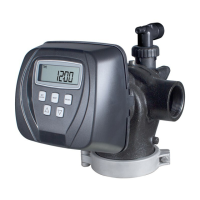
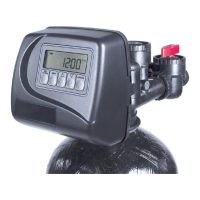
The Water Specialist CI Control Valve is a sophisticated device designed for water treatment systems, offering extensive programming capabilities to suit various installation needs. It functions as the central control unit for both softener and filter systems, managing regeneration cycles and system operations.
The control valve's primary function is to regulate the regeneration process of water treatment systems. It allows for the customization of cycle sequences, including backwash, brine (downflow or upflow), rinse (fast), fill, and softening or filtering. The OEM (Original Equipment Manufacturer) can define the order and duration of up to nine cycles, with "END" always marking the final cycle option. The "SERVICE" cycle is specifically used in brine prefill applications.
The valve supports different operational modes, such as "No Hard Water Bypass," "Separate Source Operation," and "Alternator" for twin tank systems. In "No Hard Water Bypass" mode, the valve ensures that no untreated water bypasses the system during regeneration. For "Separate Source Operation," it allows the use of an alternative water source during regeneration cycles. When configured as an "Alternator," it manages twin tank systems, ensuring continuous treated water supply by switching between tanks.
The device also incorporates a differential pressure (dP) switch function, which can be configured to initiate or delay regeneration based on pressure changes. Options include "dPon0" for immediate regeneration upon dP switch closure, "dPdEL" for delayed regeneration at a scheduled time, and "HoLd" to prevent regeneration while the switch is closed.
For softener systems, the valve calculates volumetric capacity based on user-defined measurements (ppm, dH, or FH) and salt fill settings. It can automatically calculate reserve capacity or allow manual input. Regeneration timing can be set to "NORMAL" (at a preset time), "on 0" (immediately when capacity reaches zero), or "NORMAL + on 0" (at preset time when capacity falls below reserve or after 10 minutes of no water usage when capacity reaches zero).
For filter systems, the valve manages similar cycle timings and regeneration options, with specific settings for fill volume in liters.
The control valve also features two relay outputs (Relay 1 and Relay 2) that can be programmed to activate or deactivate based on time or metered volume during service or regeneration cycles. These relays can be used to control external devices or signals.
A "Low Salt Warning" feature can be activated for softener systems, which flashes "FILL SALT" on the display when the calculated remaining salt falls below a specified level.
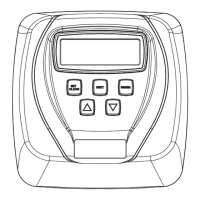
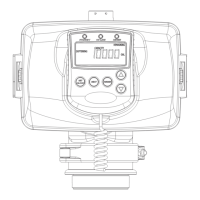
The user interface is designed for ease of use, with a display showing current time, volume remaining before regeneration, present flow rate, or days remaining before regeneration. Navigation through menus and settings is done using "NEXT," "REGEN," "SET CLOCK," and arrow buttons (up/down).
To prevent unauthorized changes, the device has a "lock out" feature for diagnostic and valve history displays and most settings, which can be activated or deactivated using a specific button sequence.
During normal operation, if no buttons are pressed for five minutes, the display returns to a normal user display, and any changes made are incorporated. The "SET CLOCK" button can be used to quickly exit setup menus.
Manual regeneration can be initiated in two ways: a "delayed regeneration" by pressing and releasing "REGEN" (if the regeneration time option is "NORMAL" or "NORMAL + on 0"), or an "immediate regeneration" by pressing and holding "REGEN" for three seconds.
The time of day can be set by the user, especially after power outages lasting more than 24 hours or when daylight saving time changes.
For twin alternator systems, the valve offers advanced features such as delayed rinse and fill, where the regeneration is split into two portions. The first portion occurs immediately, and the second portion (rinse and fill) is delayed until the on-line unit's volume capacity is depleted to 10%. This ensures continuous treated water supply. Twin alternator systems can also be programmed with a day override setting combined with volume-based regeneration or as time clock only systems.
The device includes diagnostic screens that provide valuable information for troubleshooting and maintenance. These include:
The valve also has a "Valve History" section that displays the software version, total days since startup, total number of regenerations, total volume of water treated since startup, and an error log of the last 10 errors.
In case of a power loss, the system retains time for 24 hours or until the battery is depleted. If a power outage exceeds 24 hours, the time of day will flash, indicating it needs to be reset. The system remembers other settings.
A "reset to defaults" function is available, allowing all programming and diagnostic information to be reset when the valve is installed in a new location. This is achieved by pressing "NEXT" and the down arrow simultaneously to enter the Softening/Filtering screen, then pressing the up and down arrows simultaneously.
Battery replacement is a simple process, requiring a 3-volt lithium coin cell type 2032, with clear instructions on aligning positives and seating the battery.
 General
| Brand | Clack |
|---|---|
| Model | V1CIDME-M03 |
| Category | Control Unit |
| Language | English |


 To Next Page