EasyManua.ls Logo

CLAUSING 1300 Series - Foundation; Uncrating; Cleaning; Lifting

Default Icon
36 pages
Print Icon
To Next Page IconTo Next Page
To Previous Page IconTo Previous Page
Loading...
INSTALLATION
FOUNDATION
The
Clausing
lathe
is
a
precision
machine
tool
re
quiring
a
firm
foundation.
The
floor
must
be
level
and
sol
id
enough
to
support
the
weight
of
the
machine
without
noticeable
deflection.
Reinforced
concrete
is
recommended;
it
provides
a
rigid
base,
minimizes
vibration
from
adjacent
machines
and
resists
deflec
tion.
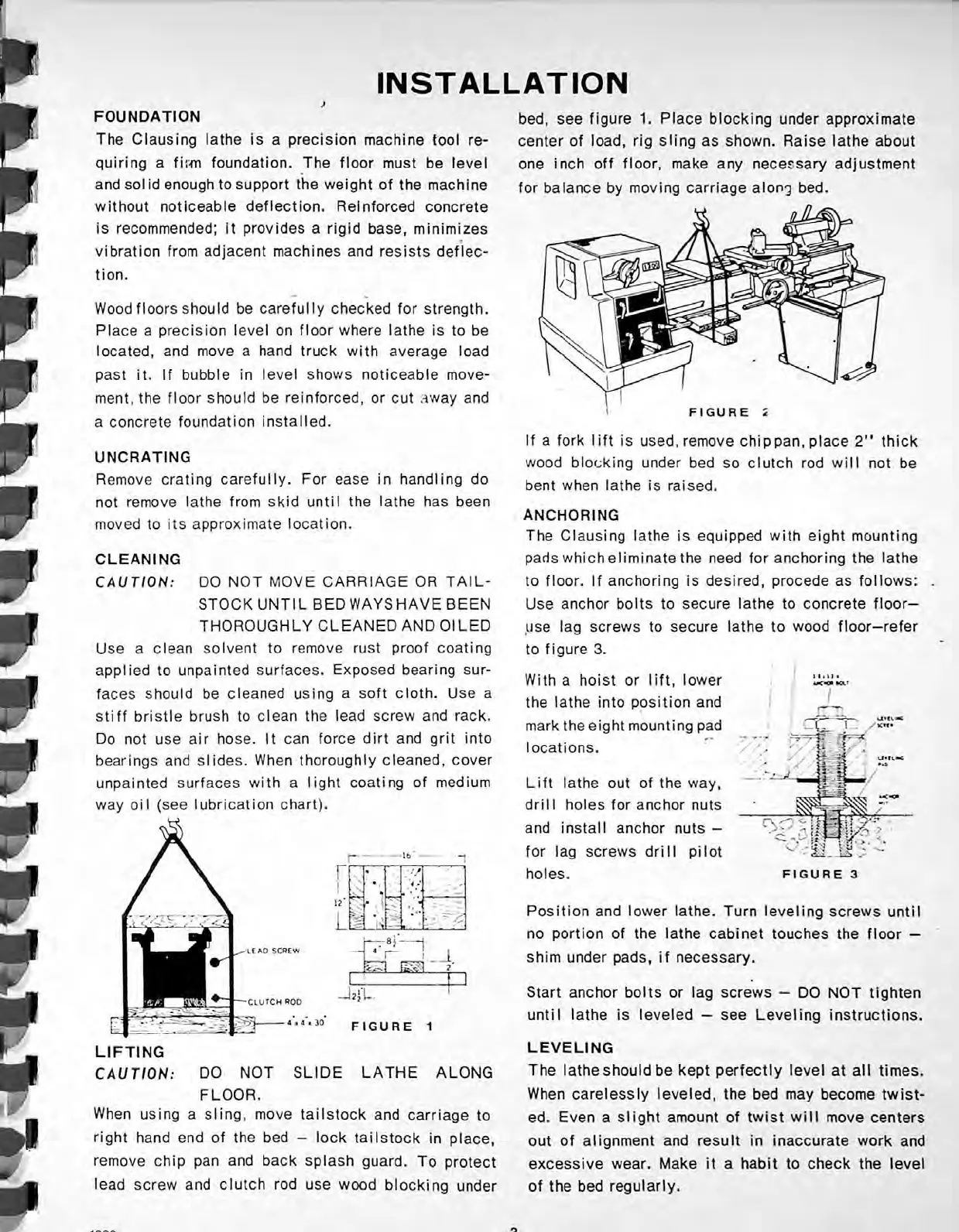
bed,
see
figure
1.
Place
blocking
under
approximate
center
of
load,
rig
sling
as
shown.
Raise
lathe
about
one
inch
off
floor,
make
any
necessary
adjustment
for
balance
by
moving
carriage
along
bed.
Wood
floors
should
be
carefully
checked
for
strength.
Place
a
precision
level
on
floor
where
lathe
is
to
be
located,
and
move
a
hand
truck
with
average
load
past
it.
If
bubble
in
level
shows
noticeable
move
ment,
the
floor
should
be
reinforced,
or
cut
away
and
a
concrete
foundation
installed.
FIGURE
;
*
If
a
fork
lift
is
used,
remove
chip
pan,
place
2
thick
wood
blocking
under
bed
so
clutch
rod
will
not
be
bent
when
lathe
is
raised.
UNCRATING
Remove
crating
carefully.
For
ease
in
handling
do
not
remove
lathe
from
skid
until
the
lathe
has
been
moved
to
its
approximate
location.
w
ANCHORING
The
Clausing
lathe
is
equipped
with
eight
mounting
pads
which
eliminate
the
need
for
anchoring
the
lathe
to
floor.
If
anchoring
is
desired,
procede
as
follows:
.
Use
anchor
bolts
to
secure
lathe
to
concrete
floor-
use
lag
screws
to
secure
lathe
to
wood
floor
refer
to
figure
3.
With
a
hoist
or
lift,
lower
the
lathe
into
position
and
mark
the
eight
mounting
pad
locations.
CLEANING
CAUTION:
DO
NOT
MOVE
CARRIAGE
OR
TAIL-
STOCK
UNTIL
BED
WAYS
HAVE
BEEN
THOROUGHLY
CLEANED
AND
OILED
Use
a
clean
solvent
to
remove
rust
proof
coating
applied
to
unpainted
surfaces.
Exposed
bearing
sur
faces
should
be
cleaned
using
a
soft
cloth.
Use
a
stiff
bristle
brush
to
clean
the
lead
screw
and
rack.
Do
not
use
air
hose.
It
can
force
dirt
and
grit
into
bearings
and
slides.
When
thoroughly
cleaned,
cover
unpainted
surfaces
with
a
light
coating
of
medium
way
oil
(see
lubrication
chart).
w
ii
.ii
.
u<o
w
f
I
l
T
l
7
12
/**"
7
7-/
/y
f
T
.
Li.flX
1
y
Lift
lathe
out
of
the
way,
drill
holes
for
anchor
nuts
and
install
anchor
nuts
-
for
lag
screws
drill
pilot
holes.
f
.
.
\nl\ly
lb'
•//
FIGURE
3
\
4
:
I
12*
Position
and
lower
lathe.
Turn
leveling
screws
until
no
portion
of
the
lathe
cabinet
touches
the
floor
-
shim
under
pads,
if
necessary.
1
m
m
im
M:
=5
-
1
iT-il
1
LEAD
SCREW
__L
S3
essi
i
7
]
Start
anchor
bolts
or
lag
screws
DO
NOT
tighten
until
lathe
is
leveled
see
Leveling
instructions.
-WL
CLUTCH
ROD
4*.
4*«
30*
m
FIGURE
1
LEVELING
The
lathe
should
be
kept
perfectly
level
at
all
times.
When
carelessly
leveled,
the
bed
may
become
twist
ed.
Even
a
slight
amount
of
twist
will
move
centers
out
of
alignment
and
result
in
inaccurate
work
and
excessive
wear.
Make
it
a
habit
to
check
the
level
of
the
bed
regularly.
LIFTING
CAUTION:
DO
NOT
SLIDE
LATHE
ALONG
FLOOR.
When
using
a
sling,
move
tailstock
and
carriage
to
right
hand
end
of
the
bed
-
lock
tailstock
in
place,
remove
chip
pan
and
back
splash
guard.
To
protect
lead
screw
and
clutch
rod
use
wood
blocking
under

Related product manuals