EasyManua.ls Logo

CLAUSING 1300 Series - Electrical Connections

Default Icon
36 pages
Print Icon
To Next Page IconTo Next Page
To Previous Page IconTo Previous Page
Loading...
LEVELING
(con
t)
from
page
3
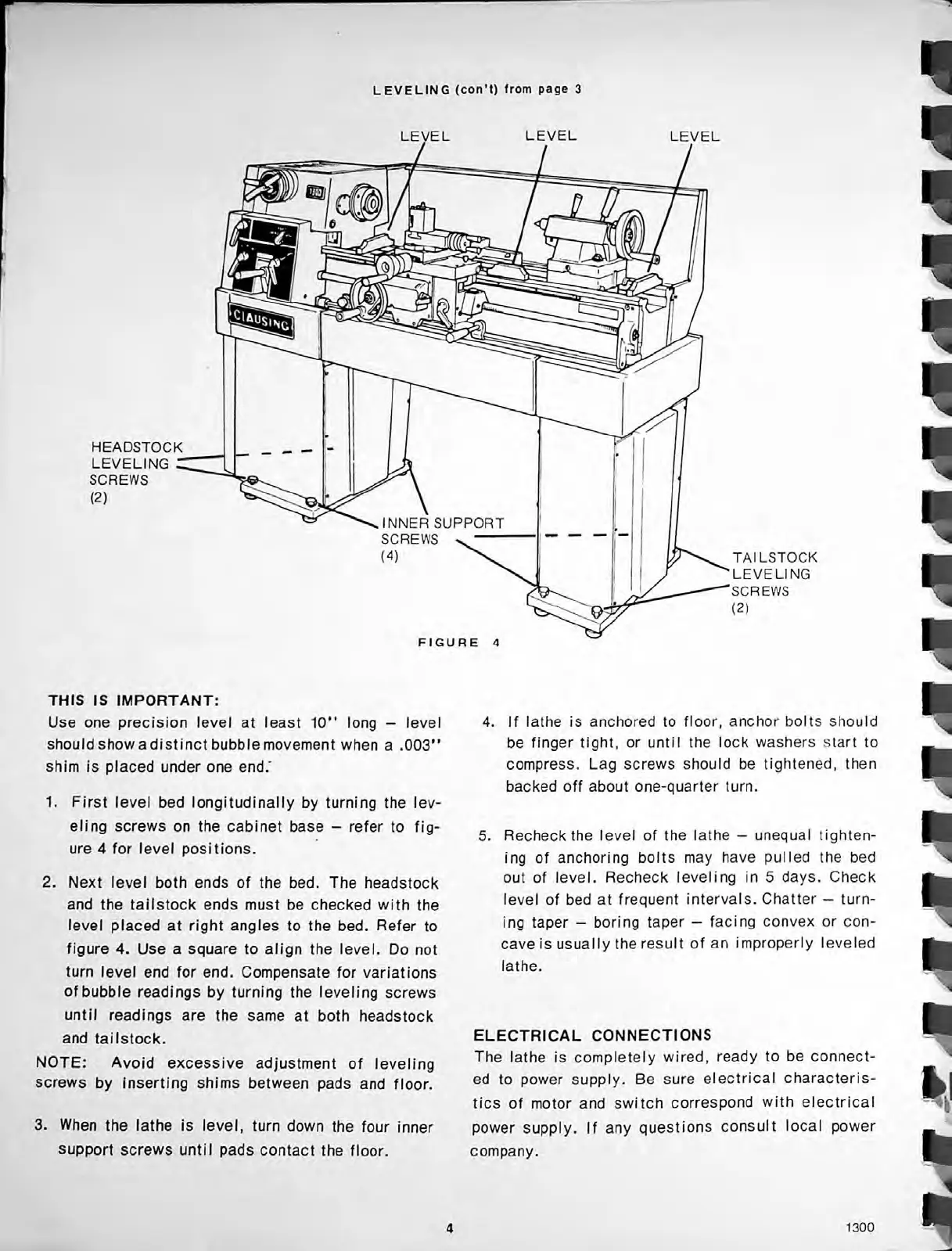
LEVEL
LEVEL
LEVEL
'
r/
HEADSTOCK
LEVELING
SCREWS
(2)
INNER
SUPPORT
SCREWS
(4)
TAILSTOCK
LEVELING
SCREWS
(2)
FIGURE
4
THIS
IS
IMPORTANT:
Use
one
precision
level
at
least
10
long
-
level
should
show
a
distinct
bubble
movement
when
a
.003
shim
is
placed
under
one
end.
4.
If
lathe
is
anchored
to
floor,
anchor
bolts
should
be
finger
tight,
or
until
the
lock
washers
start
to
compress.
Lag
screws
should
be
tightened,
then
backed
off
about
one-quarter
turn.
1.
First
level
bed
longitudinally
by
turning
the
lev
eling
screws
on
the
cabinet
base
-
refer
to
fig
ure
4
for
level
positions.
5.
Recheck
the
level
of
the
lathe
unequal
tighten
ing
of
anchoring
bolts
may
have
pulled
the
bed
out
of
level.
Recheck
leveling
in
5
days.
Check
level
of
bed
at
frequent
intervals.
Chatter
-
turn
ing
taper
boring
taper
facing
convex
or
con
cave
is
usual
ly
the
result
of
an
improperly
leveled
lathe.
2.
Next
level
both
ends
of
the
bed.
The
headstock
and
the
tailstock
ends
must
be
checked
with
the
level
placed
at
right
angles
to
the
bed.
Refer
to
figure
4.
Use
a
square
to
align
the
level.
Do
not
turn
level
end
for
end.
Compensate
for
variations
of
bubble
readings
by
turning
the
leveling
screws
until
readings
are
the
same
at
both
headstock
and
tailstock.
ELECTRICAL
CONNECTIONS
The
lathe
is
completely
wired,
ready
to
be
connect
ed
to
power
supply.
Be
sure
electrical
characteris
tics
of
motor
and
switch
correspond
with
electrical
power
supply.
If
any
questions
consult
local
power
company.
NOTE:
screws
by
inserting
shims
between
pads
and
floor.
Avoid
excessive
adjustment
of
leveling
3.
When
the
lathe
is
level,
turn
down
the
four
inner
support
screws
until
pads
contact
the
floor.
1300
4

Related product manuals