Technical Manual Page 3 CODEL
Measurement Principle
Gas flow is rarely laminar. Turbulence in the flow produces a series of swirling eddies and vortices that are
transported with the bulk flow. Infrared radiation, emitted by a hot gas system, is characterised by a flickering
signal resulting from the swirling effect of these vortices. Two infrared detectors, placed a small distance apart,
will produce very similar flickering signals, but with a displacement in time equivalent to the time taken for the
bulk gas flow to carry the vortices from the first detector to the second.
The V-CEM5100 uses a cross-correlation technique to measure this time displacement and hence the flow. The
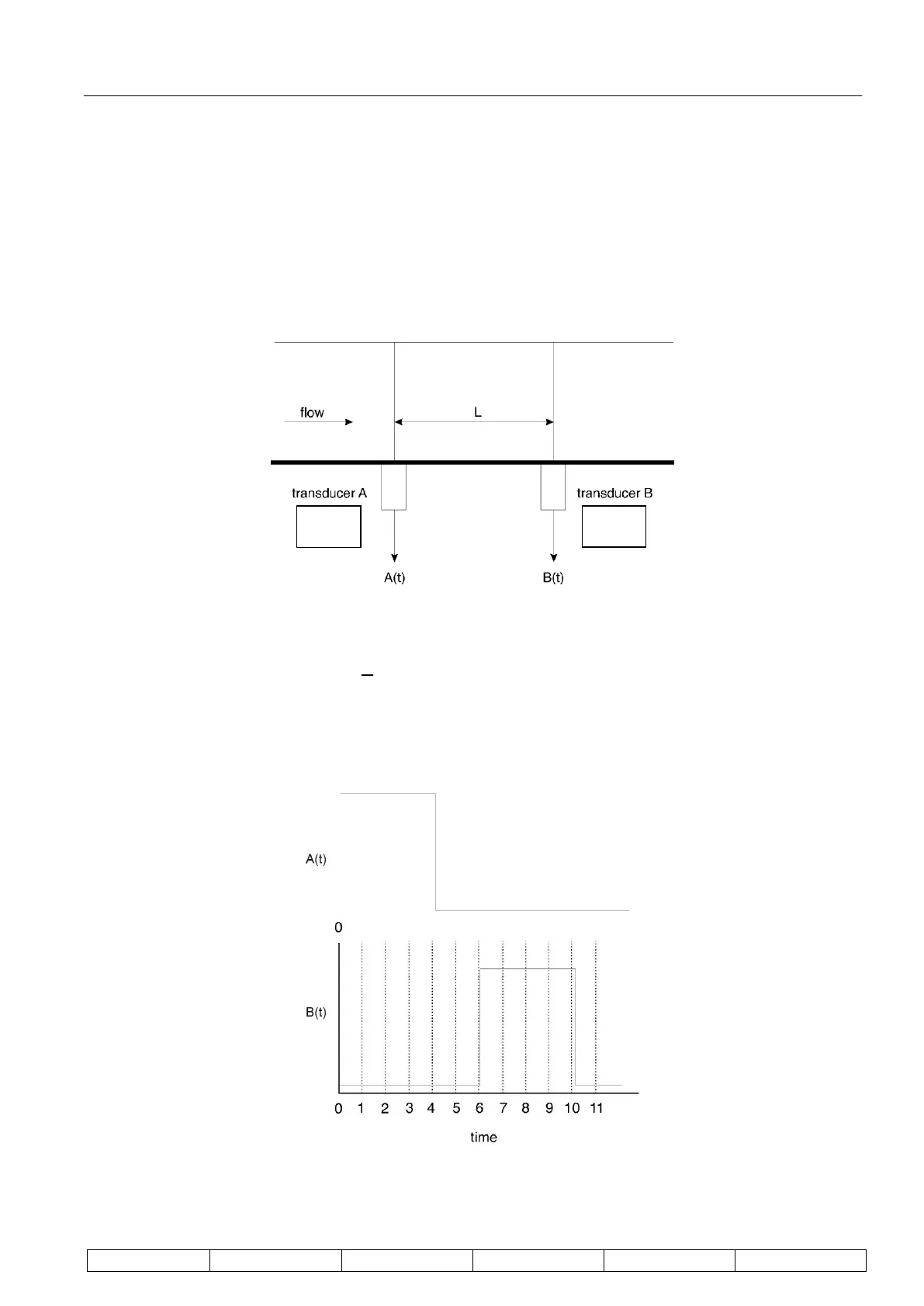
two signals from the infrared transducer units are defined as A(t) and B(t) as shown below.
The time-of-flight (and hence the flow velocity) of the naturally occurring turbulent eddies within the flow stream
can be determined by cross-correlating the two signals as shown in the following equation:
R
BA
LIM.T
1
T
B t
0
T
A t
dt
where is a variable time delay imposed on the signal A(t). Using this function a correlogram can be computed
which has a maximum when the time-of-flight and ‘t’ are equal. This can best be explained by considering the
two signals A(t) and B(t) as shown below.


 To Next Page