Operation Manual P750/P1500/P3000
Cold Jet, LLC Page 10
General Information
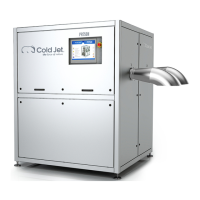
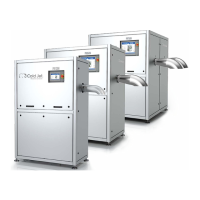
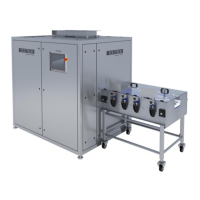
Introducing the P1500/P3000
• The Cold Jet P1500/P3000 is an industrial strength dry ice extruder designed to force
CO
2
snow into pellets and/or nuggets of variable size.
• The P1500/P3000 produces pellets for dry ice blasting, produce nuggets for
preservation of perishable items and other applications.
• The P1500/P3000 requires 3-phase AC power and a liquid CO
2
tank for operation. See
the data plate on the machine for the voltage, current, and frequency specifications.
• The P1500/P3000 can be fitted with a series of die plates to vary the diameter of the
dry ice pellets and an ice cutting extension to cut the pellets to precise lengths.
• The P1500/P3000 contains an innovative injection and extrusion system to produce the
highest density and longest lasting pellets in the industry.
• The pellets are produced by injecting liquid CO
2
into the Pelletizer extrusion cylinder
where a solid CO
2
is formed.
• A ram presses the solid CO
2
through the die plate to form pellets or nuggets.
• The P1500 is able to produce up to 1200 lb/hr (590 kg/hr) of dry ice pellets. The P3000
is able to produce up to 2400 lb/hr (1090.9 kg/hr) of dry ice pellets.
• The pellets must be stored in the proper containers to minimize sublimation (returning
to a gaseous state).
Before you Begin
CO
2
Quality Requirements
• Standard “Food Quality” liquid CO
2
is required.
• Moisture content must be between 1 ppm and 10 ppm.
• Regularly inspect all tanks for moisture or petroleum contamination.
Pressure Requirements for the Liquid CO
2
Supply
• The Liquid CO
2
supply must be selected and maintained at a constant pressure
between 210 to 290 psig (14.5 to 19.99 bar) with a variance of +/-10 psig (+/-.69 bar).
• If the supply pressure varies by more than +/-10 psig (+/-.69 bar), Cold Jet will not be
held responsible for lost production.
Liquid CO
2
Insulation Requirements
• CO
2
vaporization in the supply lines, caused by poor insulation, will reduce Pelletizer
output.
• 0-50 ft (0-15 m) - use Rubatex (or its equivalent) with minimum thickness of half the
pipe’s diameter.
• 50-100 ft (15-30 m) - use at least 6 in. (152 mm) urethane foam with a hard plastic
outer shell (or its equivalent).



 To Next Page