Basic Information
15
C2500CB-OM-EN-16
2.2 General
This truck is designed for use in ambient temperatures ranging from -40°C (-40°F) to
+40°C (+104°F) if the correct hydraulic oils and greases are used. For operation
outside these temperatures, please consult the manufacturer as special modifications
and lubricants are required.
Standard trucks must not be operated in flammable areas, corrosive atmospheres, or
in areas containing a high degree of dust contamination. Only trucks specifically
designed or modified to suit these conditions can enter such areas.
The safe maximum load capacities of the truck with relation to the load centre and fork
height, which MUST NOT BE EXCEEDED, are stated on the capacity plate.
The truck must be operated strictly in accordance with the operating instructions
provided in this manual in conjunction with the safety regulations of the country in
which the forklift truck is being operated.
2.3 Vehicle Description
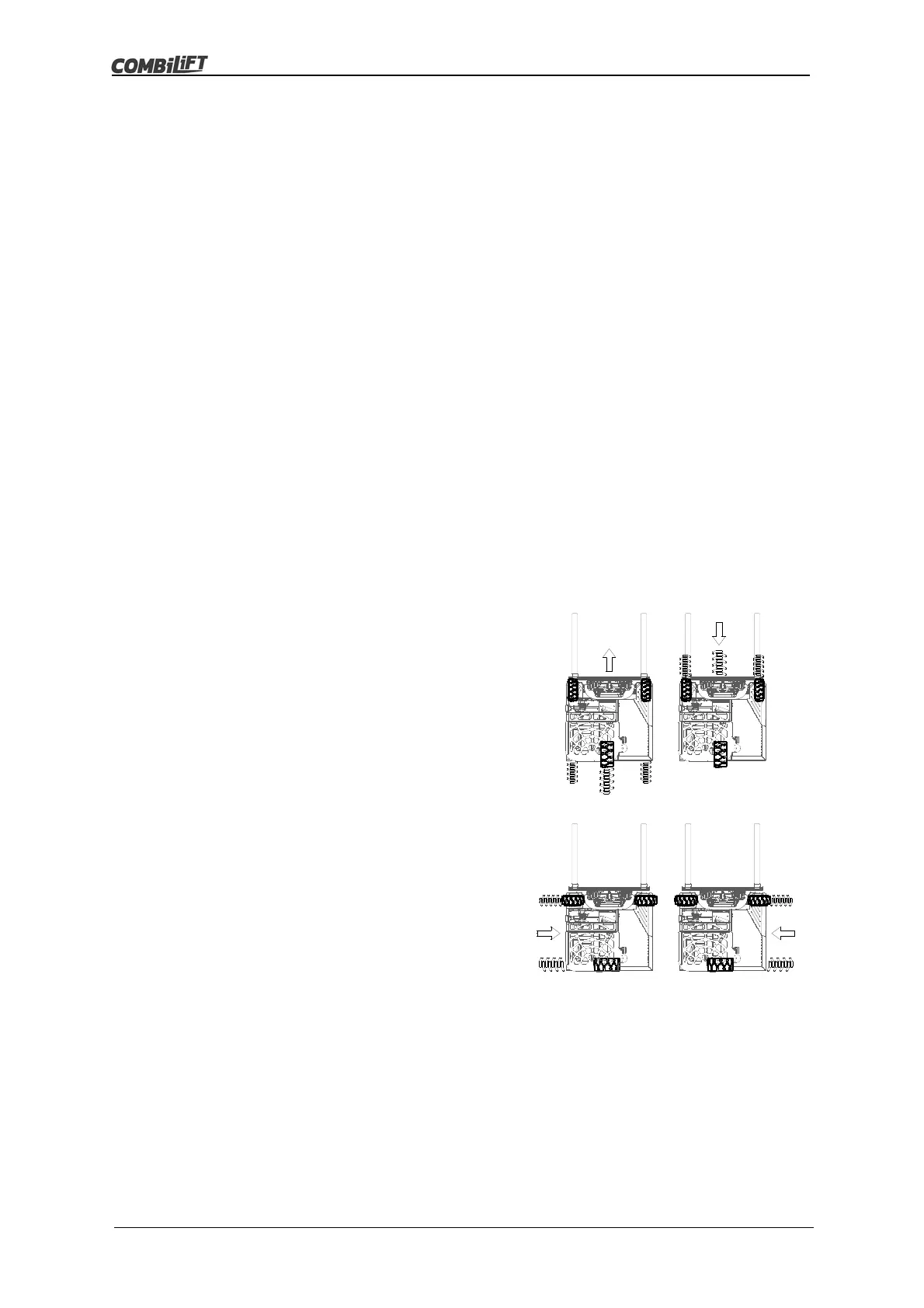
The Combilift is a multifunctional, multidirectional forklift with four directions of travel
– Forward, Reverse, Left & Right. In order for these travel directions to be possible
the Combilift has 2 modes of travel, standard mode and sideward mode.
Standard Mode – In Standard Mode all wheels
are aligned parallel to the forks. In this mode the
rear wheel steers the truck. It is in this mode that
forward travel and reverse travel can take place.
Forward Travel is traveling with the forks
leading. Reverse Travel is traveling with the
forks trailing.
Sideward Mode – In sideward mode all wheels
are aligned perpendicular to the forks. Steering
is accomplished by the two front wheels. In this
mode Left Travel and Right Travel can take
place. Left Travel refers to travel with the
operators compartment leading. Right Travel
refers to travel with operators compartment
trailing.
Having the ability to drive forward, back, left and right makes the Combilift truck
capable of performing like a standard counterbalance forklift truck, a reach truck and
a side loading truck safely and efficiently. Thus it is ideal for handling palletised loads
and also long loads such as pipes or timber.
The principle of this type of truck is that the weight of the load, which is lifted on the
forks in front of the load wheels, is offset by the combined weight of the truck chassis
and components.



 To Next Page