EasyManua.ls Logo

Commodore 1541-II - Chapter 2 Diskettes; What Is a Diskette; Position for Diskette Insertion

Commodore 1541-II
104 pages
Print Icon
To Next Page IconTo Next Page
To Previous Page IconTo Previous Page
Loading...
CHAPTER
2
DISKETTES
WHAT
IS
A
DISKETTE?
Before
we
actually
begin
using
the
drive,
let's
take
a
moment
to
look
at
the
Test/Demo
diskette
packed
with
the
disk
drive.
To
do
this,
grasp
it
by
the
label,
which
should
be
sticking
out
of
the
paper
jacket.
Then
pull
it
out
of
the
jacket
which
keeps
it
free
of
dust
and
other
contaminants.
(Save
the
jacket;
the
diskette
should
always
be
kept
in
its
jacket
except
when
actually
in
use
in
the
disk
drive.)
It
is
often
called
a
floppy
diskette,
because
it
is
flexible,
even
though
it
is
not
safe
to
bend
diskettes.
A
diskette
is
much
like
a
cassette
tape,
but
in
the
form
of
a
circle
and
enclosed
within
a
protective
square
plastic
cover.
As
on
a
cassette
tape,
only
a
small
exposed
portion
of
the
magnetic
recording
surface
is
sensitive.
You
may
touch
the
rest
of
the
diskette
any
time
you
like,
but
avoid
touching
the
few
small
portions
that
are
not
covered
by
the
protective
cover.
Also,
never
try
to
remove
this
cover.
Unlike
the
paper
jacket,
the
plastic
diskette
cover
is
intended
to
remain
on
permanently.
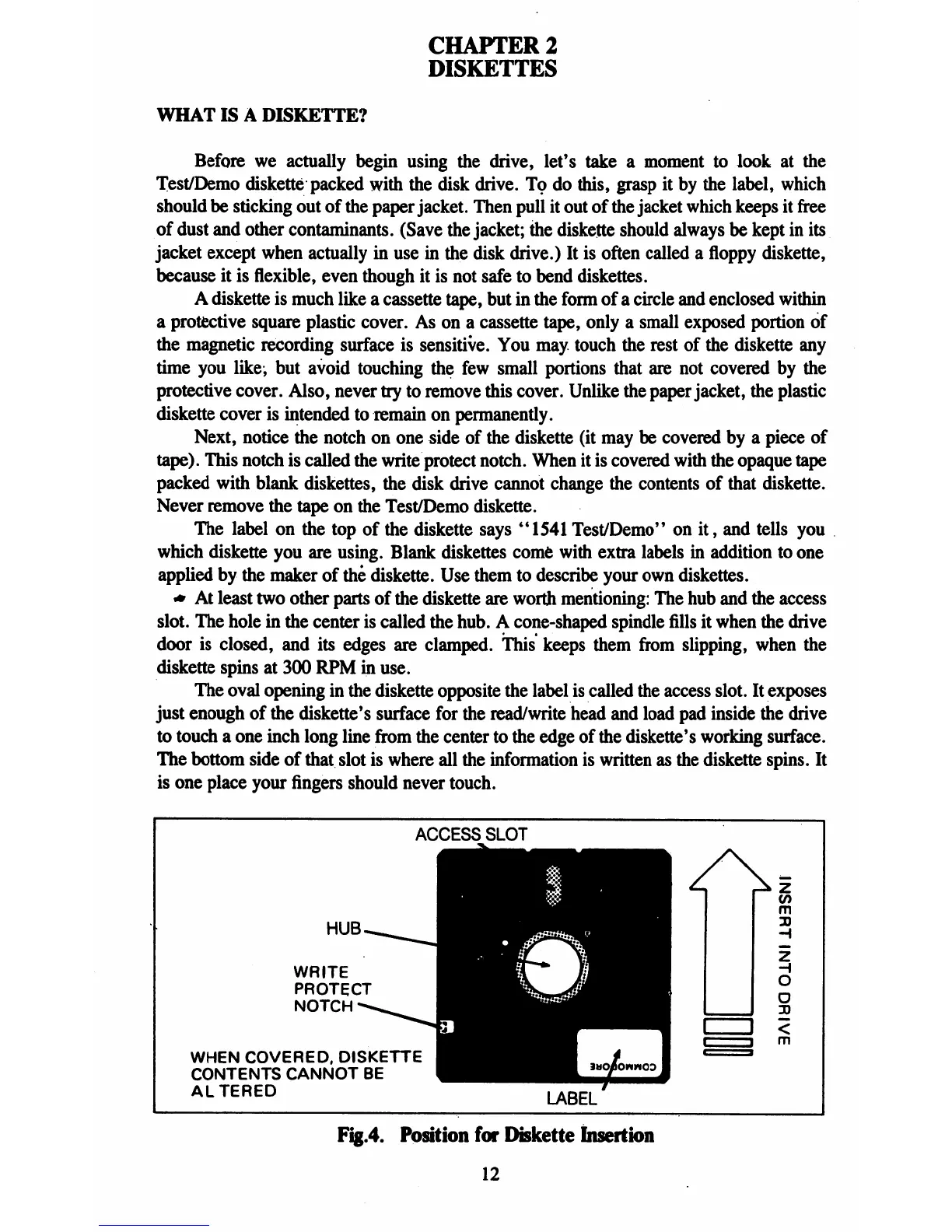
Next,
notice
the
notch
on
one
side
of
the
diskette
(it
may
be
covered
by
a
piece
of
tape).
This
notch
is
called
the
write
protect
notch.
When
it
is
covered
with
the
opaque
tape
packed
with
blank
diskettes,
the
disk
drive
cannot
change
the
contents
of
that
diskette.
Never
remove
the
tape
on
the
Test/Demo
diskette.
The
label
on
the
top
of
the
diskette
says
"1541
Test/Demo"
on
it,
and
tells
you
which
diskette
you
are
using.
Blank
diskettes
come
with
extra
labels
in
addition
to
one
applied
by
the
maker
of
the
diskette.
Use
them
to
describe
your
own
diskettes.
<*
At
least
two
other
parts
of
the
diskette
are
worth
mentioning:
The
hub
and
the
access
slot.
The
hole
in
the
center
is
called
the
hub.
A
cone-shaped
spindle
fills
it
when
the
drive
door
is
closed,
and
its
edges
are
clamped.
This
keeps
them
from
slipping,
when
the
diskette
spins
at
300
RPM
in
use.
The
oval
opening
in
the
diskette
opposite
the
label
is
called
the
access
slot.
It
exposes
just
enough
of
the
diskette's
surface
for
the
read/write
head
and
load
pad
inside
the drive
to
touch
a
one
inch
long
line
from
the center
to
the
edge
of
the
diskette's
working
surface.
The
bottom
side
of
that
slot
is
where
all
the
information
is
written
as
the
diskette
spins.
It
is
one
place
your
fingers
should
never
touch.
ACCESS
SLOT
HUB
WRITE
PROTECT
NOTCH
WHEN
COVERED,
DISKETTE
CONTENTS
CANNOT
BE
ALTERED
LABEL
Fig.4.
Position
for
Diskette
Insertion
12

Table of Contents

Related product manuals