EasyManua.ls Logo

Commodore 1541-II - Page 35

Commodore 1541-II
104 pages
Print Icon
To Next Page IconTo Next Page
To Previous Page IconTo Previous Page
Loading...
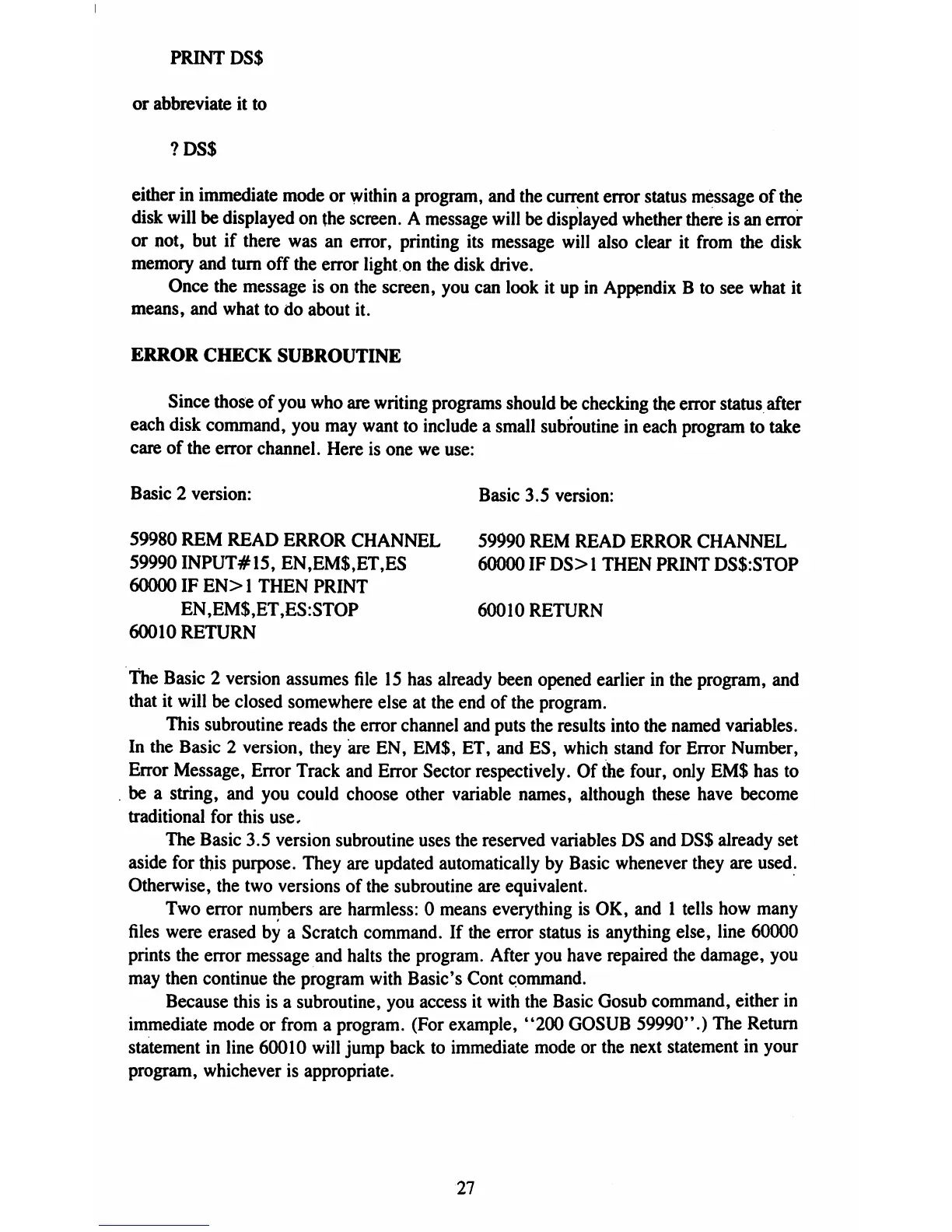
PRINT DS$
or
abbreviate
it
to
?DS$
either
in
immediate
mode
or
within
a
program,
and
the
current
error
status
message
of
the
disk
will
be
displayed
on
the
screen.
A
message
will
be
displayed
whether
there
is
an
error
or
not,
but
if
there
was
an
error,
printing
its
message
will
also
clear
it
from
the
disk
memory
and
turn
off
the
error
light
on
the
disk
drive.
Once
the
message
is
on
the
screen,
you
can
look
it
up
in
Appendix
B
to
see
what
it
means,
and
what
to
do
about
it.
ERROR
CHECK
SUBROUTINE
Since
those
of
you
who
are
writing
programs
should
be
checking
the
error
status
after
each
disk
command,
you
may
want
to
include
a
small
subroutine
in
each
program
to
take
care
of
the
error
channel.
Here
is
one
we
use:
Basic
2
version:
Basic
3.5
version:
59980
REM
READ
ERROR
CHANNEL
59990
REM
READ
ERROR
CHANNEL
59990
INPUT#15,
EN,EM$,ET,ES
60000
IF
DS>1
THEN
PRINT
DS$:STOP
60000
IF
EN>
1
THEN
PRINT
EN,EM$,ET,ES:STOP
60010
RETURN
60010
RETURN
The
Basic
2
version
assumes
file
15
has
already
been
opened
earlier
in
the
program,
and
that
it
will
be
closed
somewhere
else
at
the
end
of
the
program.
This
subroutine
reads
the
error
channel
and
puts
the
results
into
the
named
variables.
In
the
Basic
2
version,
they
are
EN,
EMS,
ET,
and
ES,
which
stand
for
Error
Number,
Error
Message,
Error
Track
and
Error
Sector
respectively.
Of
the
four,
only
EM$
has
to
be
a
string,
and
you
could
choose
other
variable
names,
although
these
have
become
traditional
for
this
use.
The
Basic
3.5
version
subroutine
uses
the
reserved
variables
DS
and
DS$
already
set
aside
for
this
purpose.
They
are
updated
automatically
by
Basic
whenever
they
are
used.
Otherwise,
the
two
versions
of
the
subroutine
are
equivalent.
Two
error
numbers
are
harmless:
0
means
everything
is
OK,
and
1
tells
how
many
files
were
erased
by
a
Scratch
command.
If
the
error
status
is
anything
else,
line
60000
prints
the
error
message
and
halts
the
program.
After
you
have
repaired
the
damage,
you
may
then
continue
the
program
with
Basic's
Cont
command.
Because
this
is
a
subroutine,
you
access
it
with
the
Basic
Gosub
command,
either
in
immediate
mode
or
from
a
program.
(For
example,
"200
GOSUB
59990".)
The
Return
statement
in
line
60010
will
jump
back
to
immediate
mode
or
the
next
statement
in
your
program,
whichever
is
appropriate.
27

Table of Contents

Related product manuals