EasyManua.ls Logo

Commodore 1541-II - Page 47

Commodore 1541-II
104 pages
Print Icon
To Next Page IconTo Next Page
To Previous Page IconTo Previous Page
Loading...
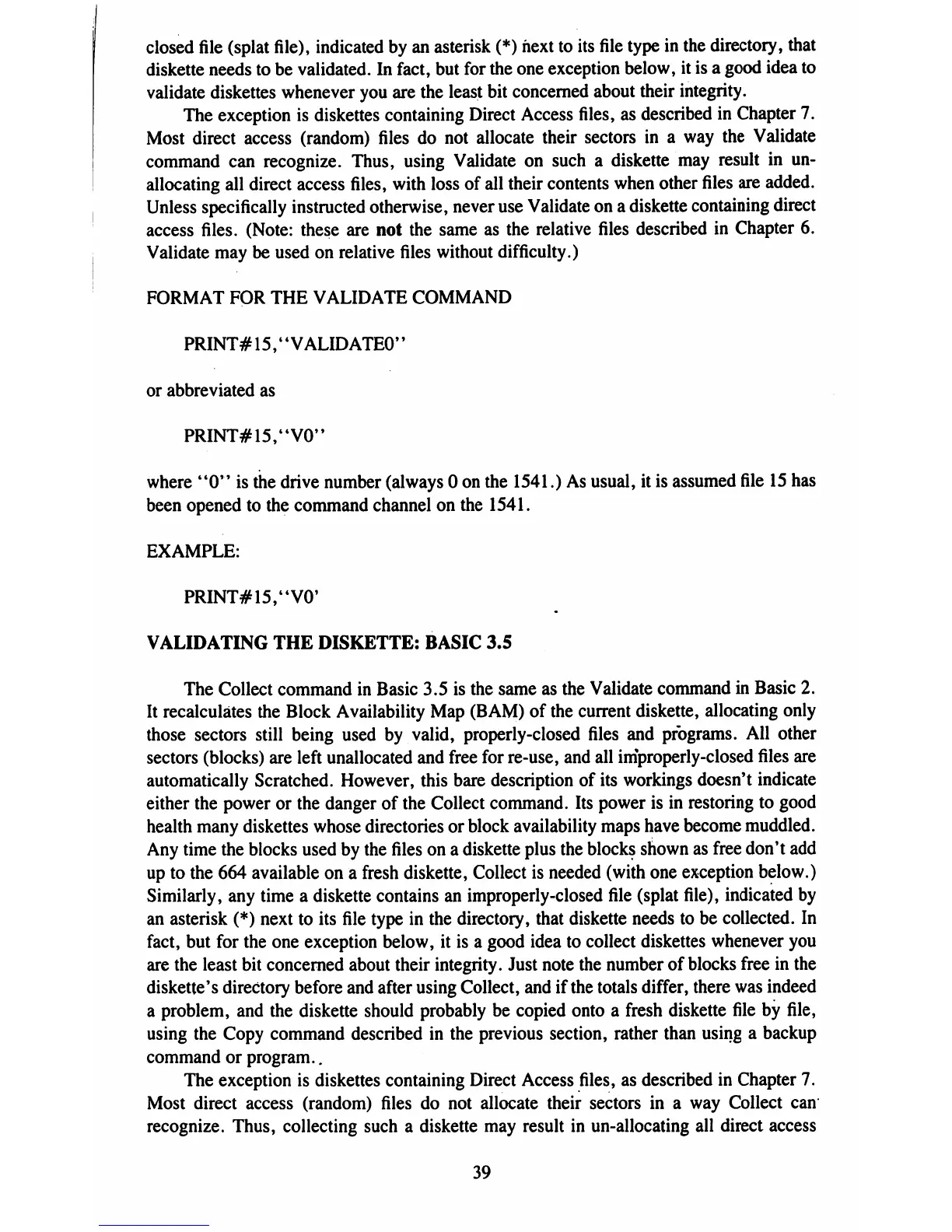
closed
file
(splat
file),
indicated
by
an
asterisk
(*)
next
to
its
file
type
in
the
directory,
that
diskette
needs
to
be
validated.
In
fact,
but
for
the
one
exception
below,
it
is
a
good
idea
to
validate
diskettes
whenever
you
are the
least
bit
concerned
about
their
integrity.
The
exception
is
diskettes
containing
Direct
Access
files,
as
described
in
Chapter
7.
Most
direct
access
(random)
files
do
not
allocate
their
sectors
in
a
way
the
Validate
command
can
recognize.
Thus,
using
Validate
on
such
a
diskette
may
result
in
un-
allocating
all
direct
access
files,
with
loss
of
all
their
contents
when
other
files
are
added.
Unless
specifically
instructed
otherwise,
never
use
Validate
on
a
diskette
containing
direct
access
files.
(Note:
these
are
not
the
same
as
the
relative
files
described
in
Chapter
6.
Validate
may
be
used
on
relative
files
without
difficulty.)
FORMAT
FOR
THE
VALIDATE
COMMAND
PRINT#15,"VALIDATE*)"
or
abbreviated
as
PRINT#15,"V0"
where
"0"
is
the
drive
number
(always
0
on
the
1541.)
As
usual,
it
is
assumed
file
15
has
been
opened
to
the
command
channel
on
the
1541.
EXAMPLE:
PRINT#15,"V0'
VALIDATING
THE
DISKETTE:
BASIC
3.5
The
Collect
command
in
Basic
3.5
is
the
same
as the
Validate
command
in
Basic
2.
It
recalculates
the
Block
Availability
Map
(BAM)
of
the
current
diskette,
allocating
only
those
sectors
still
being
used
by
valid,
properly-closed
files
and
programs.
All
other
sectors
(blocks)
are
left
unallocated
and
free
for
re-use,
and
all
improperly-closed
files
are
automatically
Scratched.
However,
this
bare
description
of
its
workings
doesn't
indicate
either
the
power
or
the
danger
of
the
Collect
command.
Its
power
is
in
restoring
to
good
health
many
diskettes
whose
directories
or
block
availability
maps
have
become
muddled.
Any
time
the
blocks
used
by
the
files
on
a
diskette
plus
the
blocks
shown
as
free
don't
add
up
to
the
664
available
on
a
fresh
diskette,
Collect
is
needed
(with
one
exception
below.)
Similarly,
any
time
a
diskette
contains
an
improperly-closed
file
(splat
file),
indicated
by
an
asterisk
(*)
next
to
its
file
type
in
the
directory,
that
diskette
needs
to
be
collected. In
fact,
but
for
the
one
exception
below,
it
is
a
good
idea
to
collect
diskettes
whenever
you
are
the
least
bit
concerned
about
their
integrity.
Just
note
the
number
of
blocks
free
in
the
diskette's
directory
before
and
after
using
Collect,
and
if
the
totals
differ,
there
was
indeed
a
problem,
and
the
diskette
should
probably
be
copied
onto
a
fresh
diskette
file
by
file,
using
the
Copy
command
described
in
the
previous
section,
rather
than
using
a
backup
command
or
program..
The
exception
is
diskettes
containing
Direct
Access
files,
as
described
in
Chapter
7.
Most
direct
access
(random)
files
do
not
allocate
their
sectors
in
a
way
Collect
can
recognize.
Thus,
collecting
such
a
diskette
may
result
in
un-allocating
all
direct
access
39

Table of Contents

Related product manuals