EasyManua.ls Logo

Commodore 1541-II - Page 51

Commodore 1541-II
104 pages
Print Icon
To Next Page IconTo Next Page
To Previous Page IconTo Previous Page
Loading...
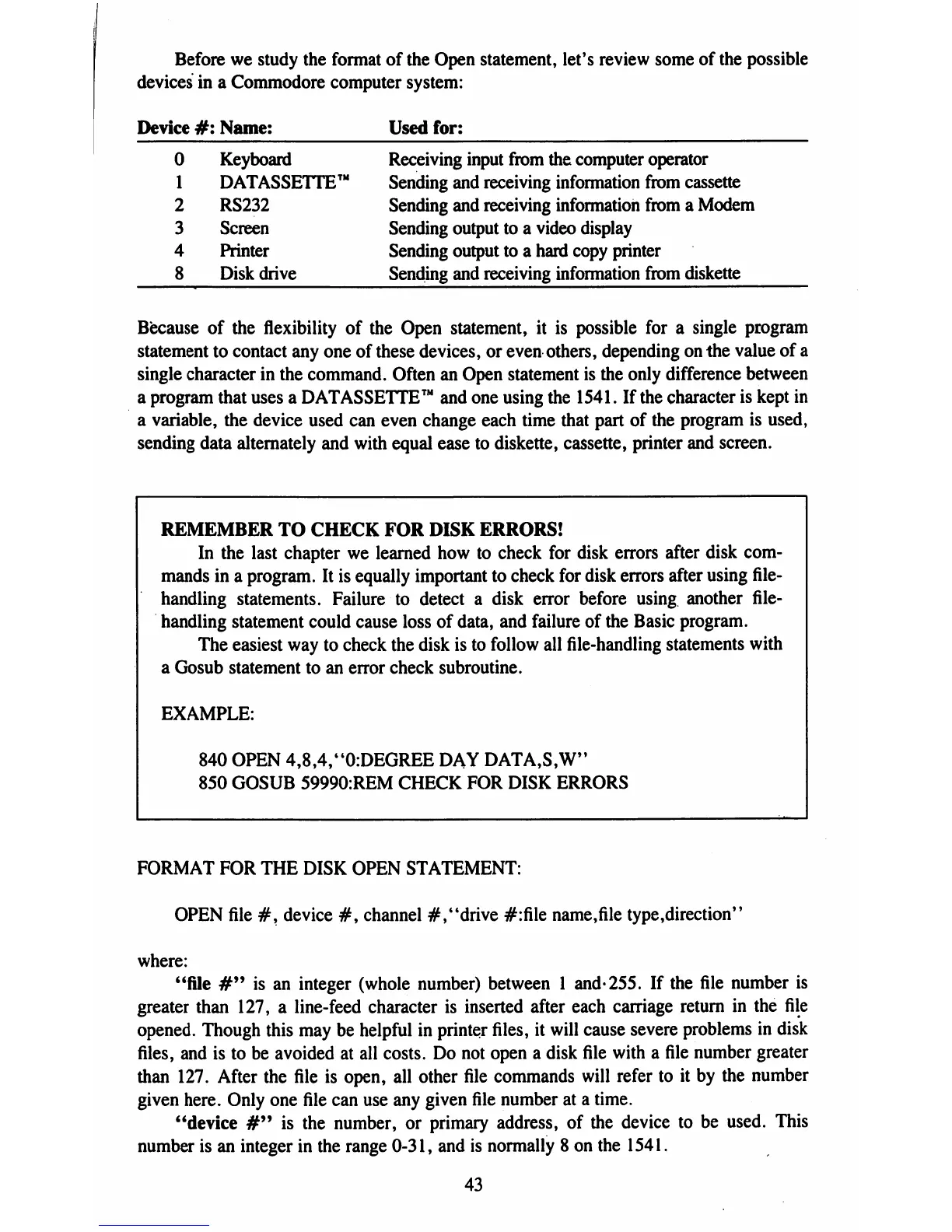
Before
we
study
the
format
of
the
Open
statement,
let's
review
some
of
the
possible
devices
in
a
Commodore
computer
system:
Device
#:
Name:
0
1
2
3
4
8
Keyboard
DATASSETTE
RS232
Screen
Printer
Disk
drive
Used
for:
Receiving
input
from
the
computer
operator
Sending
and
receiving
information
from
cassette
Sending
and
receiving
information
from
a
Modem
Sending
output
to
a
video
display
Sending
output
to
a
hard
copy
printer
Sending
and
receiving
information
from
diskette
Because
of
the
flexibility
of
the
Open
statement,
it
is
possible
for
a
single
program
statement
to
contact
any
one
of
these
devices,
or
even
others,
depending
on
the
value
of
a
single
character
in
the
command.
Often
an
Open
statement
is
the
only
difference
between
a
program
that
uses
a
DATASSETTEā„¢
and
one
using
the
1541.
If
the
character
is
kept
in
a
variable,
the
device
used
can
even
change
each
time
that
part
of
the
program
is
used,
sending
data
alternately
and
with
equal
ease
to
diskette,
cassette,
printer
and
screen.
REMEMBER
TO
CHECK
FOR
DISK
ERRORS!
In
the
last
chapter
we
learned
how
to
check
for
disk
errors
after
disk
com
mands
in
a
program.
It
is
equally
important
to
check
for
disk
errors
after
using
file-
handling
statements.
Failure
to
detect
a
disk
error
before
using
another
file-
handling
statement
could
cause
loss
of
data,
and
failure
of
the
Basic
program.
The
easiest
way
to
check
the
disk
is
to
follow
all
file-handling
statements
with
a
Gosub
statement
to
an
error
check
subroutine.
EXAMPLE:
840
OPEN
4,8,4,"0:DEGREE
DAY
DATA,S,W"
850
GOSUB
59990:REM
CHECK
FOR
DISK
ERRORS
FORMAT
FOR
THE
DISK
OPEN
STATEMENT:
OPEN
file
#,
device
#,
channel
#,"drive
#:file
name,file
type,direction"
where:
"file
#"
is
an
integer
(whole
number)
between
1
and-255.
If
the
file
number
is
greater
than
127,
a
line-feed
character
is
inserted
after
each
carriage
return
in
the
file
opened.
Though
this
may
be
helpful
in
printer
files,
it
will
cause
severe
problems
in
disk
files,
and
is
to
be
avoided
at
all
costs.
Do
not
open
a
disk
file
with
a
file
number
greater
than
127.
After
the
file
is
open,
all
other
file
commands
will
refer
to
it
by
the
number
given
here.
Only
one
file
can
use
any
given
file
number
at
a
time.
"device
#"
is
the
number,
or
primary
address,
of
the
device
to
be
used.
This
number
is
an
integer
in
the
range
0-31,
and
is
normally
8
on
the
1541.
43

Table of Contents

Related product manuals