EasyManua.ls Logo

Commodore 1541-II - Appendix B: DOS Error Messages and Causes; Common DOS Error Codes and Troubleshooting

Commodore 1541-II
104 pages
Print Icon
To Next Page IconTo Next Page
To Previous Page IconTo Previous Page
Loading...
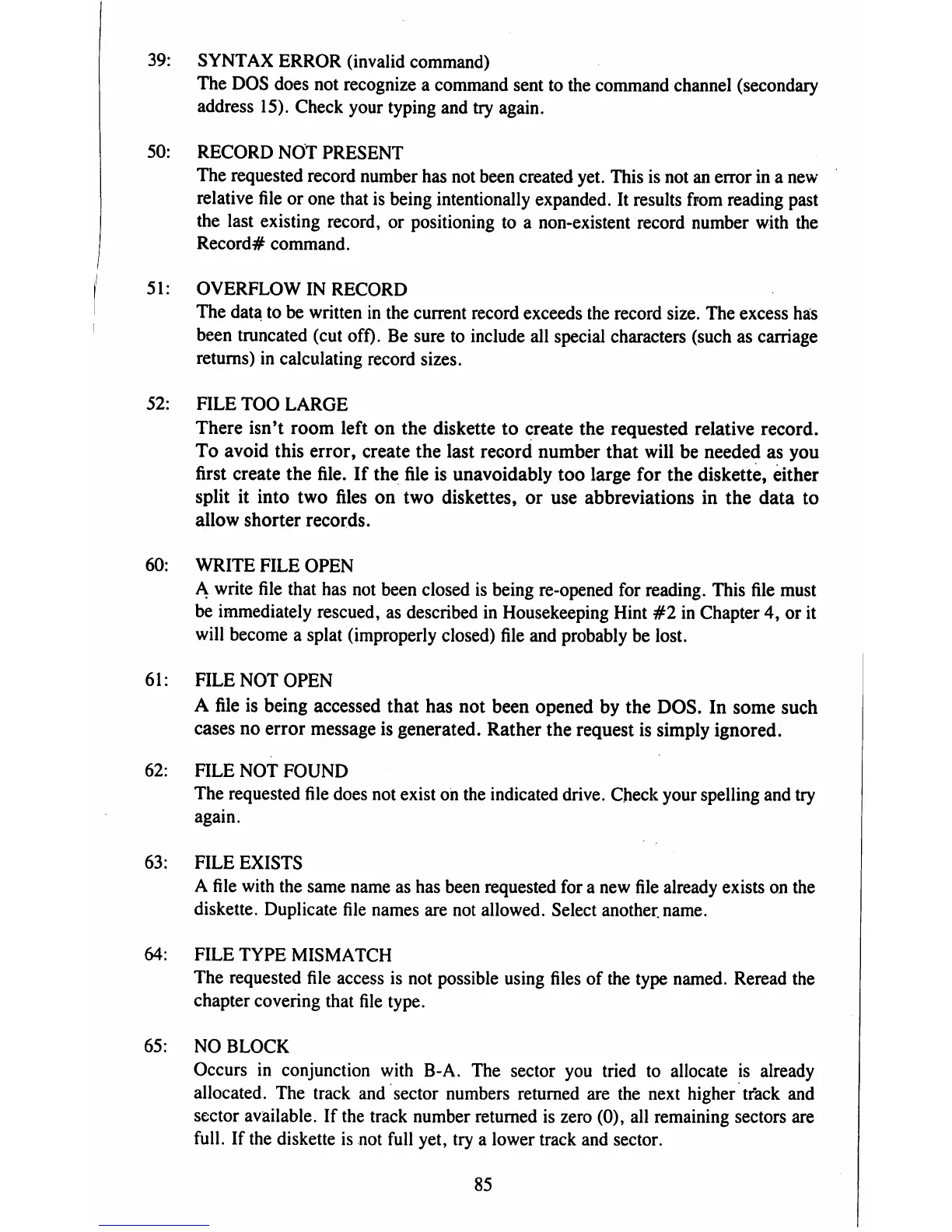
39:
SYNTAX
ERROR
(invalid
command)
The
DOS
does
not
recognize
a
command
sent
to
the
command
channel
(secondary
address
15).
Check
your
typing
and
try
again.
50:
RECORD
NOT
PRESENT
The
requested
record
number
has
not
been
created
yet.
This
is
not
an
error
in
a
new
relative
file
or
one
that
is
being
intentionally
expanded.
It
results
from
reading
past
the
last
existing
record,
or
positioning
to
a
non-existent
record
number
with
the
Record#
command.
51:
OVERFLOW
IN
RECORD
The
data
to
be
written
in
the
current
record
exceeds
the
record
size.
The
excess
has
been
truncated
(cut
off).
Be
sure
to
include
all
special
characters
(such
as
carriage
returns)
in
calculating
record
sizes.
52:
FILE
TOO
LARGE
There
isn't
room
left
on
the
diskette
to
create
the
requested
relative
record.
To
avoid
this
error,
create
the
last
record
number
that
will
be
needed
as
you
first
create
the
file.
If
the
file
is
unavoidably
too
large
for
the
diskette,
either
split
it
into
two
files
on
two
diskettes,
or
use
abbreviations
in
the
data
to
allow
shorter
records.
60:
WRITE
FILE
OPEN
A
write
file
that
has
not
been
closed
is
being
re-opened
for
reading.
This
file
must
be
immediately
rescued,
as
described
in
Housekeeping
Hint
#2
in
Chapter
4,
or
it
will
become
a
splat
(improperly
closed)
file
and
probably
be
lost.
61:
FILE
NOT
OPEN
A
file
is
being
accessed
that
has
not
been
opened
by
the
DOS.
In
some
such
cases
no
error
message
is
generated.
Rather
the
request
is
simply
ignored.
62:
FILE
NOT
FOUND
The
requested
file
does
not
exist
on
the
indicated
drive.
Check
your
spelling
and
try
again.
63:
FILE
EXISTS
A
file
with
the
same
name
as
has
been
requested
for
a
new
file
already
exists
on
the
diskette.
Duplicate
file
names
are
not
allowed.
Select
another
name.
64:
FILE
TYPE
MISMATCH
The
requested
file
access
is
not
possible
using
files
of
the
type
named.
Reread
the
chapter
covering
that
file
type.
65:
NO
BLOCK
Occurs
in
conjunction
with
B-A.
The
sector
you
tried
to
allocate
is
already
allocated.
The
track
and
sector
numbers
returned
are
the
next higher
track
and
sector
available.
If
the
track
number
returned
is
zero
(0),
all
remaining
sectors
are
full.
If
the
diskette
is
not
full
yet,
try
a
lower
track
and
sector.
85

Table of Contents

Related product manuals