EasyManua.ls Logo

Commodore 1581 - Selective Directories

Commodore 1581
138 pages
Print Icon
To Next Page IconTo Next Page
To Previous Page IconTo Previous Page
Loading...
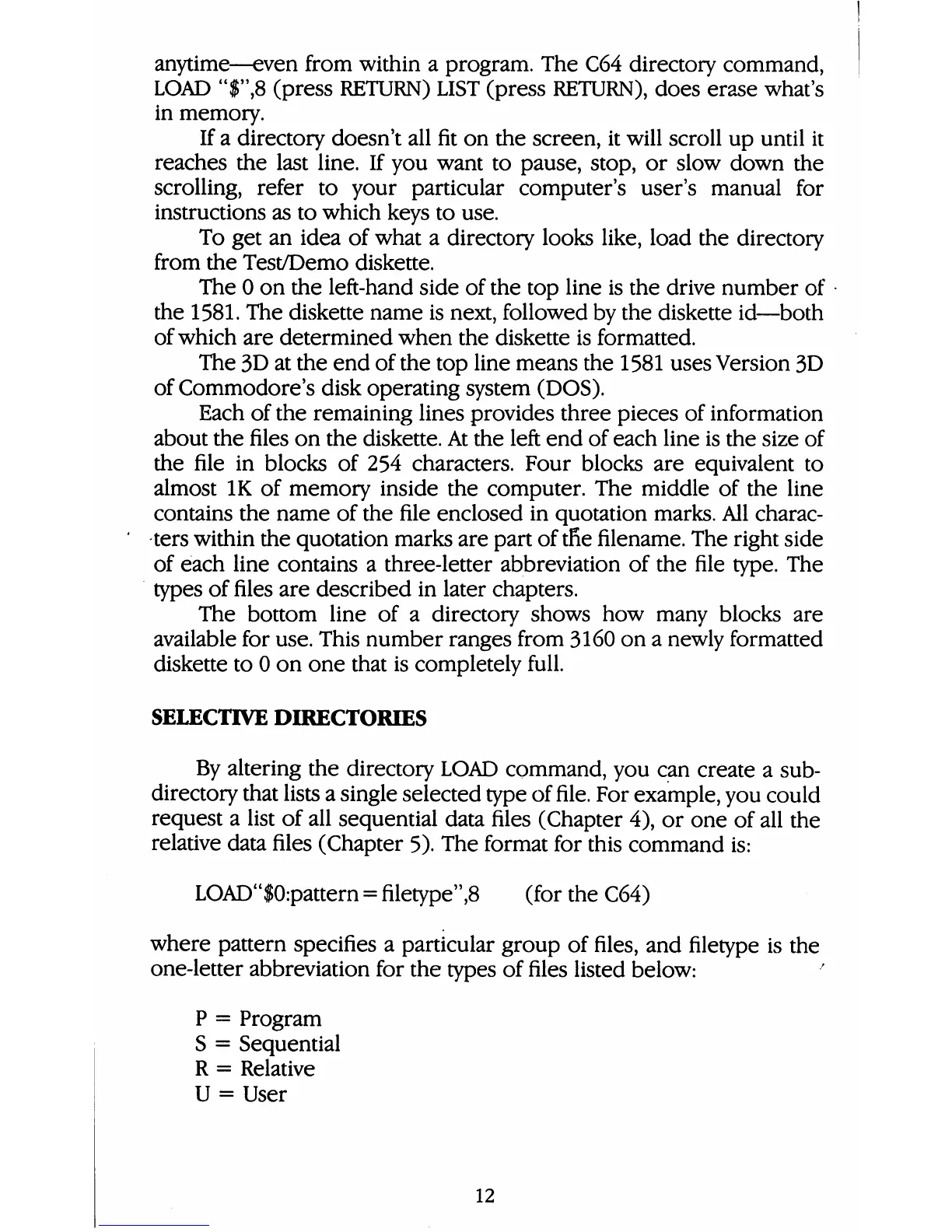
anytime—even
from
within
a
program.
The
C64
directory
command,
LOAD
"$",8
(press
RETURN)
LIST
(press
RETURN),
does
erase what's
in
memory.
If
a
directory
doesn't
all
fit
on
the
screen,
it
will
scroll
up
until
it
reaches
the
last
line.
If
you
want
to
pause,
stop,
or
slow
down
the
scrolling,
refer
to
your
particular
computer's
user's
manual
for
instructions
as
to
which
keys
to
use.
To
get
an
idea
of
what
a
directory
looks
like,
load
the
directory
from
the
Test/Demo
diskette.
The
0
on
the
left-hand
side
of
the
top
line
is
the
drive
number
of
the
1581.
The
diskette
name
is
next,
followed
by
the
diskette
id—both
of
which
are
determined
when
the
diskette
is
formatted.
The
3D
at
the
end
of
the
top
line
means
the
1581
uses
Version
3D
of
Commodore's
disk
operating
system
(DOS).
Each
of
the
remaining
lines
provides
three
pieces
of
information
about
the
files
on
the
diskette.
At
the
left
end
of
each
line
is
the
size
of
the
file
in
blocks of
254
characters.
Four
blocks
are
equivalent
to
almost
IK
of
memory
inside
the
computer.
The
middle
of
the
line
contains
the
name
of
the
file
enclosed
in
quotation
marks.
All
charac
ters
within
the
quotation
marks
are
part
of
tfie
filename.
The
right
side
of
each
line
contains
a
three-letter
abbreviation
of
the
file
type.
The
types
of
files
are
described
in
later
chapters.
The
bottom
line
of
a
directory
shows
how
many
blocks
are
available
for
use.
This
number
ranges
from
3160
on
a
newly
formatted
diskette
to
0
on
one
that
is
completely
full.
SELECTIVE
DIRECTORIES
By
altering
the
directory
LOAD
command,
you
can
create
a
sub
directory
that
lists
a
single
selected
type
of
file.
For
example,
you
could
request
a
list
of
all
sequential
data
files
(Chapter
4),
or
one
of
all
the
relative
data
files
(Chapter
5).
The
format
for
this
command
is:
LOAD"$0:pattern
=
filetype",8
(for
the
C64)
where
pattern
specifies
a
particular
group
of
files,
and
filetype
is
the
one-letter
abbreviation
for
the
types
of
files
listed
below:
P
=
Program
S
=
Sequential
R
=
Relative
U
=
User
12

Table of Contents

Other manuals for Commodore 1581

Related product manuals