EasyManua.ls Logo

Commodore 1581 - Freeing Blocks

Commodore 1581
138 pages
Print Icon
To Next Page IconTo Next Page
To Previous Page IconTo Previous Page
Loading...
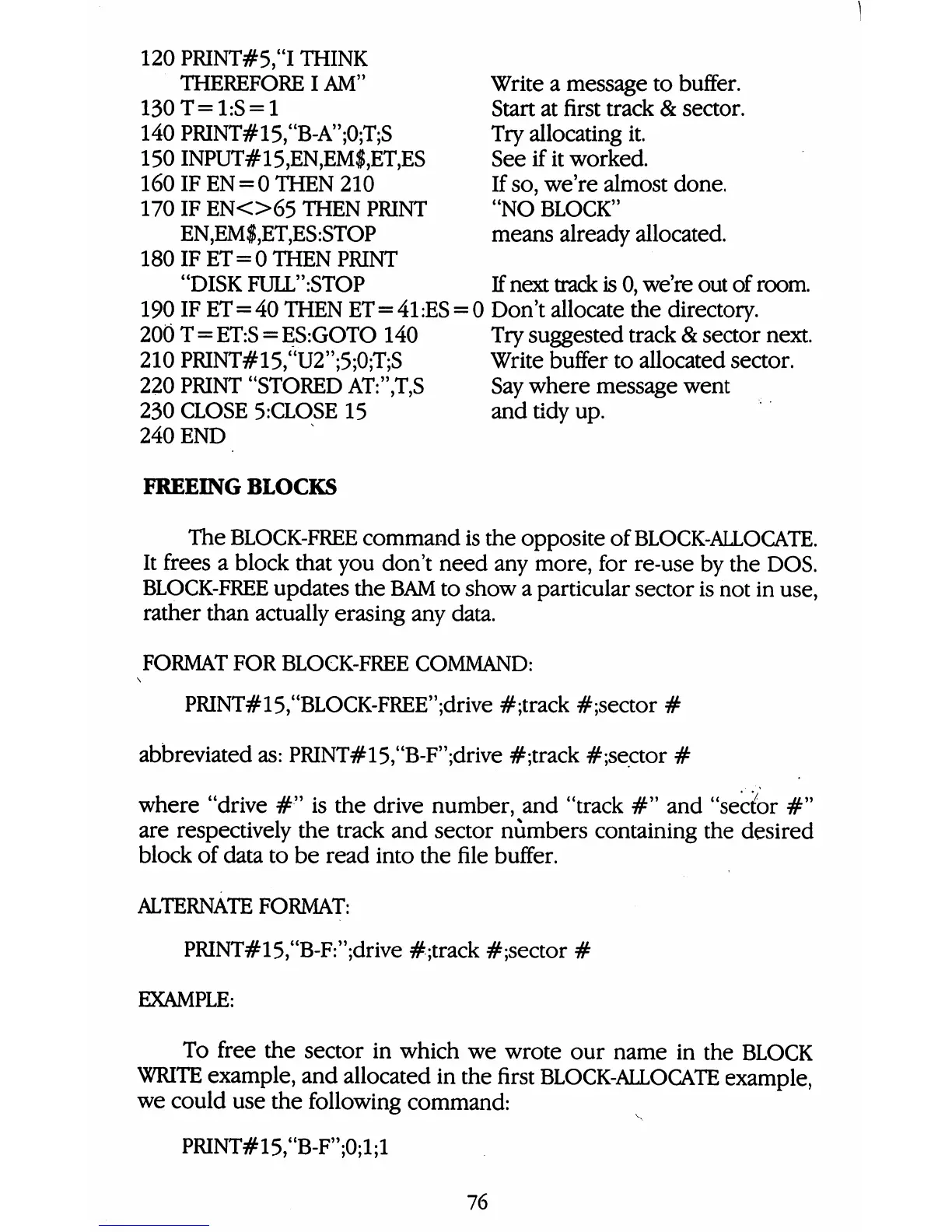
120
PRINT#5,"I
THINK
THEREFORE
I
AM"
Write
a
message
to
buffer.
130
T
=
1
:S
=
1
Start
at
first
track
&
sector.
140
PRINT#15,"B-A";0;T;S
Try
allocating
it.
150
INPUT#15,EN,EM$,ET,ES
See
if
it
worked.
160
IF
EN=0
THEN
210
If
so,
we're
almost
done.
170
IF
ENO65
THEN
PRINT
"NO
BLOCK"
EN,EM$,ET,ES:STOP
means
already
allocated.
180
IF
ET=0
THEN
PRINT
"DISK
FULL":STOP
If
next
track
is
0,
we're
out
of
room.
190
IF
ET=40
THEN
ET=4l:ES
=
0 Don't
allocate
the
directory.
200
T=ET:S
=
ES:GOTO
140 Try
suggested
track
&
sector
next.
210
PRINT#15,"U2";5;0;T;S
Write
buffer
to
allocated
sector.
220
PRINT
"STORED
AT:",T,S
Say
where
message
went
230
CLOSE
5:CLOSE
15
and
tidy
up.
240
END
FREEING
BLOCKS
The
BLOCK-FREE
command
is
the
opposite of
BLOCK-ALLOCATE.
It
frees
a
block
that
you
don't
need
any
more,
for
re-use
by
the
DOS.
BLOCK-FREE
updates
the
BAM
to
show
a
particular
sector
is
not
in
use,
rather
than
actually
erasing
any
data.
FORMAT
FOR
BLOCK-FREE
COMMAND:
PRINT#15,uBLOCK-FREE";drive
#;track
#;sector
#
abbreviated
as:
PRINT#15,"B-F";drive
#;track
#;sector
#
where
"drive
#"
is
the
drive
number,
and
"track
#"
and
"sector
#"
are
respectively
the
track
and
sector
numbers
containing
the
desired
block
of
data
to
be
read
into
the
file
buffer.
ALTERNATE
FORMAT:
PRINT#15,"B-F:'';drive
#;track
#;sector
#
EXAMPLE:
To
free
the
sector
in
which
we
wrote
our
name
in
the
BLOCK
WRITE
example,
and
allocated
in
the
first
BLOCK-ALLOCATE
example,
we
could
use
the
following
command:
PRINT#15/'B-F";0;l;l
76

Table of Contents

Other manuals for Commodore 1581

Related product manuals