EasyManua.ls Logo

Commodore 1581 - Chapter 4: Sequential Data Files

Commodore 1581
138 pages
Print Icon
To Next Page IconTo Next Page
To Previous Page IconTo Previous Page
Loading...
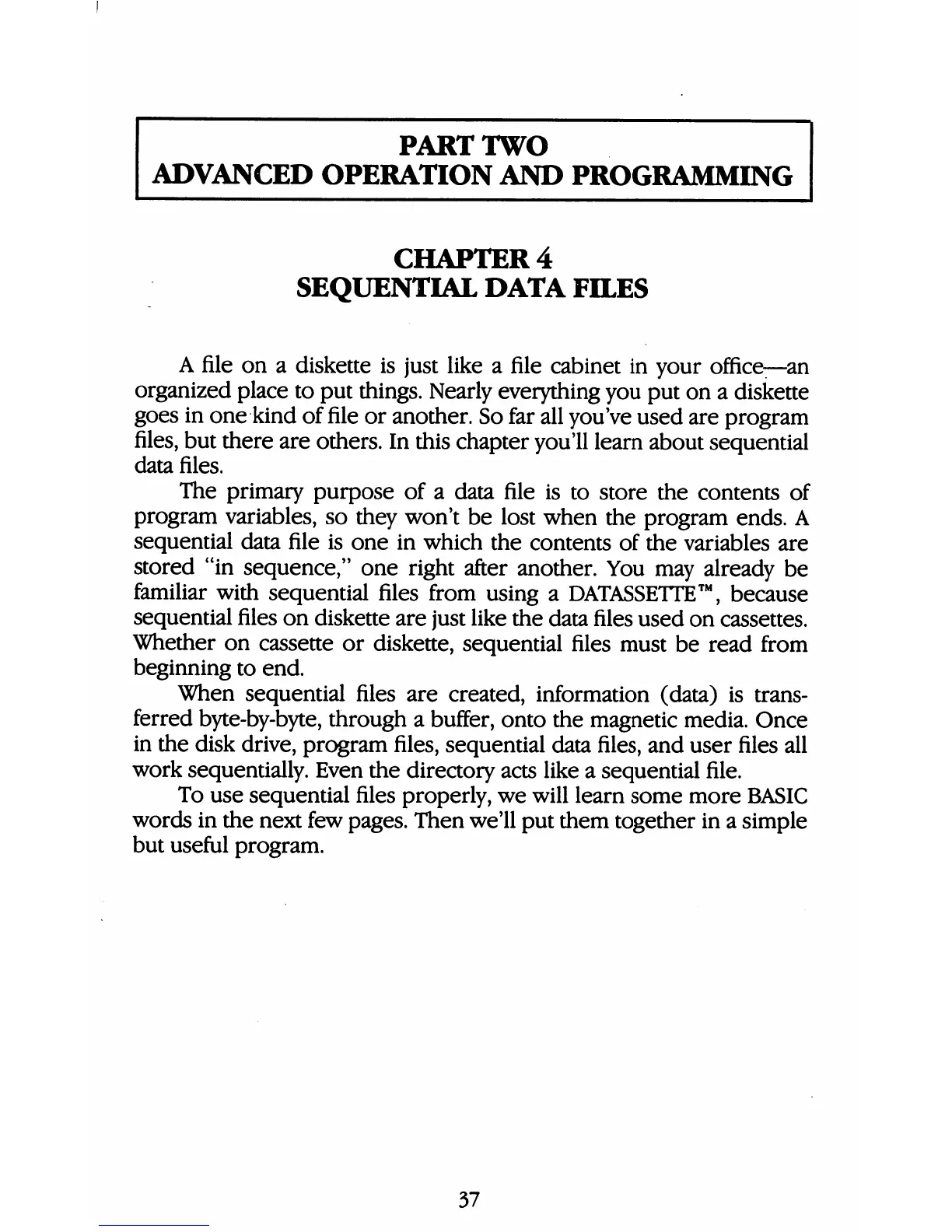
PART
TWO
ADVANCED
OPERATION
AND
PROGRAMMING
CHAPTER
4
SEQUENTIAL
DATA
FILES
A
file
on
a
diskette
is
just
like
a
file
cabinet
in
your
office^—an
organized
place
to
put
things.
Nearly
everything
you
put
on
a
diskette
goes
in
one
kind
of
file
or
another.
So
far
all
you've
used
are
program
files,
but
there
are
others.
In
this
chapter
you'll
learn
about
sequential
data
files.
The
primary
purpose
of
a
data
file
is
to
store
the
contents
of
program
variables,
so
they
won't
be
lost
when
the
program
ends.
A
sequential
data
file
is
one
in
which
the
contents
of
the
variables
are
stored
"in
sequence,"
one
right
after
another.
You
may
already
be
familiar
with
sequential
files
from
using
a
DATASSETTE™,
because
sequential
files
on
diskette
are
just
like
the
data
files
used
on
cassettes.
Whether
on
cassette
or
diskette,
sequential
files
must
be
read
from
beginning
to
end.
When
sequential
files
are
created,
information
(data)
is
trans
ferred
byte-by-byte,
through
a
buffer,
onto
the
magnetic
media.
Once
in
the disk
drive,
program
files,
sequential
data
files,
and
user
files
all
work
sequentially.
Even
the
directory
acts
like
a
sequential
file.
To
use
sequential
files
properly,
we
will
learn
some
more
BASIC
words
in
the
next
few
pages.
Then
we'll
put
them
together
in
a
simple
but
useful
program.
37

Table of Contents

Other manuals for Commodore 1581

Related product manuals