EasyManua.ls Logo

Commodore 1581 - More About INPUT#

Commodore 1581
138 pages
Print Icon
To Next Page IconTo Next Page
To Previous Page IconTo Previous Page
Loading...
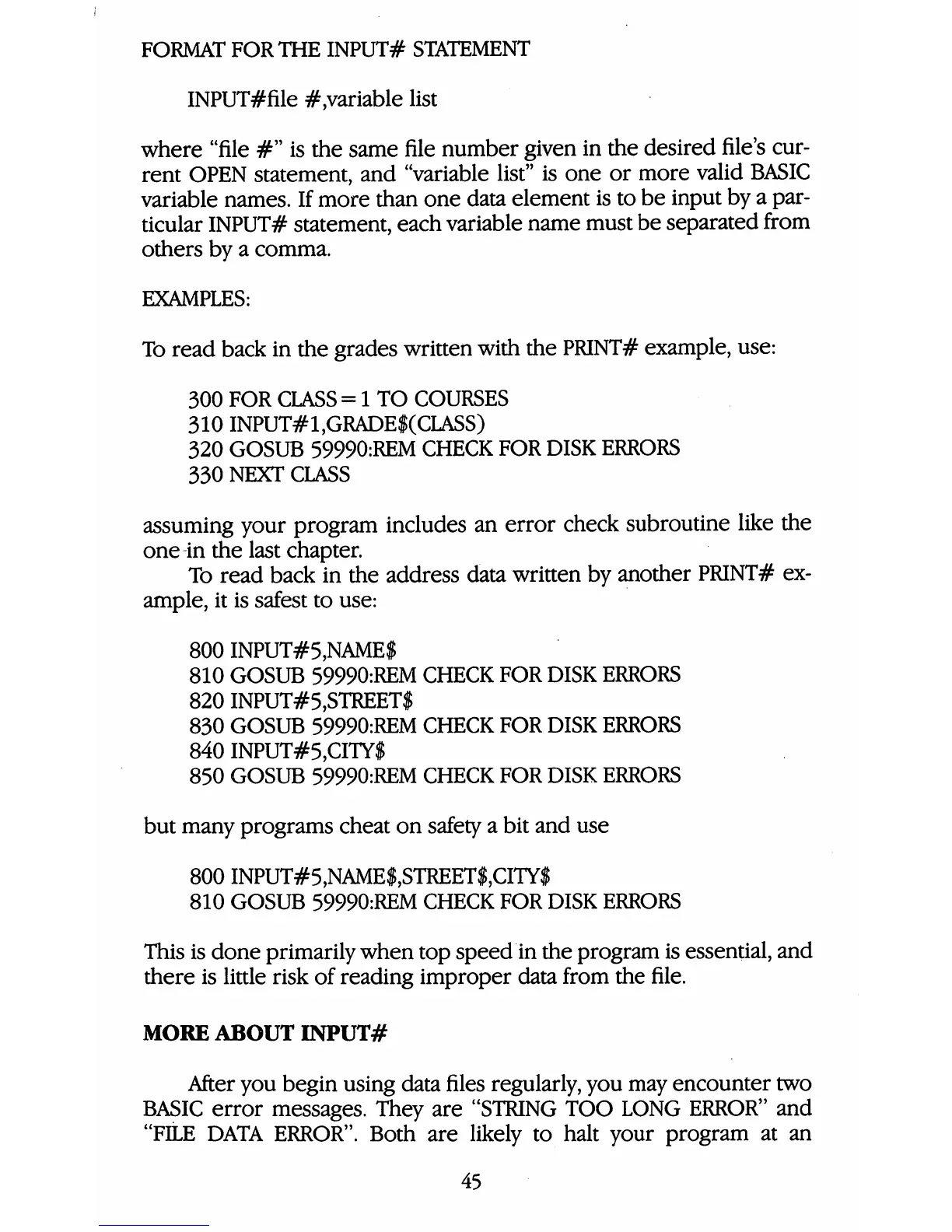
FORMAT
FOR
THE
INPUT#
STATEMENT
INPUT#file
#,variable
list
where
"file
#"
is
the
same
file
number
given
in
the
desired
file's
cur
rent
OPEN
statement,
and
"variable
list"
is
one
or
more
valid
BASIC
variable
names.
If
more
than
one
data
element
is
to
be
input
by
a par
ticular
INPUT#
statement,
each
variable
name
must
be
separated
from
others
by
a
comma.
EXAMPLES:
To
read
back
in
the
grades
written
with
the
PRINT#
example,
use:
300
FOR
CLASS
=
1
TO
COURSES
310
INPUT#1,GRADE$(CLASS)
320
GOSUB
59990:REM
CHECK
FOR
DISK
ERRORS
330
NEXT
CLASS
assuming
your
program
includes
an
error
check
subroutine
like
the
one
in
the
last
chapter.
To
read
back
in
the
address
data
written
by
another
PRINT#
ex
ample,
it
is
safest
to
use:
800
INPUT#5,NAME$
810
GOSUB
59990:REM
CHECK
FOR
DISK
ERRORS
820
INPUT#5,STREET$
830
GOSUB
59990:REM
CHECK FOR
DISK
ERRORS
840
INPUT#5,CITY$
850
GOSUB
59990:REM
CHECK FOR
DISK
ERRORS
but
many
programs
cheat
on
safety
a
bit
and
use
800
INPUT#5,NAME$,STREET$,CITY$
810
GOSUB
59990:REM
CHECK
FOR
DISK
ERRORS
This
is
done
primarily
when
top
speed
in
the
program
is
essential,
and
there
is
little
risk
of
reading
improper
data
from
the
file.
MORE
ABOUT
INPUT#
After
you
begin
using
data
files
regularly,
you
may
encounter
two
BASIC
error
messages.
They
are
"STRING
TOO
LONG
ERROR"
and
"FILE
DATA
ERROR".
Both
are
likely
to
halt
your
program
at
an
45

Table of Contents

Other manuals for Commodore 1581

Related product manuals