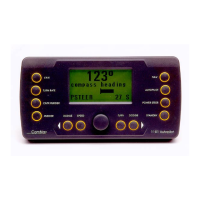
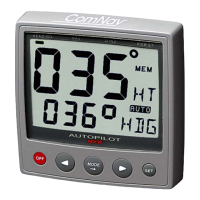
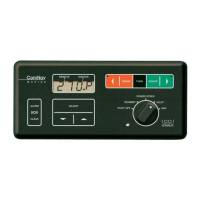
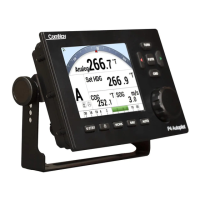
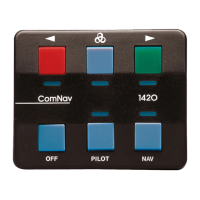
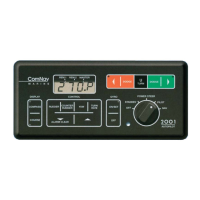
ComNav 2001 Autopilot System
P/N 29010017 V1.0 - 11-
INTRODUCTION
This autopilot is a microprocessor operated PID
(Proportional/Integral/Differential) controller,
working from a high quality, externally gimballed
magnetic ships steering compass fitted with a
flux-gate sensor.
An analog to digital converter changes the signals
from the sensor into digital heading information
with a resolution of 1/2 of a degree, and an
overall accuracy of +/- 2 degrees or better. This
heading information is compared against the
programmed heading, and the desired rudder
position determined.
The desired rudder position is compared against
the actual rudder position transmitted by the
rudder follower, and if they are not the same,
either the Port or Starboard output line is
activated. The Port and Starboard output lines can
drive a load at up to 3 amps. They are designed to
operate solenoid valves in a hydraulic steering
system.
A speed control signal is also available for use
with variable speed rudder drives. The outputs,
either by themselves or with an optional solid
state control box, can be adapted to operate a
wide variety of power steering systems.
If the autopilot is installed as a retrofit, it is
usually possible to use the existing power steering
installation. The autopilot can operate from any
DC voltage between 10 and 40 volts.
The autopilot is equipped to interface with a
Loran C Receiver, Satnav Receiver, GPS
Receiver, or any other navigation computer
which outputs one of the NMEA 0180, 0182, or
0183 formats at either 1200 or 4800 Baud. It can
also transmit heading information in a variety of
formats.
The autopilot is designed to accept up to two
remote controls. Control can be taken at either
remote simply by pressing both its pushbuttons
simultaneously for one second.
Control is taken at the other remote, or at the
autopilot front panel the same way. By adding a
remote expander, each remote receptacle on the
rear of the autopilot can support up to four remote
controls, for a total of eight
The autopilot can drive up to four Remote
Heading Displays which continuously display the
vessel's actual compass heading. The autopilot
can run up to 4 rudder angle indicators which
continuously display the vessel's actual rudder
angle.
1 shows most interconnections between the
autopilot, its accessories, and other external
equipment.


 To Next Page