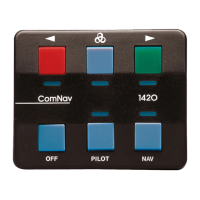
ComNav 2001 Autopilot System
P/N 29010017 V1.0 - 26-
NAVIGATION INTERFACE
If the autopilot is being interfaced to a navigation
device with any of the NMEA 0180, 0182, or
0183 outputs, determine the type(s) of output
format(s) from its data sheets.
If an option is available, select the higher
numbered output format for better performance.
If 0180 and 0182 formats are interspersed on the
output line, the autopilot will automatically
switch to use the 0182 data and ignore the 0180
data.
NMEA 0180
If the autopilot is using NMEA 0180 data to
navigate, '180' will be displayed when the TURN
key is pressed with the master select switch in the
NAV position.
The standard baud rate for the 0180 data format is
1200 baud.
This format gives the autopilot cross track error
information only. Cross track error is the distance
and direction the vessel is from the line between
the beginning and ending waypoints of the track.
The autopilot will use this information to make
course adjustments to keep the vessel as close as
possible to the track. Because the autopilot does
not know the direction to the destination, there
will often be one or two swings across the track
as the autopilot determines the correct course to
steer.
If the Nav. Device is set for automatic waypoint
sequencing, the autopilot will always overshoot
before locking onto the new course, as some cross
track error has to build up before the autopilot can
know that the Nav. Device has changed
waypoints.
NMEA 0182
If the autopilot is using NMEA 0182 data to
navigate, '182' will be displayed when the TURN
key is pressed with the master select switch in the
NAV position.
The standard baud rate for the 0182 data format is
1200 baud.
This format gives the autopilot the same cross
track error information as 0180, but adds the
heading from the vessel's present position to the
waypoint.
The autopilot will turn to the indicated heading
when the interface is engaged, and will
automatically turn to the new heading when the
Nav. Device sequences to a new waypoint.
It will use the Cross Track Error to make course
adjustments to keep the vessel as close as
possible to the track to the waypoint.
The Heading To Steer information is from the
vessel's present position to the destination
waypoint, so when the vessel is close to the
waypoint (ie. less than 0.2 Nautical Miles), the
Heading To Steer will jump, causing the vessel to
wander slightly until the Nav. Device sequences
to the next waypoint.
NMEA 0183
If the autopilot is using NMEA 0183 data to
navigate, the three letters of the data sentence
being used can be displayed by pressing the
TURN key. Please note that the pilot must be in
the NAV position.


 To Next Page