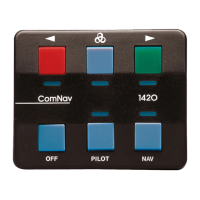
ComNav 2001 Autopilot System
P/N 29010017 V1.0 - 29-
DATA OUTPUT
The autopilot can send out heading information
for other external devices in a variety of formats.
In the standard autopilot, three heading output
formats have been implemented. These are the
'Remote Heading Display', 'N+1' and 'BCD'
formats.
The Remote Heading Display format is for use
with ComNav Marine Remote Heading Display
repeaters.
The N+1 output is identical to the output from a
Digicourse electronic compass, and has been
tested with the Magnavox MX4102 Satnav
equipped with the MX41D N+1 interface circuit
board.
The BCD output is identical to the output from
the Furuno AD-10S gyrocompass interface, and
has been tested with the Furuno FSN50 Satnav
equipped with the DE-FSN8-8M-1 interface
circuit board.
The Remote Heading Display format is a four
wire signal. Refer to the instructions
accompanying the Remote Heading Displays for
information on connecting them into the autopilot
distribution box.
The Remote Heading Display output is selected
by setting Dip Switches 3 and 4 on the autopilot
control circuit board both to OFF.
The N+1 format is a two wire signal. One wire
connects to TX CLOCK, terminal 22 in the
autopilot distribution box. This terminal transmits
a number of pulses corresponding to the vessel's
heading in degrees, plus one extra pulse.
The other wire is the return, connected to
COMMON, terminal 25 in the autopilot
distribution box. The wire should be shielded,
with the shield also connected to the COMMON
terminal in the autopilot distribution box, and
unterminated at the other end, to prevent the
radiation of any radio noise.
The pulses are 5 volts in amplitude, transmitted at
a frequency of approximately 20 KHz. The
information is transmitted twice a second.
The N+1 format is selected by setting Dip Switch
3 on the autopilot Control circuit board to ON,
and Dip Switch 4 to OFF.
The BCD format is a three wire signal. One
wire connects to TX CLOCK, terminal 22 in the
autopilot distribution box. This terminal transmits
a synchronizing clock signal.
The second wire is connected to TX DATA,
terminal 23 in the autopilot distribution box. This
terminal transmits the vessel's heading in degrees
in BCD (Binary Coded Decimal) format
synchronously with the SATNAV CLOCK.
The third wire is the return, connected to
COMMON terminal 25 in the distribution box.
The wire should be shielded, with the shield also
connected to COMMON in the autopilot
distribution box, and unterminated at the other
end, to prevent the radiation of any radio noise.
The clock and data pulses are 5 volts in
amplitude, and the clock is transmitted at a
frequency of approximately 10 KHz. The
information is transmitted ten times a second.
The BCD format is selected by setting Dip
Switch 3 on the autopilot control board to OFF,
and Dip Switch 4 to ON.
When interfacing to Furuno equipment which is
compatible with the Furuno AD-10S
gyrocompass interface, CLK-H corresponds to
TX CLOCK, DATA-H corresponds to TX
DATA and CLK-C and DATA-C both
correspond to COMMON.


 To Next Page