ComNav 2001 Autopilot System
P/N 29010017 V1.0 - 38-
CONTROLS
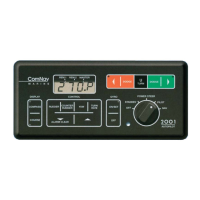
The controls consist of a five position master select switch, and a 15 position membrane keypad. The controls operate as
follows:
MASTER SELECT SWITCH
OFF
All power to the autopilot is turned off. The
display will be blank.
STANDBY
The left three digits of the display show the
vessel's current compass heading. This is the
mode the autopilot must be in to select various
presets, such as compass heading offset,
gyrocompass heading offset, wind angle offset,
watch alarm interval select, or U-Turn function
select.
POWER STEER
The left three digits of the display show the
vessel's current compass heading. The vessel can
be steered by using the red and green ARROW
keys to turn the rudder port or starboard as
desired.
PILOT
The vessel will steer the course indicated on the
left three digits of the display (provided that the
display is in the COURSE mode). The vessel can
be brought to the desired heading by pressing
either the red or green ARROW keys.
Pressing and releasing either key will change the
heading by one degree. Pressing and holding
either key will initially change the vessel's
heading by one degree, and after a one/half
second delay, by ten degrees per second until the
key is released. The function display will show a
'c' until the course change is completed. Pressing
the U-TURN and then either the red or green
ARROW key for one second will initiate a
special turn (Emergency turn, Continuous turn, or
U-turn; selected in STANDBY) in that direction.
The function display will show an 'E', 'C', or 'U'
until the turn is completed.
NAV
Place the master select switch in this position
when the autopilot is being operated with a
navigation computer (ie. Loran, Sat Nav, etc.)
which has an NMEA 0180, 0182 or 0183 format
output. The autopilot operates the same way as in
the PILOT position, except that it will change its
course as directed by the navigation computer to
maintain a Zero Track Error. The autopilot will
display 'FdEr' if there is a problem with the data it
is receiving such as Low Signal To Noise Ratio,
Blink Alarm, or Incorrect Cycle Selection. The
autopilot will display 'ndEr' and maintain its last
course if it does not receive any data from the
navigation computer. The DODGE keys can be
used as described above to avoid obstacles in the
water. Press the U-TURN key to display which
data port (1 or 2) the autopilot is looking at for
data. Press the U-TURN key followed by the red
ARROW key to select the other data port. Press
the U-TURN key followed by the green
ARROW key to change the sense of the Cross
Track Error for that data port.


 To Next Page