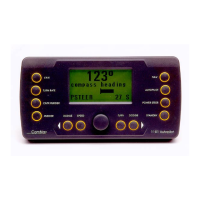
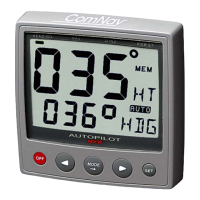
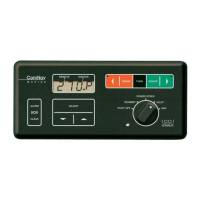
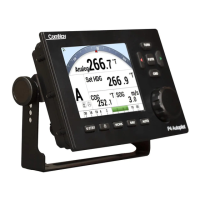
ComNav 2001 Autopilot System
P/N 29010017 V1.0 - 54-
GYBING
To gybe the vessel, press either the red or green
ARROW key (pushbutton) to make the
command heading increase to 180 degrees, and
then decrease on the opposite tack to the desired
wind angle.
The alarm will sound and the display will show a
'GYbe' warning once when the command wind
angle equals 180 degrees to notify you that you
have programmed a gybe, and again when the
actual wind angle reaches 180 degrees to notify
you that it is now time to gybe.
NOTES
The autopilot does not actually steer by the wind.
Instead it steers by the magnetic compass, which
is a much more stable source of heading
information, and adjusts the compass course it is
steering to make the command wind angle and
the actual wind angle equal each other. This
method results in much more accurate steering
while engaged in the wind mode than is possible
by just steering by the wind.
If you attempt to tack automatically in very light
air, and the vessel gets stuck in irons, the
autopilot will continue to adjust the compass
course in an attempt to make the vessel come
around, and will end up not knowing which way
to steer the vessel. If this happens, simply move
the master select switch to the POWER STEER
or STANDBY position and bring the vessel onto
the proper tack by hand, and then return the
master select switch to the PILOT position.
INSTALLATION
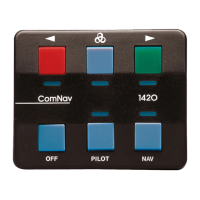
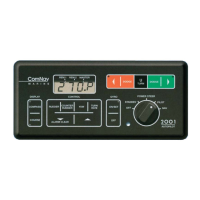
We recommend mounting the 2001s Autopilot
below decks at the nav station and mounting a
101s Remote Control (a version of the standard
101 remote designed specifically for use with the
2001s Autopilot) in the cockpit.
On large vessels an additional 101s remote may
be mounted at the base of the mainmast for use
during deck work. Except for the actual wind
vane interface, all other installation and setup
procedures are the same as for the standard 2001
autopilot.
In many cases, it is possible to tap into the wind
angle information coming down the mast from an
existing windvane to avoid the expense and
hassle of installing another piece of equipment at
the top of the mast. The wind vane must be of the
type which reads over a full 360 degrees.
Most windvanes of this type have a three phase
output. The autopilot is shipped configured to be
connected to this type of wind vane.
Some wind vanes have a 2 phase output (ie.
VDO). Two jumpers must be moved on the
Compass Interface PCB inside the autopilot to
adapt to this type of output (see Figure 15). This
should be done by your dealer. A 10 foot cable
terminated in flying leads which plugs into the
OPTION receptacle is included. Refer to the
table below for the wire colours corresponding to
the S1, S2 and S3 leads (3 phase) or Sine,
Reference and Cosine leads (2 phase).
Hookup information on wind vanes we know to
be compatible with the autopilot are listed on the
next page.


 To Next Page