1.1. Incorrect number or placement of flat springs
The upper half of a bottom crust die set has a series of fasteners, pins, and flat springs
that must be properly configured for successful crust production. Occasionally, the flat
springs and the pins need replacement due to normal wear and tear.
A properly functioning bottom crust die set forms dough to the thickness specified in
the original purchase order. For many of our customers, the specified thickness is 1/8
inch across the bottom, 1/8 inch thick on the sidewall, and 1/8 inch thick on the rim.
If ever in doubt, measure the unbaked dough crust thickness with a small ruler.
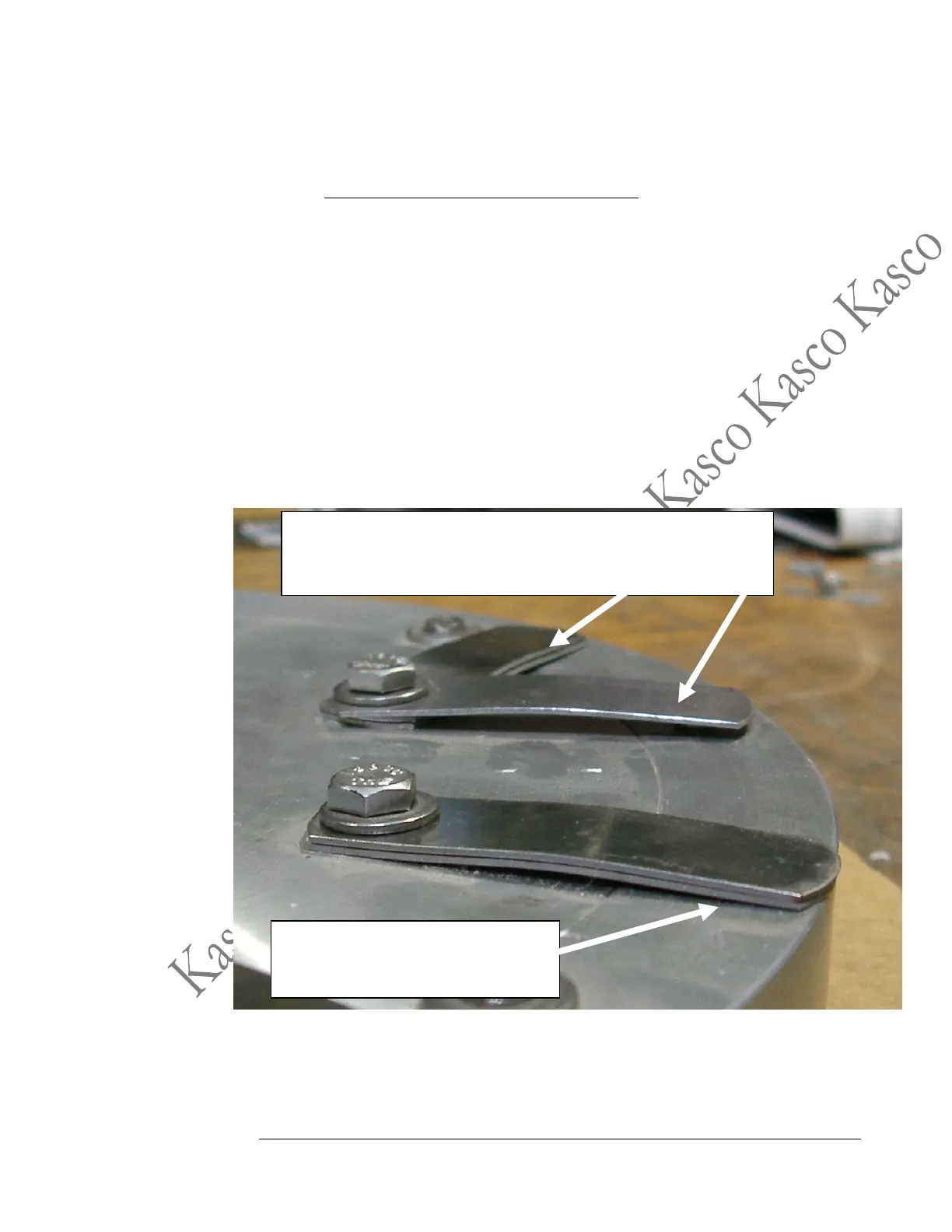
Typically, Dies Sets will have locations with two or three flat springs. When there are
only 2 flat springs, they should be stacked vertically and positioned so that they reach
across the ring of the die. Where there are 3 springs, the bottom two springs should be
stacked vertically and extend onto the die’s ring. ONLY the top-most spring should
extend over the stripper pin.
In either case, the springs should always be attached to the die so that the bend in the
middle of the spring is the highest point on the spring.
Correct 2-spring location. Springs
are stacked, touching the ring and
reaching out over the ring.
Correct 3-spring location. Lower 2 springs are stacked, touching
the ring and reaching out over the ring. ONLY the upper spring
is covering the pin.



 To Next Page