INSTALLATION, OPERATION AND MAINTENANCE MANUAL – COSA
9610™
16 | Page
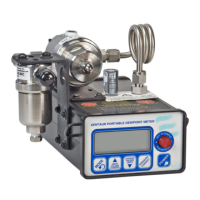
The X-Purge is user programmable for many of the configurable options available. This is
done with the intrinsically safe user-interface on the face of the unit, which can also be
remote mounted. The user-interface is a 2 x 20 LCD that is programmed through a set of
buttons on the menu driven unit. All configuration and options are programmed through
this unit. There are also (5) LEDs for easy visual indication of operation:
•
Safe Pressure – This turns on (blue) when safe pressure is achieved inside the
enclosure.
•
Enclosure power – This is (red) when the enclosure power is off, and (green) when
enclosure power is on. The enclosure power can be on only after a successful purge
and a safe pressure is achieved. Bypass option allows power to remain on if safe
pressure is lost.
•
Rapid Exchange® – The Rapid Exchange or purging flow rate turns on (blue) when the
flow rate is measuring proper flow.
•
System Bypass – This turns on (yellow) when the system bypass is active. This should
be used only when the area around the enclosure is known to be safe.
•
Alarm Fault – The (red) LED blinks when any alarm input is detected and is solid when
there is an internal system fault.
1.6.2.4. Pneumatic Manifold with I.S. Solenoid
•
Manifold with I.S. solenoid valve: The manifold system is mounted on the 6000 control
unit providing a needle valve to set enclosure pressure and an I.S. solenoid valve that is
used for purging (Rapid Exchange). Power for the I.S. solenoid valve is provided by the
EPCU and is galvanically isolated. Regulated instrument-grade air is required.
• Proportional valve option: The I.S. proportional valve is separated on the 6000 control unit
and provides continuous flow and pressure to the enclosure for purging (Rapid Exchange)
and pressurization. Power for the I.S. solenoid valve is provided by the EPCU and is
galvanically isolated. No needle valve is required. Pressures can be controlled from a user
set-point.
Certifications allow the X-Purge to be used on enclosures in a gas hazardous atmosphere.
Gas atmospheres require the purging of the enclosure. Dust atmospheres require the
physical removal of all the dust that collects inside. Both gas and dust atmospheres require
the following:
1) removing the dust,
2) sealing the enclosure, and then
3) purging the enclosure.


 To Next Page