2.2.2 Safe use of liquid nitrogen
The temperature of liquid nitrogen is -196 °C. As a
result:
You must never touch objects which
have been in contact with liquid
nitrogen with your bare hands.
Always wear special gloves and visors
when handling liquid nitrogen
Liquid nitrogen used in storage
freezing chambers evaporates into the
air; 1 litre of liquid nitrogen releases
around 700 litres of nitrogen in the
gaseous state. Nitrogen is an inert,
non-toxic gas, but displaces oxygen
when released into the atmosphere.
Once the atmospheric oxygen content
falls below 19% there is a risk for
humans.
Any room or place where liquid
nitrogen containers are kept must
always be completely ventilated and, at
least, equipped with an oxygen
detector; it should not be used for
other purposes than those defined by
your integrator. All personnel should
be informed of the risks associated
with the use of nitrogen.
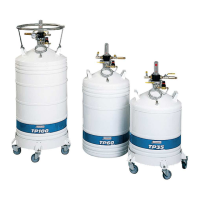
The storage tank is designed for use
with liquid nitrogen only.
When in new condition, the tank must
always be transported empty, in its
original packaging and in compliance
with current national and international
regulations. Never stack storage tanks
on top of each other.
According to the ADR directive on
transporting dangerous goods by road,
in order to avoid falling under the
TPED directive, TP tanks must be
transported without being under
pressure (at atmospheric pressure)
and with their neck open.
The tank may be moved across short
distances (using the dolly base) with
its head installed, with the tank not
being under pressure (i.e. at
atmospheric pressure).
If the tank is moved without the head,
the control head can be reinstalled in
the tank once full. This installation
phase must be conducted with caution
operator equipped with all required
cryogenic personal protection
equipment: gloves, apron, visor, etc.)
in order to avoid any liquid nitrogen
splashing.
The neck of the tank must never be
hermetically sealed. Use the stopper
provided.
The tank must always be kept vertical.
2.3 Precautions in the event of
operating faults
If you suspect that the integrity of the equipment has
been compromised (for example as a result of
damage sustained during transit or during use), it
should be withdrawn from service. Make sure that the
withdrawn equipment cannot be accidentally used by
others. The defective equipment should be handed
over to authorized technicians for inspection.
2.4 Important Safety Elements
(ISE)
These ISE are:
Design rules for the EC Medical directives.
Technical documentation (maintenance
instructions and services),
Components integral to the products (valves,
solenoid valves, electronic equipment such as
control and traceability electronics, overflow
prevention and degassing devices, sensors and
interfaces for remote monitoring (by an automation
controller etc.), the cover contact); these elements
are not necessarily present on the product.
Obligatory safety recommendations or advice (the
wearing of personal protection equipment when
using our products, instructions for the use of
equipment etc.).
During filling and transfer operations, ensure that
equipment and procedures that ensure safety are
used (hose, vacuum valve).


 To Next Page