8. Use
This section introduces the use of the assembled tank
during transport, handling, filling (by gravity or from a
supply tank) and withdrawal (using the liquid
nitrogen).
8.1 Storage precautions
Before installing the equipment or using it
for the first time, it is essential to refer to
the safety instructions on page 6.
The storage tank must always be kept
sheltered from exposure to the elements,
with its control head or stopper fitted.
8.2 Moving
The tank may be moved across short
distances (using the dolly base) with its
head installed, with the tank not being
under pressure (i.e. at atmospheric
pressure).
If the tank is moved without the head, the
control head can be reinstalled in the tank
once full. This installation phase must be
conducted with caution (operator equipped
with all required cryogenic personal
protection equipment: gloves, apron, visor,
etc.) in order to avoid any liquid nitrogen
splashing.
8.3 Handling
To keep the rate of loss low and keep the tank
serviceable for as long as possible, we strongly
recommend that you:
Avoid severe impacts.
Keep tanks upright at all times.
Only move a tank inside the same laboratory (see
section 8.2).
If possible, use the optional dolly base.
Move the tank with the neck open.
Use the tank in a fixed location.
8.4 Filling the tank
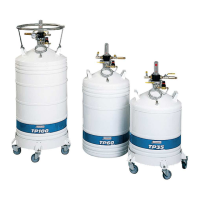
The tank is filled from a low-pressure supplying tank
or a transfer line using type 130/130 or other flexible
filling lines:
For any operation with a liquefied gas
you must wear protective gloves and
goggles.
Mandatory: Protect your hands using
appropriate personal protection
equipment.
The gas transferred is at a very low
temperature.
A safety valve calibrated to 15 bar max
must be fitted at one end of the flexible
line.
When filling the tank, make sure that
neither personnel nor equipment are in
the area facing the vent valve (1,
diagram on next page) or the filling valve
(2).
Filling must always be done by a
qualified person in constant attendance.


 To Next Page