
 Need help?
Do you have a question about the CryopAL TP-35 and is the answer not in the manual?
Defines the manual's scope, focusing on self-pressurizing storage tanks for liquid nitrogen storage and transport.
Identifies the manual's target audience as any professional using Cryopal TP line cryogenic containers.
Explains the manual's logical flow, following the user's typical steps for ease of consultation.
Provides guidance on effectively using the manual, following the sequence of product usage.
Advises against skimming due to the specific nature of cryogenic products, recommending thorough reading.
Lists accompanying documents, including the electronic PDF manual and other Cryopal manuals.
Lists cited trademarks, such as Adobe and Adobe Acrobat Reader.
Details warning symbols and their meanings, crucial for understanding safety instructions and potential hazards.
Outlines essential safety precautions for personnel authorized to handle and use the apparatus.
Provides critical safety guidelines for handling liquid nitrogen, including protective measures and environmental considerations.
Specifies actions to take if equipment integrity is compromised, emphasizing withdrawal from service and expert inspection.
Lists key safety elements (ISE) including design rules, technical documentation, integral components, and safety advice.
Instructs on the proper environmental disposal of the equipment and its peripheral components.
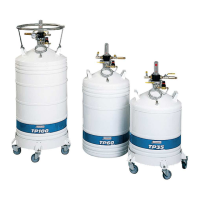
Illustrates and describes the main parts of a TP storage tank, including optional components.
Explains the operational purpose of Cryopal TP range cryogenic containers for storing and withdrawing liquid nitrogen.
Details the self-pressurizing principle of the storage tank, involving gas vaporization via an exchanger.
Describes the construction of the aluminum storage tank, its insulation, flange head, handles, and stopper.
Details the optional dolly base accessory, designed for easy indoor mobility with castors and brakes.
Describes the removable metal hand rail accessory, which aids in moving the tank and protects the control head.
Provides specifications for the Type 130/130 flexible transfer line used for filling the TP tank.
Details the Type 130 TC flexible transfer line, used for transferring between different TP or TR tanks.
Outlines safety rules and procedures for safely unpacking the cryogenic storage tank assembly.
Covers customer responsibilities for ensuring premises comply with regulations and provides installation recommendations.
Presents a checklist to verify that all necessary conditions and safety measures are met before installation.
Provides step-by-step instructions for installing the control head onto the storage tank, emphasizing safety precautions.
Details the procedure for safely removing the control head from the storage tank, including necessary checks.
Offers essential precautions for storing the assembled tank, emphasizing protection from elements and proper fitting.
Provides guidance on safely moving the tank, including recommendations for using the dolly base and keeping the neck open.
Offers recommendations for handling the tank to minimize loss rate and maintain serviceability, advising against impacts.
Explains the procedure for filling the tank from a supply tank or transfer line, including safety measures.
Describes the process of transferring liquid nitrogen from the storage tank to another container.
Addresses operating incidents where the level indicator shows an incorrect reading, detailing causes and corrective actions.
Troubleshoots incidents where valves operate below 0.5 bar, covering causes like pressure gauge issues or valve faults.
Details troubleshooting for valves that continuously operate at a high flow rate, such as a pressure-building valve left open.
Covers abnormal evaporation rates due to issues like pressure-building circuit leaks or poor vacuum quality.
Explains how to address uncontrolled service pressure, often caused by an out-of-adjustment pressure controller.
Outlines the recommended frequency for inspecting key components like pressure gauges, valves, and seals.
Details the procedure and equipment needed for inspecting the pressure gauge for accuracy.
Describes the process for inspecting the tank's valves to ensure they function correctly within specified pressure ranges.
Explains how to check the mechanical level indicator, including adjusting the zero mark if necessary.
Details the annual procedure for inspecting the tank and its connections for leaks using soapy water.
Provides steps to adjust the zero mark on the level indicator's stem, often needed after handling.
Describes how to reposition the red ring on the level indicator stem for accurate readings.
Details the procedure for replacing the pressure gauge and safety valve assembly.
Outlines the steps for changing individual valves on the control head.
Specifies the recommended frequency for maintenance operations like defrosting the control head and cleaning the tank exterior.
Lists technical specifications for the TP range tanks, including capacity, pressure, weight, and dimensions.
Details the principal characteristics of the control head, such as nitrogen level indication and pressure measurement.
Lists product references for spare parts specifically for the storage tank, like pressure-building valves and controllers.
Provides product references for spare parts and components for the control head assembly.
Lists product references for various optional accessories, including flexible transfer lines, dolly bases, and insulating stoppers.
Explains the warranty period, coverage, conditions for claims, and exclusions for the equipment.
Defines the limits of Cryopal's liability regarding damages, losses, or consequences arising from product use.
 General
| Brand | CryopAL |
|---|---|
| Model | TP-35 |
| Category | Storage Bin |
| Language | English |

 To Next Page