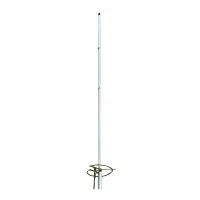
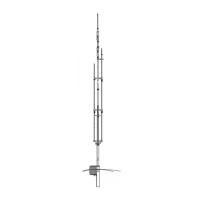
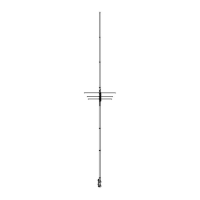
Cushcraft HV4E Vertical Antenna
Version 0 12 2024 Cushcraft
ANTENNA TUNING
Tuning of the antenna requires some patience with the trimming of the radial spokes for each band.
Checking the results can be done with an SWR meter but it is strongly suggested to use an antenna
analyzer because the initial tuning will be outside of the amateur bands and using an analyzer will make
tracking changes much easier. Exact lengths of the spoke radials will vary depending on the ground
system, mounting location, and items near by the antenna.
When tuning, do not stand close to the antenna. Stand about 10-20 ft away from the antenna so your
body will not detune the antenna.
FREQUENCY AND SWR ADJUSTMENT
This antenna covers wider frequency ranges on the higher bands, and narrower segments on the lower
frequency bands. The 40 meter band has the narrowest range of operation (approximately 150 KHz) and
is the most sensitive to adjustments.
The entire antenna must be accessible during initial tuning and testing. If the MFJ-1901 Ground
Coupled™ Portable Antenna Base is used, attach the antenna to the base and place it in a location away
from buildings or other objects that could affect the measurements. If the portable antenna base is not
used, it is best to install the antenna on the final mounting pipe or a short, temporary mast or pipe.
IMPORTANT:
A suitable Ground radial system must be connected to the antenna mounting
bracket if the Ground Coupled Portable™ Antenna Base is not used.
The SWR can be measured by using a transmitter and SWR bridge or an SWR Analyzer. The measuring
device should be connected to the antenna with a length of high quality 50-Ohm coaxial cable. If using a
transceiver and SWR meter, set the transceiver to the lowest possible power to take measurements.
Please read the following hints:
• The normal resonant frequency of this antenna is at or below the bottom of each amateur
band. This allows the user to "trim" a small amount off the inside end of the capacitance spokes to
raise the resonant frequency. Conversely, adding a longer capacitance spoke will lower the resonant
frequency of a loading assembly. Spare spokes are included in case you need to lower the resonant
frequency of the antenna.
• If the suspected resonant frequency is lower than your equipment can detect, for example
below 14 MHz, take one 20 meter spoke entirely off the antenna. Measure the resonant frequency
again. If the resonant frequency still cannot be found, check another band. If none of these tests
results in a good SWR on any frequency, substitute a 50-Ohm load for the antenna to test the feed
line. If the SWR checks good, the antenna assembly will have to be checked for proper assembly,
shorts, or openings at the feed point of the antenna.
• If the antenna operates normally higher than the band after one spoke is removed, install all the
spokes and trim each spoke in 1/4 inch increments. The spokes for each band should be cut to the
same length.
• Once the resonant frequency is found, use the chart located under the section Tuning The
Antenna section of this manual to estimate the amount of the spoke length to cut so that the antenna
will resonate at your favorite section of the band.


 To Next Page