• Do not weld or cut in locations near degreasing, cleaning, or spraying operations. The heat and rays of
the arc can react with vapors to form highly toxic and irritating gases.
• Do not weld or cut on coated metals, such as galvanized, lead, or cadmium plated steel, unless the
coating is removed from the weld area, the area is well ventilated, and while wearing an air supplied
respirator. The coatings and any metals containing these elements can give off toxic fumes if welded.
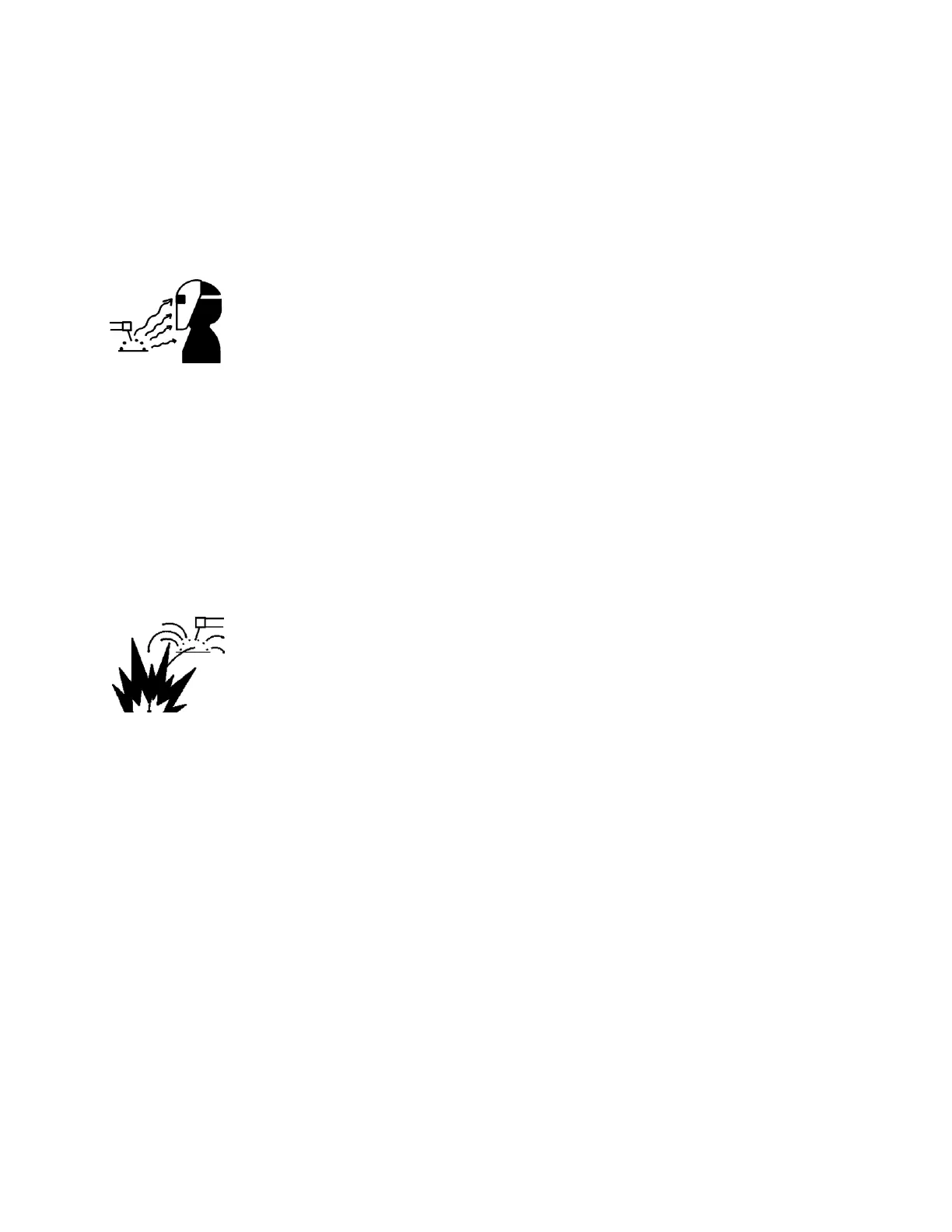
Arc Rays
ARC RAYS can burn eyes and skin. Arc rays from welding and cutting processes
produce intense visible and invisible (ultraviolet and infrared) rays that can burn eyes
and skin. Sparks fly off from the weld.
• Wear an approved welding helmet fitted with a proper shade of filter lenses to protect your face and
eyes from arc rays and sparks when welding, cutting, or watching (see ANSIZ49.1 and Z87.1 listed in
Safety Standards).
• Wear approved safety glasses with side shields under your helmet.
• Use protective screens or barriers to protect others from flash, glare and sparks; warn others not to
watch the arc.
• Wear body protection made from durable, flame resistant material (leather, heavy cotton, wool).
• Body protection includes oil-free clothing such as leather gloves, heavy shirt, cuff less trousers, high
shoes and a cap.
Welding and Cutting
Welding or cutting on closed containers such as tanks, drums or pipes, can cause
them to blow up. Sparks can fly off from the welding or cutting arc. The flying sparks,
hot work piece and hot equipment can cause fires and burns. Accidental contact of
electrode to metal objects can cause sparks, explosion, overheating or fire. Check
and be sure the area is safe before doing any welding or cutting.
• Remove all flammables within 35 ft. (10.7 m) of the welding or cutting arc. If this is not possible, tightly
cover them with approved covers.
• Do not weld or cut where flying sparks can strike flammable material.
• Protect yourself and others from flying sparks and hot metal.
• Be aware that welding sparks and hot materials from welding and cutting can easily go through small
cracks and openings to adjacent areas.
• Watch for fire, and keep a fire extinguisher nearby.
• Be aware that welding or cutting on a ceiling, floor, bulkhead or partition can cause fire on the hidden
side.
• Do not weld or cut on containers that have held combustibles, or on closed containers such as tanks,
drums, or pipes unless they are properly prepared according to AWS F4.1 and AWS A6.0 (see Safety
Standards).
• Do not weld or cut where the atmosphere may contain flammable dust, gas, or liquid vapors (such as
gasoline).
• Connect work cable to the work as close to the welding or cutting area as practical to prevent welding
or cutting current from traveling long, possibly unknown paths and causing electric shock, sparks and
fire hazards.
• Do not use welder to thaw frozen pipes.
• Remove stick electrode from holder or cut off welding wire at contact tip when not in use.
• Remove any combustibles, such as a butane lighter or match, from your person before doing any
welding or cutting.


 To Next Page