14
TROUBLE SHOOTINGTROUBLE SHOOTING
Trouble Shooting
These cases are not troubles.
The following cases are not air conditioner troubles but have some reasons. You may just continue using it.
Case Explanation
Does not operate at all. • Check if the fuse has blown.
Set power switch to off.
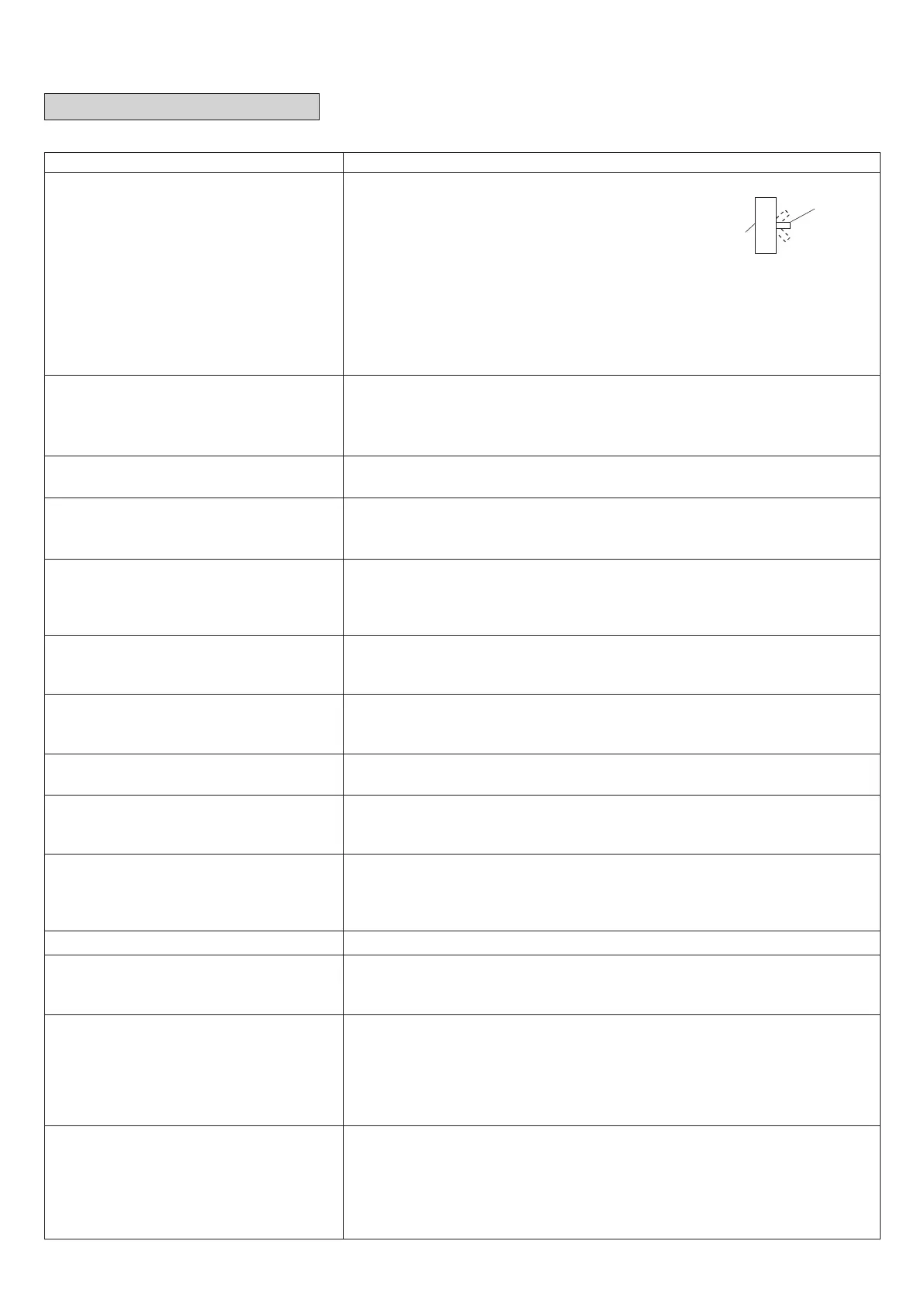
• Check if breaker has worked.
Turn the power on with the breaker switch in the
off position.
Do not turn the power on with the breaker switch in the trip position.
(Contact your dealer.)
• When the power is interrupted.
Wait until the power is recovered, then operate the air conditioner again.
The air conditioner automatically resumes operation in about 3 minutes.
You should just wait for a while.
Operation does not start soon.
• When ON/OFF button was pressed
soon after operation was stopped.
• When the mode was reselected.
• This is to protect the air conditioner.
You should wait for about 5 minutes.
(The microcomputer is preparing for operation. Wait for about 10 minutes.)
Hotairdoesnotowoutsoonafter
thepowersupplyisturnedon.
•
The air conditioner is warming up. You should wait for about 1 minute. (The system
is designed to start discharging air only after it has reached a certain temperature.)
The heating operation stops suddenly
andaowingsoundisheard.
• The system is taking away the frost on the outdoor unit.
You should wait for about 3 to 8 minutes. (Max. 10 minutes).
•
This sound indicates that the valve for the refrigerant bypass is in operation.
A“Zeen”soundisheardimmediately
afterthepowersupplyisturnedon.
• The electronic expansion* valve inside an indoor unit starts working and
makes the noise. Its volume will reduce in about one minute.
* Electronic expansion valve … Controls the ow rate of the gas
(refrigerant) owing inside the indoor unit.
Acontinuouslow“Shah”soundis
heardwhenthesystemisincooling
operation or at a stop.
• When the drain pump (optional accessories) is in operation, this noise is
heard.
A“Pishi-pishi”squeakingsoundis
heardwhenthesystemstopsafter
heating operation.
• Expansion and contraction of plastic parts caused by temperature change
makes this noise.
Alow“Sah”,“Choro-choro”soundis
heardwhileanindoorunithasstopped.
•
When the other indoor unit is in operation, this noise is heard. In order to prevent oil and
refrigerant from remaining in the system, a small amount of refrigerant is kept owing.
Acontinuouslow“Shuh”soundis
heardwhenthesystemsisincooling
or defrost operation.
• This is the sound of refrigerant gas owing through both indoor and
outdoor units.
A“Shuh”soundwhichisheardatthestart
orimmediatelyafterthestopofoperation
orwhichisheardatthestartorimmediately
after the stop of defrost operation.
• This is the noise of refrigerant caused by ow stop and ow change.
Whenthetoneofoperatingnoisechanges.
• This noise caused by the change of frequency.
A continuous “shuh” sound generated
duringoperationorimmediatelyafter
the operation is started or stopped.
• This sound indicates that the valve for the refrigerant bypass is in operation.
Theoutdoorunitemitswaterorsteam. In heating mode
• The frost on the outdoor unit melts into water or steam when the air
conditioner is in defrost operation.
In cooling or dry mode
• Moisture in the air condenses into water on the cool surface of outdoor
unit piping and drips.
Mistscomeoutoftheindoorunit. • This happens when the air in the room is cooled into mist by the cold
airow during cooling operation.
• If the inside of an indoor unit is extremely contaminated, the temperature
distribution inside a room becomes uneven. It is necessary to clean the
inside of the indoor unit. Ask your Daikin dealer for details on cleaning the
indoor unit. This operation requires a qualied service person.
ON
Switch
Trip position
OFF
Breaker
01_EN_3P344160-13U.indd 14 06-Oct-20 2:42:06 PM



 To Next Page