EasyManua.ls Logo

Delta 46-700 - Turning Techniques: Roughing; Roughing Cylinder Cuts

Delta 46-700
26 pages
Print Icon
To Next Page IconTo Next Page
To Previous Page IconTo Previous Page
Loading...
TOOL
REST
POSITION
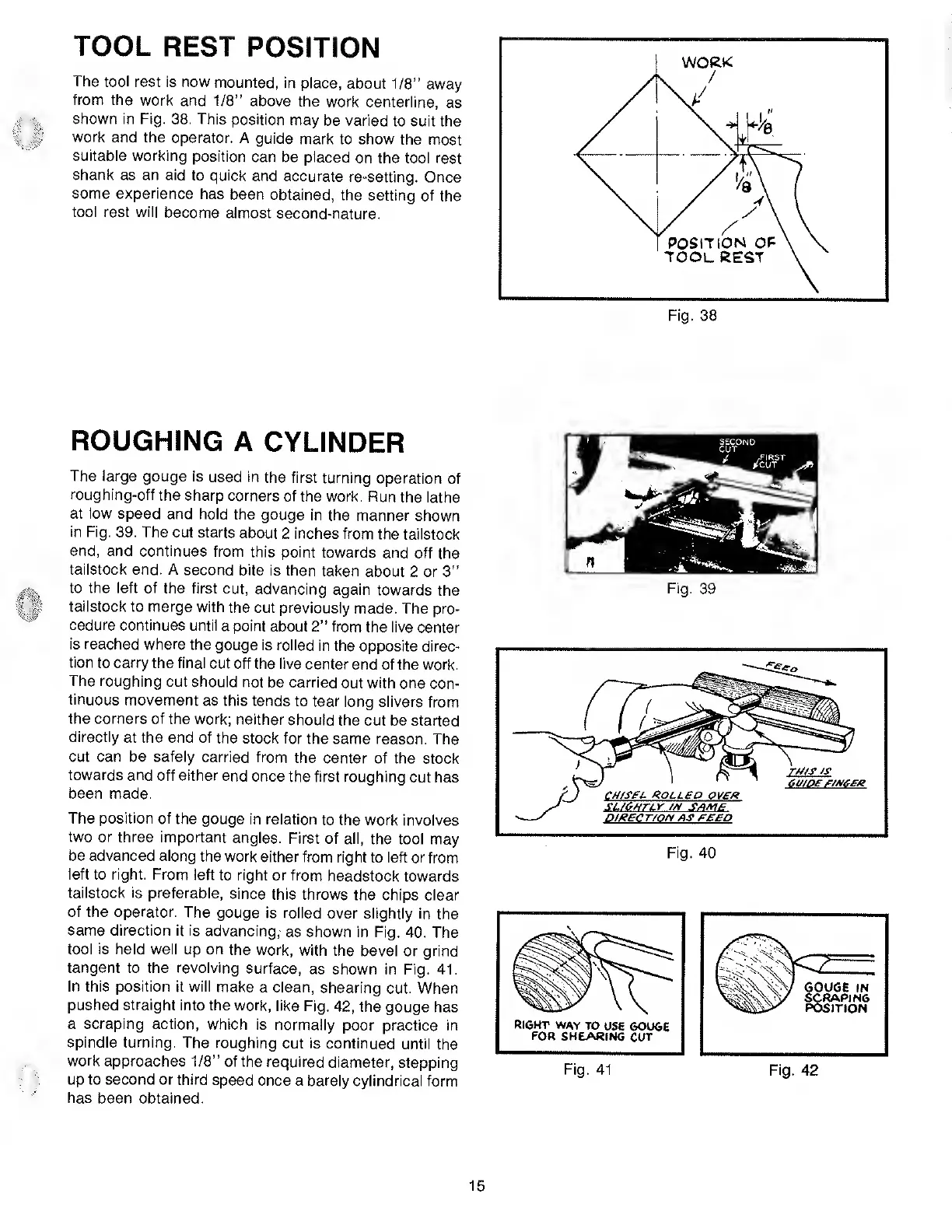
The
tool
rest
is
now
mounted,
in
place,
about
1/8”
away
from
the
work
and
1/8”
above
the
work
centerline,
as
shown
in
Fig.
38.
This
position
may
be
varied
to
suit
the
work
and
the
operator.
A
guide
mark
to
show
the
most
suitable
working
position
can
be
placed
on
the
tool
rest
shank
as
an
aid
to
quick
and
accurate
re-setting.
Once
some
experience
has
been
obtained,
the
setting
of
the
tool
rest
will
become
almost
second-nature.
ROUGHING
A
CYLINDER
The
large
gouge
is
used
in
the
first
turning
operation
of
roughing-off
the
sharp
corners
of
the
work.
Run
the
lathe
at
low
speed
and
hold
the
gouge
in
the
manner
shown
in
Fig.
39.
The
cut
starts
about
2
inches
from
the
tailstock
end,
and
continues
from
this
point
towards
and
off
the
tailstock
end.
A
second
bite
is
then
taken
about
2
or
3”
to
the
left
of
the
first
cut,
advancing
again
towards
the
tailstock
to
merge
with
the
cut
previously
made.
The
pro¬
cedure
continues
until
a
point
about
2”
from
the
live
center
is
reached
where
the
gouge
is
rolled
in
the
opposite
direc¬
tion
to
carry
the
final
cut
off
the
live
center
end
of
the
work.
The
roughing
cut
should
not
be
carried
out
with
one
con¬
tinuous
movement
as
this
tends
to
tear
long
slivers
from
the
corners
of
the
work;
neither
should
the
cut
be
started
directly
at
the
end
of
the
stock
for
the
same
reason.
The
cut
can
be
safely
carried
from
the
center
of
the
stock
towards
and
off
either
end
once
the
first
roughing
cut
has
been
made.
The
position
of
the
gouge
in
relation
to
the
work
involves
two
or
three
important
angles.
First
of
all,
the
tool
may
be
advanced
along
the
work
either
from
right
to
left
or
from
left
to
right.
From
left
to
right
or
from
headstock
towards
tailstock
is
preferable,
since
this
throws
the
chips
clear
of
the
operator.
The
gouge
is
rolled
over
slightly
in
the
same
direction
it
is
advancing,
as
shown
in
Fig.
40.
The
tool
is
held
well
up
on
the
work,
with
the
bevel
or
grind
tangent
to
the
revolving
surface,
as
shown
in
Fig.
41.
In
this
position
it
will
make
a
clean,
shearing
cut.
When
pushed
straight
into
the
work,
like
Fig.
42,
the
gouge
has
a
scraping
action,
which
is
normally
poor
practice
in
spindle
turning.
The
roughing
cut
is
continued
until
the
work
approaches
1/8”
of
the
required
diameter,
stepping
up
to
second
or
third
speed
once
a
barely
cylindrical
form
has
been
obtained.
Fig.
39
15

Related product manuals