EasyManua.ls Logo

Delta 46-700 - Turning Techniques: End and Shoulder Cuts; Squaring an End; Cutting a Shoulder

Delta 46-700
26 pages
Print Icon
To Next Page IconTo Next Page
To Previous Page IconTo Previous Page
Loading...
SQUARING
AN
END
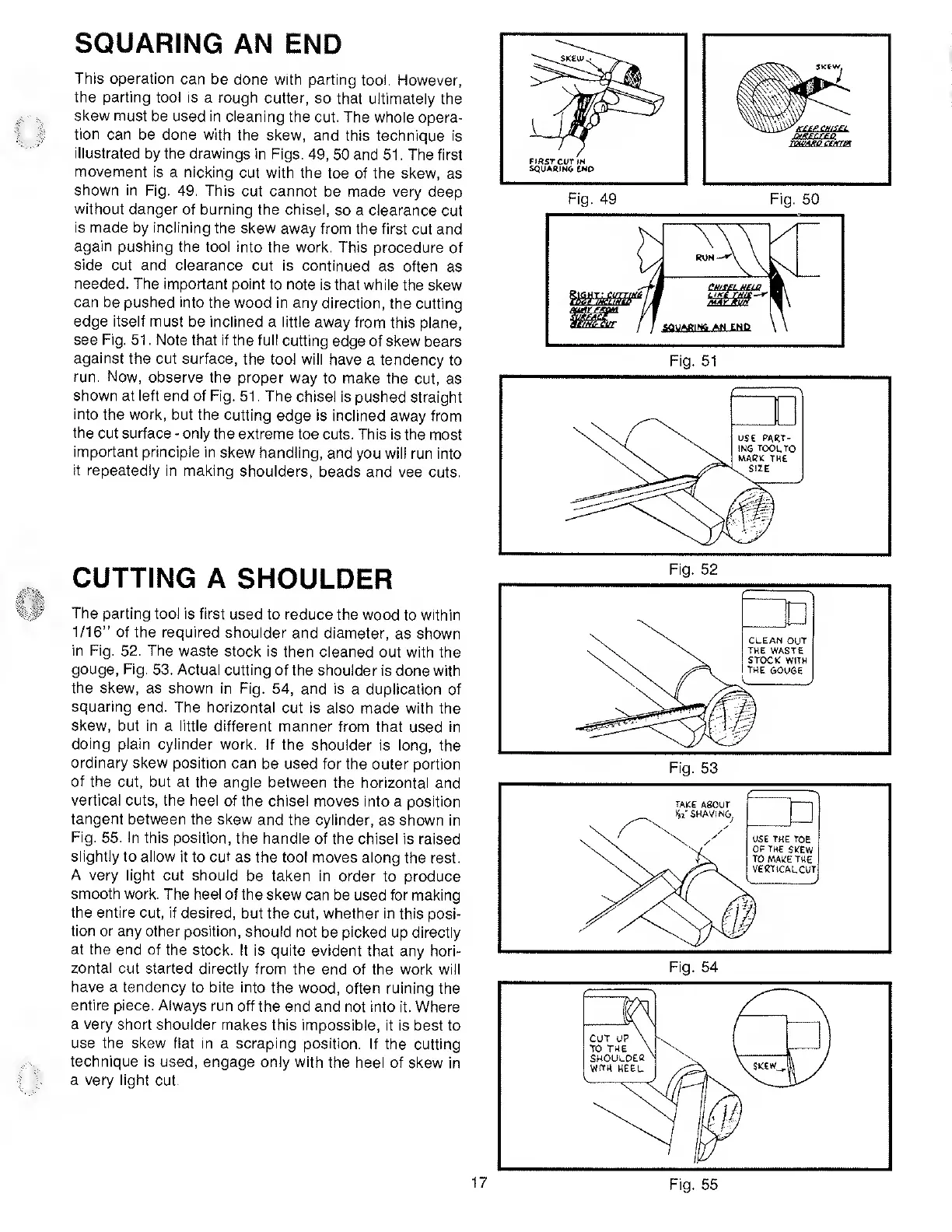
This
operation
can
be
done
with
parting
tool.
However,
the
parting
tool
is
a
rough
cutter,
so
that
ultimately
the
skew
must
be
used
in
cleaning
the
cut.
The
whole
opera¬
tion
can
be
done
with
the
skew,
and
this
technique
is
illustrated
by
the
drawings
in
Figs.
49,
50
and
51.
The
first
movement
is
a
nicking
cut
with
the
toe
of
the
skew,
as
shown
in
Fig.
49.
This
cut
cannot
be
made
very
deep
without
danger
of
burning
the
chisel,
so
a
clearance
cut
is
made
by
inclining
the
skew
away
from
the
first
cut
and
again
pushing
the
tool
into
the
work.
This
procedure
of
side
cut
and
clearance
cut
is
continued
as
often
as
needed.
The
important
point
to
note
is
that
while
the
skew
can
be
pushed
into
the
wood
in
any
direction,
the
cutting
edge
itself
must
be
inclined
a
little
away
from
this
plane,
see
Fig.
51.
Note
that
if
the
full
cutting
edge
of
skew
bears
against
the
cut
surface,
the
tool
will
have
a
tendency
to
run.
Now,
observe
the
proper
way
to
make
the
cut,
as
shown
at
left
end
of
Fig.
51.
The
chisel
is
pushed
straight
into
the
work,
but
the
cutting
edge
is
inclined
away
from
the
cut
surface
-
only
the
extreme
toe
cuts.
This
is
the
most
important
principle
in
skew
handling,
and
you
will
run
into
it
repeatedly
in
making
shoulders,
beads
and
vee
cuts.
CUTTING
A
SHOULDER
The
parting
tool
is
first
used
to
reduce
the
wood
to
within
1/16”
of
the
required
shoulder
and
diameter,
as
shown
in
Fig.
52.
The
waste
stock
is
then
cleaned
out
with
the
gouge,
Fig.
53.
Actual
cutting
of
the
shoulder
is
done
with
the
skew,
as
shown
in
Fig.
54,
and
is
a
duplication
of
squaring
end.
The
horizontal
cut
is
also
made
with
the
skew,
but
in
a
little
different
manner
from
that
used
in
doing
plain
cylinder
work.
If
the
shoulder
is
long,
the
ordinary
skew
position
can
be
used
for
the
outer
portion
of
the
cut,
but
at
the
angle
between
the
horizontal
and
vertical
cuts,
the
heel
of
the
chisel
moves
into
a
position
tangent
between
the
skew
and
the
cylinder,
as
shown
in
Fig.
55.
In
this
position,
the
handle
of
the
chisel
is
raised
slightly
to
allow
it
to
cut
as
the
tool
moves
along
the
rest.
A
very
light
cut
should
be
taken
in
order
to
produce
smooth
work.
The
heel
of
the
skew
can
be
used
for
making
the
entire
cut,
if
desired,
but
the
cut,
whether
in
this
posi¬
tion
or
any
other
position,
should
not
be
picked
up
directly
at
the
end
of
the
stock.
It
is
quite
evident
that
any
hori¬
zontal
cut
started
directly
from
the
end
of
the
work
will
have
a
tendency
to
bite
into
the
wood,
often
ruining
the
entire
piece.
Always
run
off
the
end
and
not
into
it.
Where
a
very
short
shoulder
makes
this
impossible,
it
is
best
to
use
the
skew
flat
in
a
scraping
position.
If
the
cutting
technique
is
used,
engage
only
with
the
heel
of
skew
in
a
very
light
cut.
Fig.
49
Fig.
50
Fig.
51
Fig.
53
Fig.
54
17
Fig.
55

Related product manuals