EasyManua.ls Logo

Delta 46-700 - Turning Techniques: Smoothing and Sizing; Smoothing Cylinders with Skew Chisel; Using the Parting Tool

Delta 46-700
26 pages
Print Icon
To Next Page IconTo Next Page
To Previous Page IconTo Previous Page
Loading...
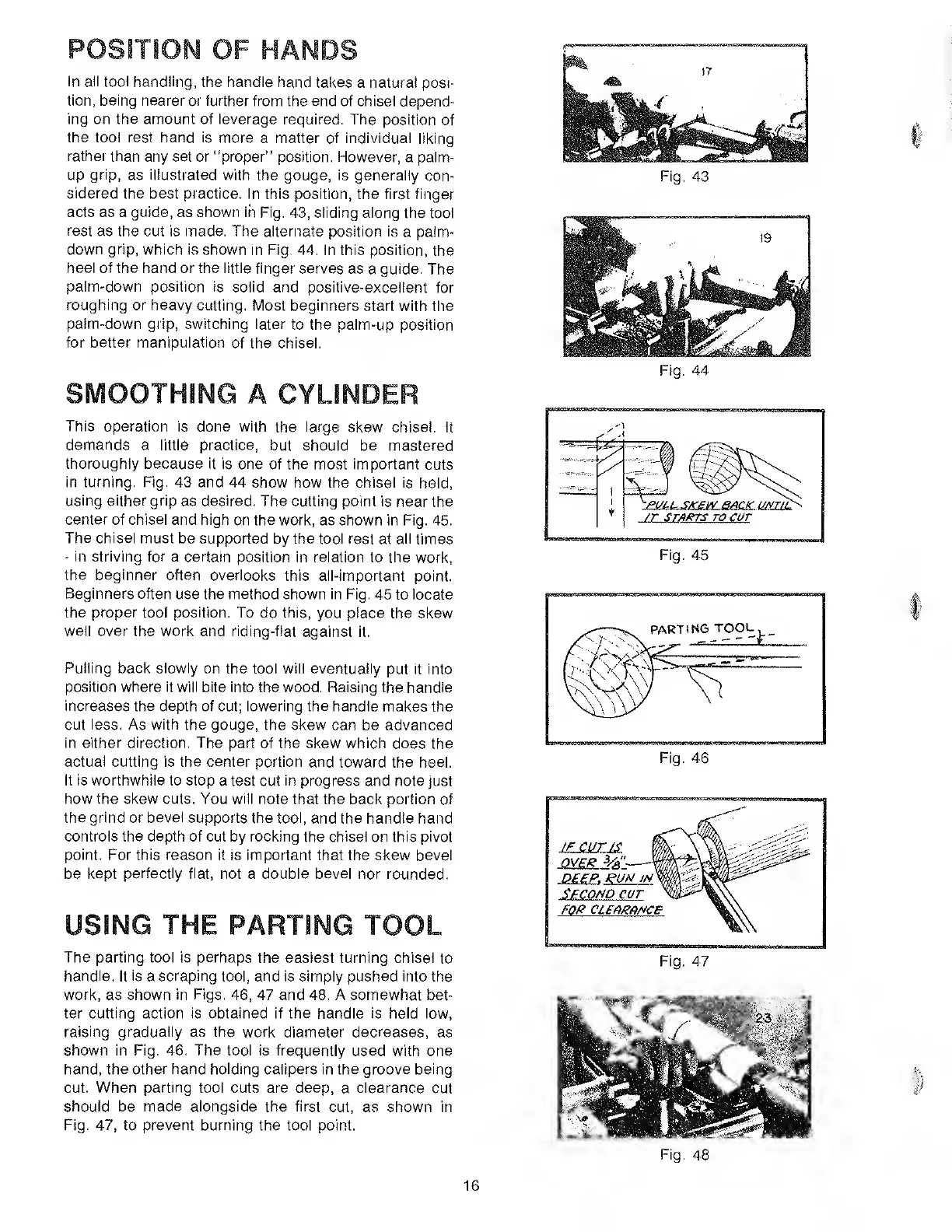
In
all
tool
handling,
the
handle
hand
takes
a
natural
posi¬
tion,
being
nearer
or
further
from
the
end
of
chisel
depend¬
ing
on
the
amount
of
leverage
required.
The
position
of
the
tool
rest
hand
is
more
a
matter
of
individual
liking
rather
than
any
set
or
ā€œproperā€
position.
However,
a
palm-
up
grip,
as
illustrated
with
the
gouge,
is
generally
con¬
sidered
the
best
practice.
In
this
position,
the
first
finger
acts
as
a
guide,
as
shown
in
Fig.
43,
sliding
along
the
too!
rest
as
the
cut
is
made.
The
alternate
position
is
a
palm-
down
grip,
which
is
shown
in
Fig.
44.
In
this
position,
the
heel
of
the
hand
or
the
little
finger
serves
as
a
guide.
The
palm-down
position
is
solid
and
positive-excellent
for
roughing
or
heavy
cutting.
Most
beginners
start
with
the
palm-down
grip,
switching
later
to
the
palm-up
position
for
better
manipulation
of
the
chisel.
This
operation
is
done
with
the
large
skew
chisel.
It
demands
a
little
practice,
but
should
be
mastered
thoroughly
because
it
is
one
of
the
most
important
cuts
in
turning.
Fig.
43
and
44
show
how
the
chisel
is
held,
using
either
grip
as
desired.
The
cutting
point
is
near
the
center
of
chisel
and
high
on
the
work,
as
shown
in
Fig.
45.
The
chisel
must
be
supported
by
the
tool
rest
at
all
times
-
in
striving
for
a
certain
position
in
relation
to
the
work,
the
beginner
often
overlooks
this
all-important
point.
Beginners
often
use
the
method
shown
in
Fig.
45
to
locate
the
proper
tool
position.
To
do
this,
you
place
the
skew
well
over
the
work
and
riding-flat
against
it.
Pulling
back
slowly
on
the
tool
will
eventually
put
it
into
position
where
it
will
bite
into
the
wood.
Raising
the
handle
increases
the
depth
of
cut;
lowering
the
handle
makes
the
cut
less.
As
with
the
gouge,
the
skew
can
be
advanced
in
either
direction.
The
part
of
the
skew
which
does
the
actual
cutting
is
the
center
portion
and
toward
the
heel.
It
is
worthwhile
to
stop
a
test
cut
in
progress
and
note
just
how
the
skew
cuts.
You
will
note
that
the
back
portion
of
the
grind
or
bevel
supports
the
tool,
and
the
handle
hand
controls
the
depth
of
cut
by
rocking
the
chisel
on
this
pivot
point.
For
this
reason
it
is
important
that
the
skew
bevel
be
kept
perfectly
flat,
not
a
double
bevel
nor
rounded.
The
parting
tool
is
perhaps
the
easiest
turning
chisel
to
handle.
It
is
a
scraping
tool,
and
is
simply
pushed
into
the
work,
as
shown
in
Figs.
46,
47
and
48.
A
somewhat
bet¬
ter
cutting
action
is
obtained
if
the
handle
is
held
low,
raising
gradually
as
the
work
diameter
decreases,
as
shown
in
Fig.
46.
The
tool
is
frequently
used
with
one
hand,
the
other
hand
holding
calipers
in
the
groove
being
cut.
When
parting
tool
cuts
are
deep,
a
clearance
cut
should
be
made
alongside
the
first
cut,
as
shown
in
Fig.
47,
to
prevent
burning
the
tool
point.
Fig.
43
Fig.
44
Fig.
48
16

Related product manuals