EasyManua.ls Logo

Delta 46-700 - Turning Techniques: Advanced Cuts; Making Long Convex or Tapered Cuts; Making Cove Cuts

Delta 46-700
26 pages
Print Icon
To Next Page IconTo Next Page
To Previous Page IconTo Previous Page
Loading...
LONG
CUTS
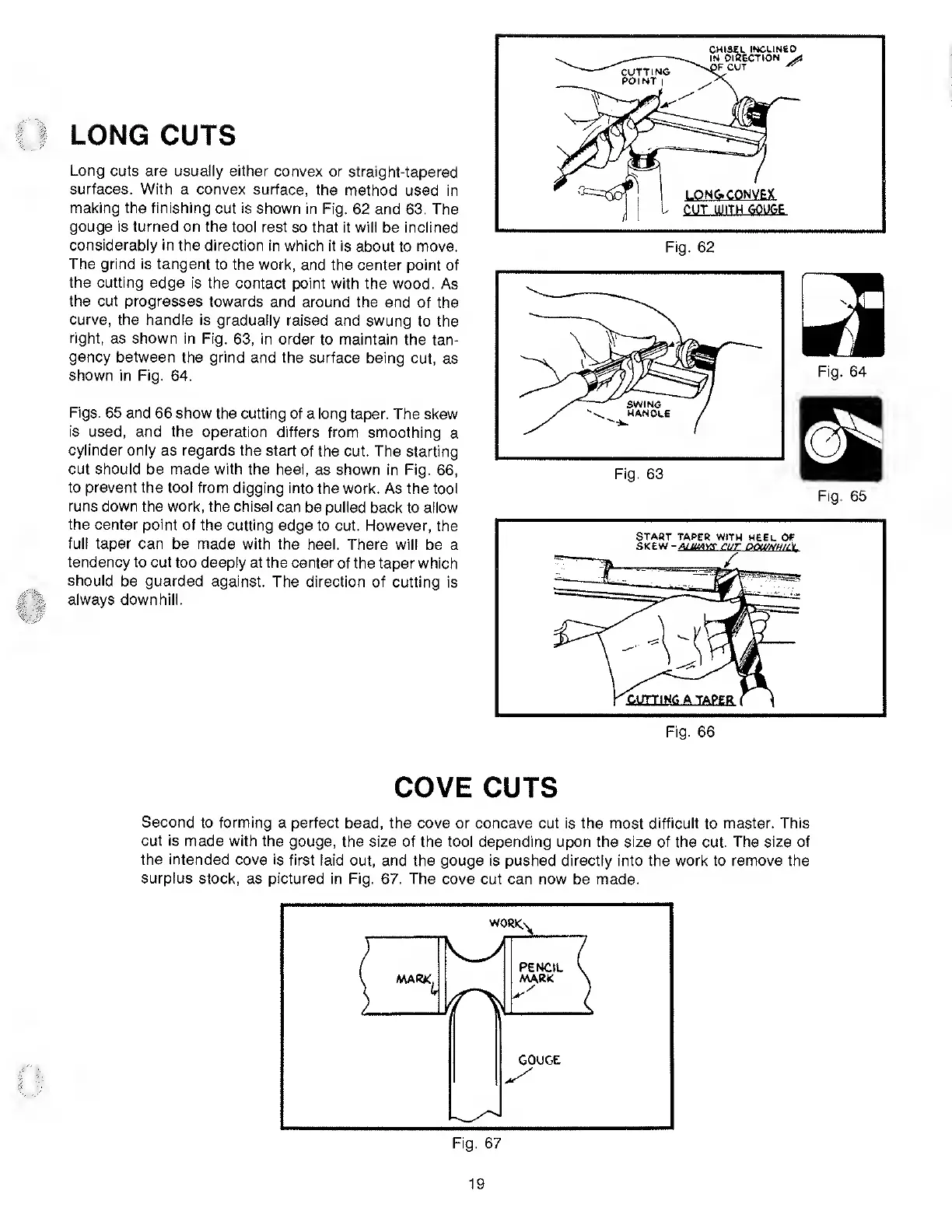
Long
cuts
are
usually
either
convex
or
straight-tapered
surfaces.
With
a
convex
surface,
the
method
used
in
making
the
finishing
cut
is
shown
in
Fig.
62
and
63.
The
gouge
is
turned
on
the
tool
rest
so
that
it
will
be
inclined
considerably
in
the
direction
in
which
it
is
about
to
move.
The
grind
is
tangent
to
the
work,
and
the
center
point
of
the
cutting
edge
is
the
contact
point
with
the
wood.
As
the
cut
progresses
towards
and
around
the
end
of
the
curve,
the
handle
is
gradually
raised
and
swung
to
the
right,
as
shown
in
Fig.
63,
in
order
to
maintain
the
tan-
gency
between
the
grind
and
the
surface
being
cut,
as
shown
in
Fig.
64.
Figs.
65
and
66
show
the
cutting
of
a
long
taper.
The
skew
is
used,
and
the
operation
differs
from
smoothing
a
cylinder
only
as
regards
the
start
of
the
cut.
The
starting
cut
should
be
made
with
the
heel,
as
shown
in
Fig.
66,
to
prevent
the
tool
from
digging
into
the
work.
As
the
tool
runs
down
the
work,
the
chisel
can
be
pulled
back
to
allow
the
center
point
of
the
cutting
edge
to
cut.
However,
the
full
taper
can
be
made
with
the
heel.
There
will
be
a
tendency
to
cut
too
deeply
at
the
center
of
the
taper
which
should
be
guarded
against.
The
direction
of
cutting
is
always
downhill.
Fig.
64
Fig.
65
COVE
CUTS
Second
to
forming
a
perfect
bead,
the
cove
or
concave
cut
is
the
most
difficult
to
master.
This
cut
is
made
with
the
gouge,
the
size
of
the
tool
depending
upon
the
size
of
the
cut.
The
size
of
the
intended
cove
is
first
laid
out,
and
the
gouge
is
pushed
directly
into
the
work
to
remove
the
surplus
stock,
as
pictured
in
Fig.
67.
The
cove
cut
can
now
be
made.
19

Related product manuals