16
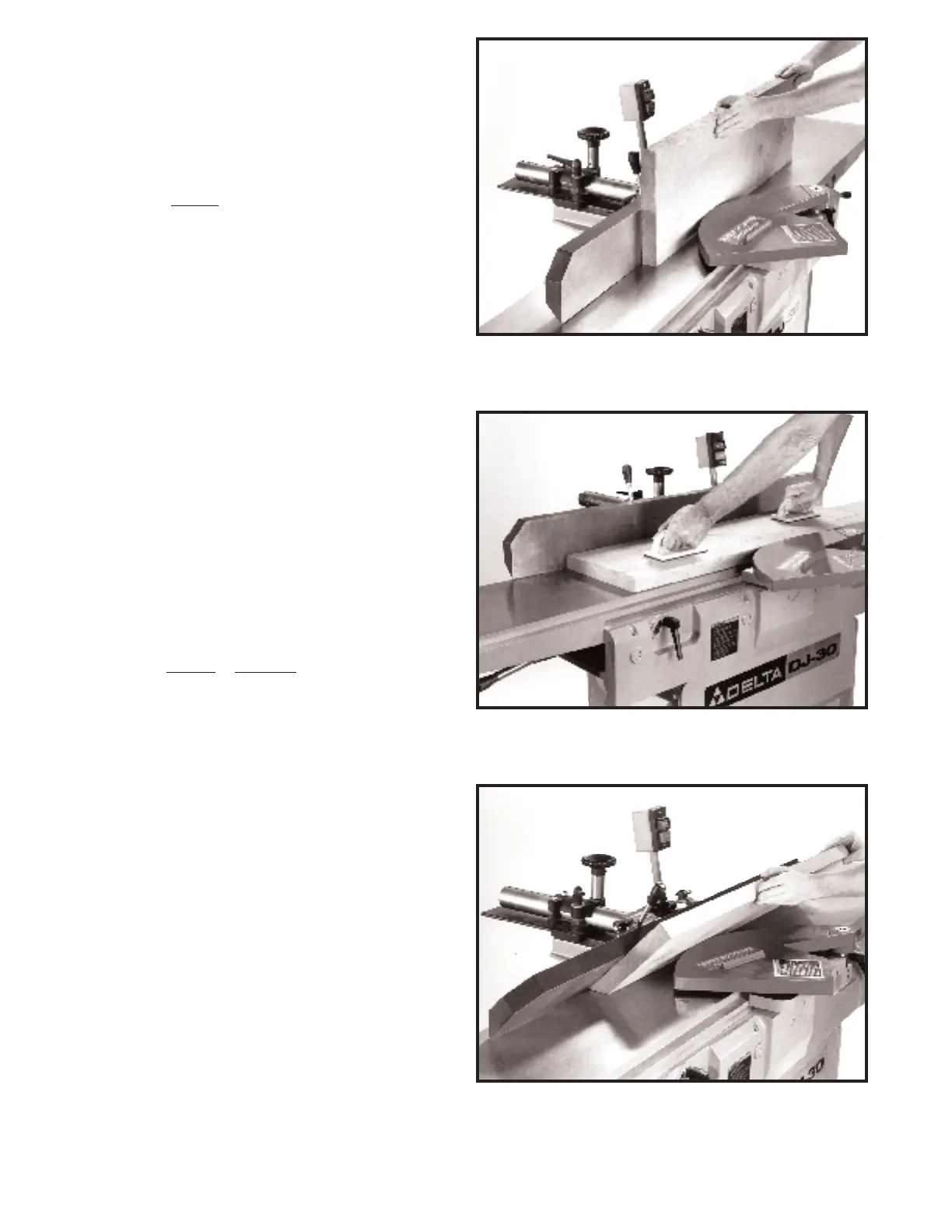
Fig. 37
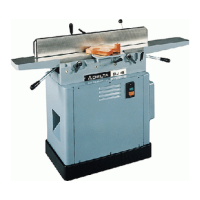
Fig. 38
Fig. 39
JOINTING AN EDGE
This is the most common operation for the jointer. Set the
guide fence square with the t able. Depth of cut should be
the minimum required to obt ain a straight edge. Hold the
best face of the piece firmly against the fence throughout
the feed as shown in Fig. 37.
D O N O T perform jointing operations on material shorter
than 14 inches, narrower than 3/4 inch or less than 1/2 inch
thick.
N E V E R pass your hands directly over the cutterhead and
use push blocks to feed the workpiece whenever possible.
PLANING OR SURFACING
Planing or surfacing is identical to the jointing operation
except for the position of the workpiece. For planing, the
major flat surface of the workpiece is placed on the infeed
table of the jointer with the narrow edge of the workpiece
against the fence, as shown in Fig. 38. The workpiece is
moved from the infeed t able, across the cutterhead to the
out feed t able est ablishing a flat surface on the workpiece.
Always use push blocks when performing planing opera -
tions and NEVER pass your hands directly over the cutter -
head.
D O N O T perform planing or surfacing operations on mater-
ial shorter than 14 inches, narrower than 3/4 inch, wider
than 12 inches or less than 1/2 inch thick.
BEVELING
To cut a bevel, lock the fence at the required angle and run
the work across the knives while keeping the work firmly
against the fence and t ables. Several p asses may be nec-
essary to arrive at the desired result. When the angle is
small, there is little dif ference whether the fence is tilted to
the right or left. However, at greater angles approaching 45
degrees, it is increasingly dif ficult to hold the work properly
when the fence is tilted to the right. The advantage of the
double-tilting fence is appreciated under such conditions.
When tilted to the lef t, the fence forms a V -shape with the
tables, and the work is easily pressed into the pocket while
passing it across the knives as shown in Fig. 39. If the
bevel is laid out on the piece in such direction that this
involves cutting against the grain, it will be better to tilt the
fence to the right.


 To Next Page