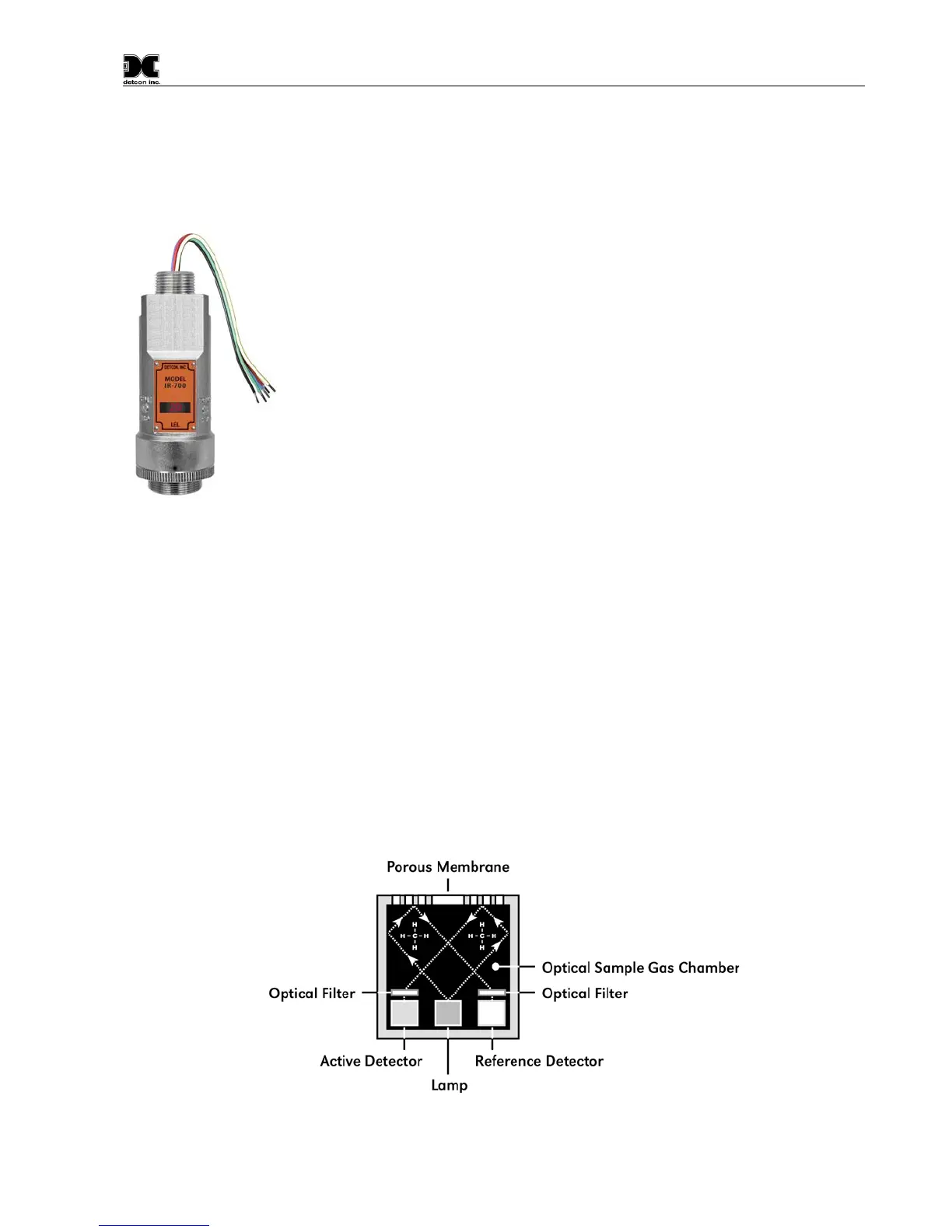
Model IR-700
IR-700 Instruction Manual Rev. 4.3 Page 1 of 46
1. Introduction
1.1 Description
Detcon Model IR-700 combustible gas sensors are non-intrusive “Smart” sensors
designed to detect and monitor combustible hydrocarbon gases in air. The range of
detection is 0-100% LEL or 0-50% LEL. The Model IR-700 CO
2
Sensor is designed to
detect CO
2
in air at ranges from 0-.3% to 0-100% by Volume. The sensor features an
LED display of current reading, fault and calibration status. The unit is equipped with
standard analog 4-20mA and Modbus™ RS-485 outputs. A primary feature of the
sensor is its method of automatic calibration, which guides the user through each step
via fully scripted instructions shown on the LED display.
The microprocessor-supervised electronics are packaged in an encapsulated module and
housed in an explosion proof casting. The unit includes a 4 character alpha/numeric
LED used to display sensor readings and the sensor’s menu-driven interface when the
hand-held programming magnet is used.
1.1.1 Non-Dispersive Infrared (NDIR) Optical Sensor Technology
The sensor technology is designed as a miniature plug-in replaceable component, which can easily be changed
out in the field. The NDIR sensor consists of an infrared lamp source, two pyro electric detectors, and an optical
gas sample chamber. The lamp source produces infrared radiation, which interacts with the target gas as it is
reflected through the optical gas sample chamber. The infrared radiation contacts each of the two pyro electric
detectors at the completion of the optical path. The “active” pyro electric detector is covered by a filter specific
to the part of the IR spectrum where the target gas absorbs light. The “reference” pyro electric detector is covered
by a filter specific to the non-absorbing part of the IR spectrum. When the target gas is present, it absorbs IR
radiation and the signal output from the active detective decreases accordingly. The reference detector output
remains unchanged. The ratio of the active and reference detector outputs are then used to compute the target
gas concentration.
The technique is referred to as non-selective and may be used to monitor most any combustible hydrocarbon
gas. The technique for CO
2
is similar except that the sensor provides a selective response to CO
2
. Unlike
catalytic bead type sensors, Detcon IR sensors are completely resistant to poisoning from corrosive gases and
they can operate in the absence of an oxygen background. The sensors are characteristically stable and capable
of providing reliable performance for periods exceeding 5 years in most industrial environments.
Figure 1 Sensor Cell Construction


 To Next Page