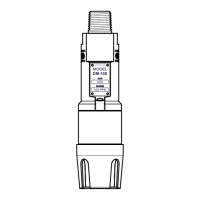
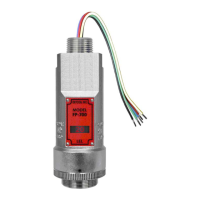
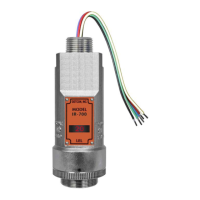
Model IR-700
IR-700 Instruction Manual Rev. 4.3 Page 2 of 46
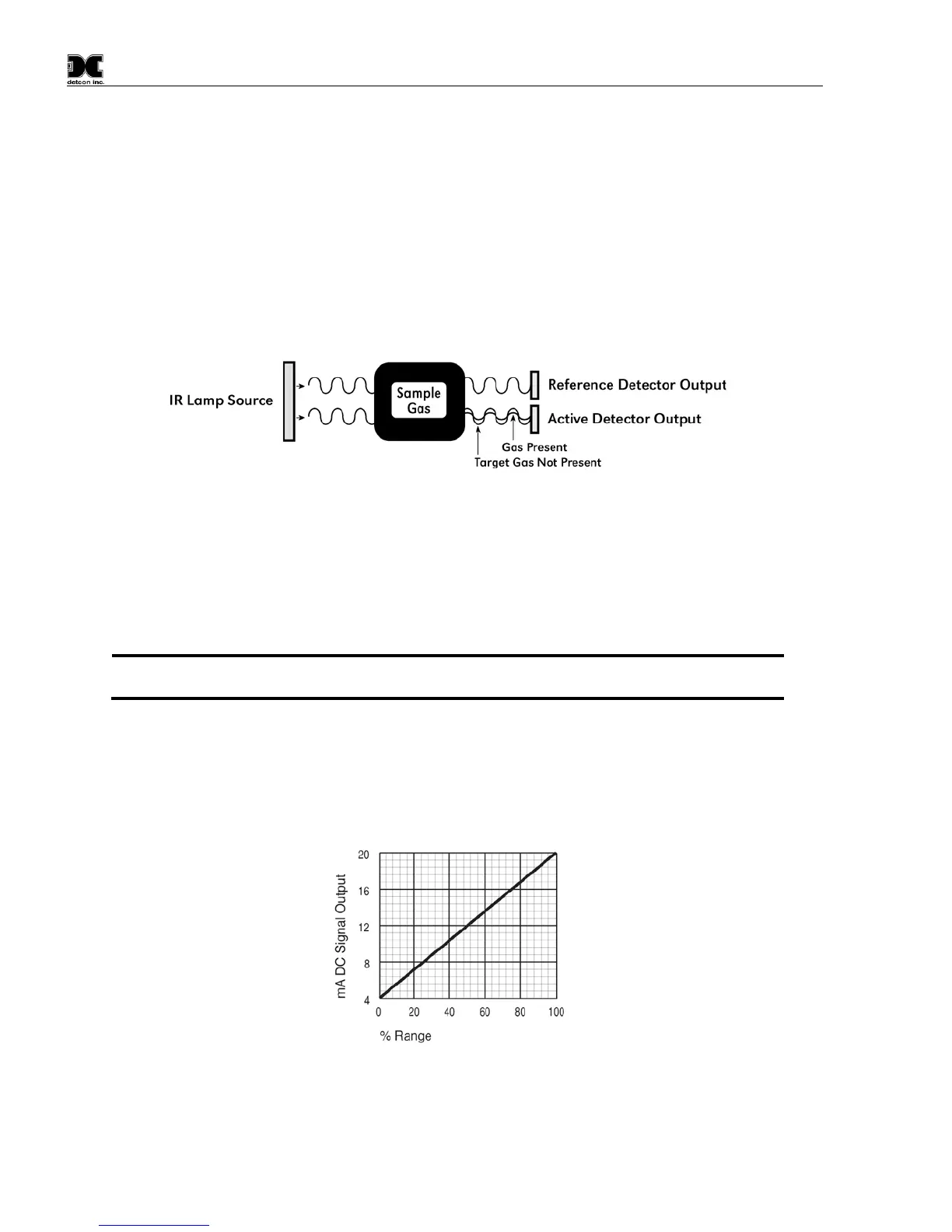
1.1.2 Principle of Operation
The target gas diffuses through a sintered stainless steel flame arrestor and into the volume of the sample gas
optical chamber. An alternating miniature lamp provides a cyclical IR radiation source, which reflects through
the optical gas sample chamber and terminates at two pyro electric detectors. The active and reference pyro
electric detectors each give an output which measures the intensity of the radiation contacting their surface. The
active detector is covered by an optical filter specific to the part of the IR spectrum where the target gas absorbs
light. The reference detector is covered by a filter specific to the non-absorbing part of the IR spectrum. When
present, the target gas absorbs a fraction of the IR radiation and the signal output from the active detector
decreases accordingly. The signal output of the reference detector remains unchanged in the presence of the
target gas. The ratio of the active/reference signal outputs is then used to compute the target gas concentration.
By using the ratio of the active/reference signal outputs, measurement drift caused by the changes in the intensity
of the IR lamp source or changes in the optical path’s reflectivity is prevented.
Figure 2 Principle of Operation
1.1.3 Performance Characteristics
The IR sensor maintains strong sensitivity to most all combustible hydrocarbon gases in the Lower Explosive
Limit (LEL) range, as shown in the response curve illustration below. When compared with the typical catalytic
bead LEL sensor, the IR sensor exhibits improved long-term zero and span stability. Typical zero calibration
intervals would be quarterly to semi-annual and typical span intervals would be semi-annual to annual.
However, actual field experience is always the best determination of appropriate calibration intervals.
NOTE: The IR-700 sensor will not respond to combustible gases that are not hydrocarbons,
such as H
2
, NH
3
, CO, H
2
S….etc. It can only be used to measure hydrocarbon type gases.
The IR sensor generates different signal sensitivity levels for different combustible hydrocarbon target gases.
Unless otherwise specified the IR-700 sensor will be factory calibrated for methane service. If the target
hydrocarbon gas is other than methane, then the unit will have to be span calibrated and configured accordingly
per this Instruction Manual.
Figure 3 Response Curve


 To Next Page