LT-1859
9
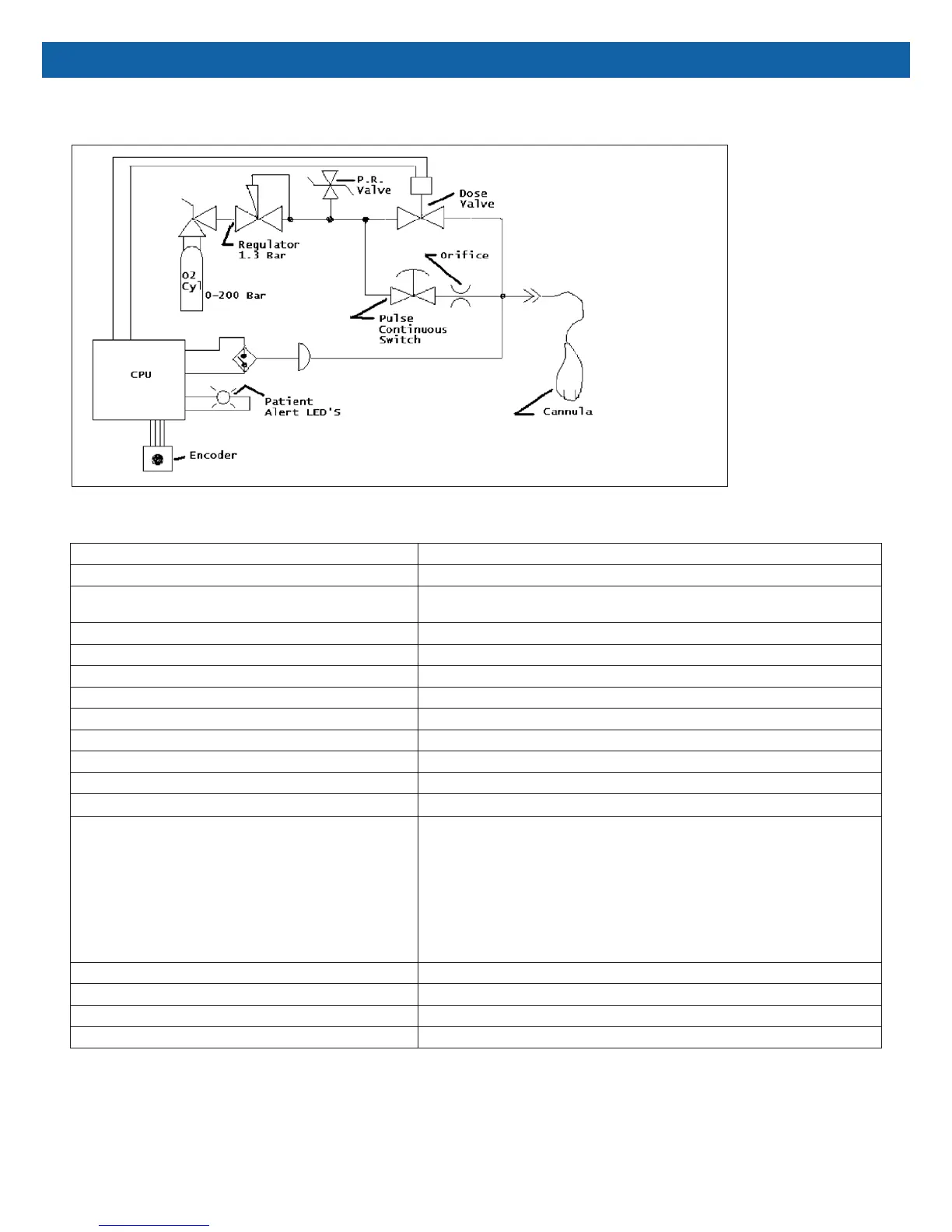
PNEUMATIC DIAGRAM / UNIT SPECIFICATIONS
IX. UNIT SPECIFICATIONS
Weight 14. 7 ounces (16.3 ounces with battery)
Dimensions 4.75"L x 3.4"W x 2.8"H (12.06 cm L x 8.64 cm W x 7.11 cm H)
Power Supply (2) Standard "AA" alkaline or NiMH. NOTE-Batteries other than alkaline
or NiMH are not recommended due to their limited capacities.
Operational Voltage Range 2.3 to 3.6V DC
Operating Temperature Range 5° to 40° C (41˚ to 104°F)
Operating Pressure Range 500 to 2250 PSIG (34 to 155 Bar) tank pressure
Operating Atmospheric Conditions 500 to 1020 millibar
Operating Humidity Range 0 to 95% R.H., non-condensing
Storage and Transportation Temperature Range 20° to 60° C ( -4° to 140° F)
Storage and Transportation Humidity Range Up to 95% R.H., Non-condensing
Degree of Protection Against Ingress of liquids None
Degree of Protection Against Electric Shock TYPE BF applied part
Power Requirements Average steady state “ON” current 1.6 uA. Batteries other than alkaline
or NiMH are not recommended due to the capacity needed for operation
and battery life of the unit. Typical new battery life is 200 hours when
used at 25°C, 2 LPM and 20 BPM. Settings and breath rate will affect
battery life. After the Low Battery (flashing red) light illuminates, the unit
will continue to operate about four hours when used at 25°C, 20 BPM
and the 6 LPM setting. Settings, breath rate, and battery conditions will
affect use times. Refer to local regulations for battery recycling and/or
disposal requirements
Expected Shelf and Service Life (excluding batteries) 5 years based on 4 hours use per day at 20 BPM
Modes of Operation Continuous/Pulsed
Approval Body And Safety Standards IEC 601-1;CAN/CSA-C22.2 No. 601.1-M90 and IEC 601-1-2
US Patents 4,519,387; 5,755,224; 4,457,303
X. PROVIDER’S NOTES
No routine calibration or service is required provided the device is used in accordance with the manufacturer’s
directions. Between patients wipe with a damp cloth having a maximum 5.25% Sodium Hypochlorite (Bleach) or 3%
Hydrogen peroxide solution. Avoid getting uids or debris such as sand or dirt inside the oxygen connections. Do not
immerse in water.
VIII. PNEUMATIC DIAGRAM


 To Next Page