EN-22 452172.66.10-EN · FD 0311 www.dimplex.de
English LIA 0608BWCF M - LIA 1316BWCF M
7.4 Leak test and evacuation
Air and moisture in the cooling system have unwanted effects
as outlined below.
1) The pressure in the system increases.
2) The operating current increases.
3) The cooling (or heating) output falls.
4) Moisture in the cooling circuit can freeze and block the
capillary tubes.
5) Water can cause corrosion on parts in the cooling
system.
This means that the indoor and outdoor unit, as well as the con-
nection pipe, must be checked for leaks and pumped empty to
remove any non-condensable gases and moisture from the
system.
7.4.1 Preparation
Ensure that each pipe (liquid and air side) between the indoor
and outdoor unit is connected correctly and the wiring for the
test operation has been carried out. Remove the maintenance
valve caps from both the gas and liquid side of the outdoor unit.
Ensure that both maintenance valves on the liquid and air side
of the outdoor unit are closed at this point.
7.4.2 Leakage tightness test
Connect the multi-way valve (with pressure gauges) and
dry nitrogen gas cylinder with the filling hoses on this
maintenance connection.
º
A multi-way valve must be used for the leak test. If no multi-
way valve is available, an isolating valve can also be used. The
"Hi" lever on the 3-way valve must be closed at all times.
The system may be charged with max. 3.0 MPa dry nitro-
gen. The cylinder valve must be closed with a pressure of
3.0 MPa. The next step is to search for leaks with liquid
soap.
º
In order to prevent liquid nitrogen from entering the cooling
system, the top side of the gas cylinder must be higher than
the bottom side when pressure is building in the system.
1) The gas cylinder is usually used in an upright position.
Check all pipe connections (indoor and outdoor) and main-
tenance valves of the air and liquid side for leaks. Bubbles
indicate a leak. The soap must be wiped away with a clean
cloth.
2) If no leaks are identified in the system, reduce the nitrogen
pressure by removing the filling hose connection from the
gas cylinder. When the system pressure is normal again,
the hose must be removed from the gas cylinder.
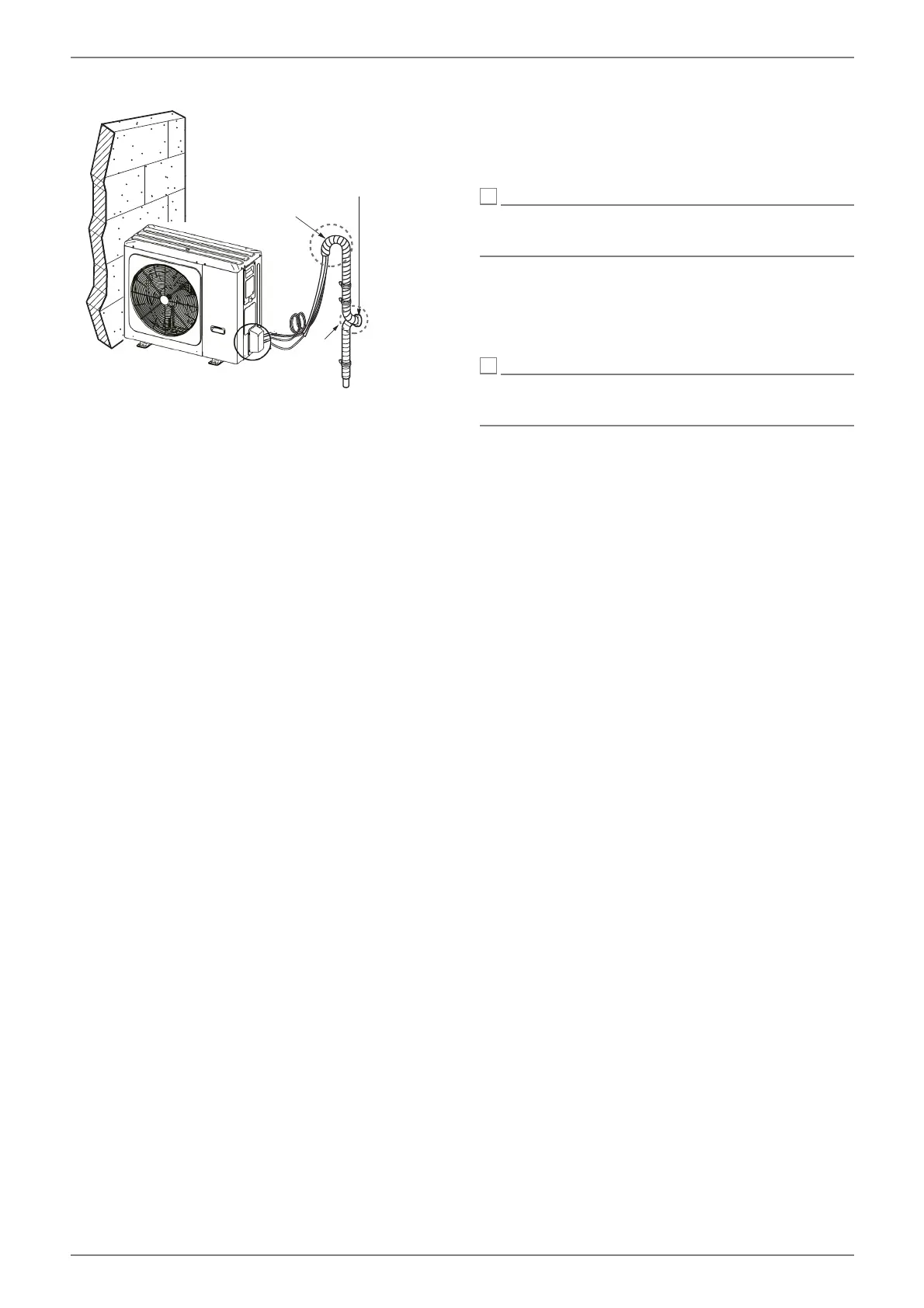
Siphon
Tr
a
pSiphon
Seal small gaps around
the pipe, e.g. with silicon.



 To Next Page