30 4445103618
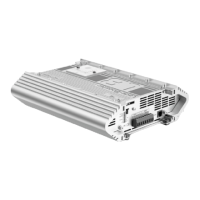
The charging booster
stops the charging pro-
cess. The red “Power” LED
flashes.
Shutdown by safety timer. The I phase has
lasted too long (> 15 h).
➤ Reset the device by removing the
control signal at D+. Switch off the
motor and disconnect the device
from the mains.
Too many DC loads connected.
➤ Reduce the connected DC loads.
The battery is defective.
➤ Replace the battery.
Overheating of the charging booster. The charging booster restarts automati-
cally when the temperature drops.
Full charging current is not
reached. The red “Power”
LED is lit.
The house battery is already charged.
➤ Load with powerful consumers.
The sense cables are reversed.
➤ Check the connections at START
(VS–/ VS+) and BORD (VB–/ VB+).
The charging current is not set correctly.
➤ Check the setting of the charging cur-
rent (see chapter “Adapting the
charging current” on page 26).
The battery is significantly sulfated.
➤ Replace the battery.
Full charging current is not
reached. The “Batt. II” LED
flashes.
Voltage at START+ < 11 V.
➤ Check voltage at START+. Increase
the motor speed so that the booster
can regulate.
The battery terminals are not connected
correctly.
➤ Check the connections.
➤ Check the cable cross-sections and
lengths (see chapter “Determine the
cable cross-section” on page 23).
➤ Check the stripped cable ends.
➤ Check the voltages directly at the ter-
minals.
Hidden cutoff relay present (e.g. in the
central electrical system).
➤ Adapt connection variant for vehicles
with an existing cutoff relay.
DIP switch is set to “OUT Limit”.
➤ Check the position of the DIP switch
(see chapter “Limiting the current
consumption” on page 27).
The charging booster con-
stantly switches between
active and idle state.
Starting battery voltage too low.
➤ The charging current is too high for
the alternator. Reduce the charging
power (see chapter “Limiting the cur-
rent consumption” on page 27).
➤ Check the starting battery and the
alternator.
Weak D+ signal.
➤ Check the D+ signal.
➤ Alternatively use the ignition key sig-
nal (terminal 15) or install a D+ active
simulator.
Fault Possible cause Suggested remedy


 To Next Page
 Loading...